Search
 August 05, 2026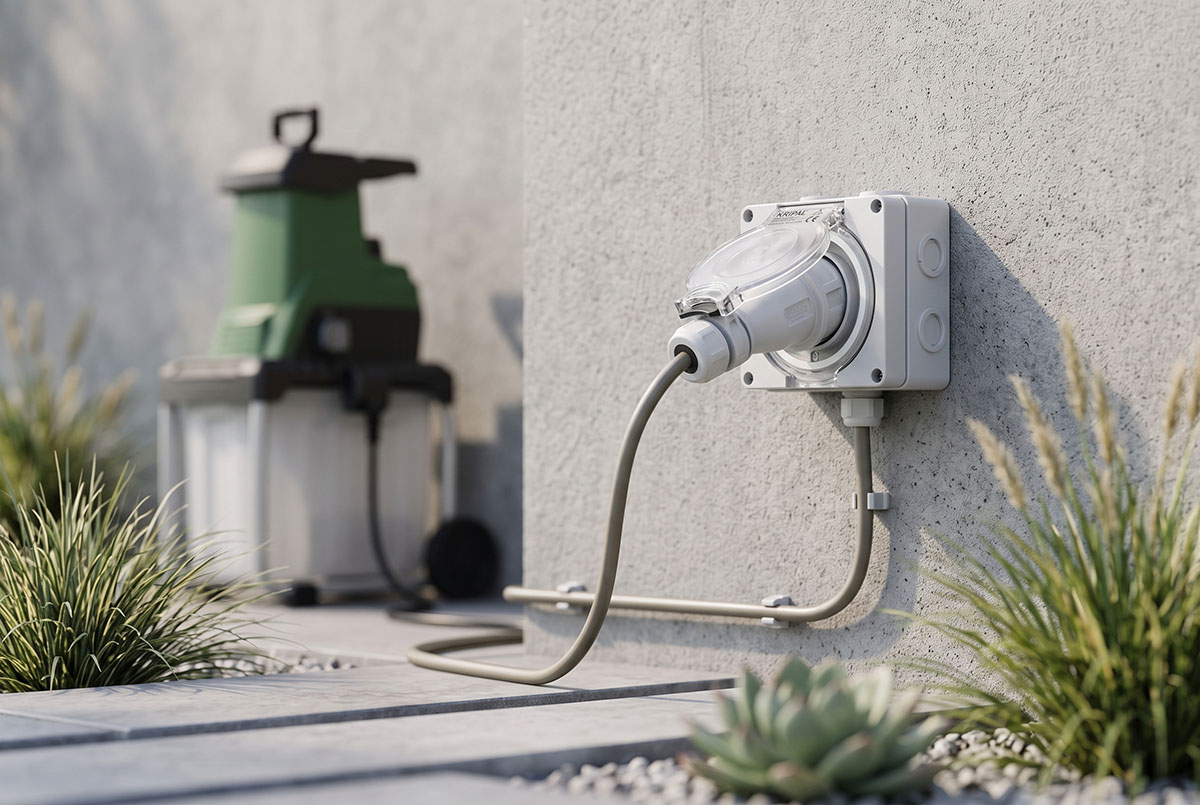
Most outdoor electrical failures are not caused by a poorly made product. They are often caused by selecting a product whose ingress protection does not match the conditions at the installation site. A switch rated IP44 under a deep porch may perform well for years. The same type of product installed on a fully exposed boundary wall faces a very different combination of rain, water spray, dust, UV exposure, and temperature changes.
The purpose of this guide is to provide a practical method for selecting an IP rating. Instead of asking which rating is “best,” start by identifying what the installation location actually exposes the enclosure to, then select a rating and product construction suitable for those conditions.
Outdoor waterproof switch and socket products from KRIPAL Electric are used as worked examples because the range includes products for exposed outdoor switching, socket outlets, combination units, and cable termination applications.
Why the Installation Environment Matters More Than the IP Rating
Ingress protection is a test classification, not a general quality label. Under IEC 60529, each IP code describes the protection provided by an enclosure against specified ingress conditions under defined test conditions. It does not automatically describe resistance to impact, ultraviolet radiation, corrosion, temperature, or every other environmental condition.
This is why the useful first step is to describe the installation location honestly rather than simply choosing the highest number available. Four questions cover most outdoor applications:
- Does rain land directly on the enclosure, or is it sheltered by a porch, eaves, or carport?
- Is water ever directed at it under pressure, such as from a hose or cleaning equipment?
- Is the product likely to be exposed to standing water or temporary immersion?
- Is the exposure occasional or continuous?
A location that may experience temporary flooding requires a different approach from a sheltered installation that only receives an occasional splash.
What the Two Digits Actually Test
An IP rating has two characteristic digits. The first concerns protection against access to hazardous parts and ingress of solid foreign objects, including dust. The second concerns protection against water. A rating such as IP66 is not a score out of 100. It consists of two separate protection classifications written together.
| First Digit | Protection Against Solids | Second Digit | Protection Against Water |
|---|---|---|---|
| 0 | No protection | 0 | No protection |
| 1 | Objects over 50 mm | 1 | Vertical dripping water |
| 2 | Objects over 12.5 mm | 2 | Dripping when tilted up to 15 degrees |
| 3 | Objects over 2.5 mm | 3 | Spray when tilted up to 60 degrees |
| 4 | Objects over 1 mm | 4 | Splashing from any direction |
| 5 | Dust protected | 5 | Low pressure jets from any direction |
| 6 | Dust tight | 6 | Powerful jets from any direction |
| 7 | Temporary immersion, around 30 minutes | ||
| 8 | Continuous immersion, depth stated by the maker |
The exact test conditions for each numeral are defined by IEC 60529. The important point for product selection is that the digits address specific ingress conditions rather than overall outdoor durability. An IP66 rating, for example, indicates a dust-tight enclosure with protection against powerful water jets under the specified test conditions. It does not by itself indicate impact resistance, UV resistance, corrosion resistance, or operating temperature. Those properties must be considered separately when the installation environment requires them.
The Ratings You Will Meet in Practice
In outdoor electrical work, a relatively small group of IP ratings appears frequently. Understanding the protection represented by each rating removes much of the guesswork.
| Rating | Test Applied | What It Survives | What It Does Not Survive |
|---|---|---|---|
| IP44 | Splash from any direction | Rain blown sideways under cover | Direct driving rain, any jet |
| IP54 | Splash plus limited dust | Sheltered walls, light dust | Direct exposure, washdown |
| IP55 | Low pressure jet | Covered areas, outbuildings | Powerful jets, standing water |
| IP65 | Low pressure jet, dust tight | Sheltered exterior walls | Powerful jets, immersion |
| IP66 | Powerful jet, dust tight | Fully exposed walls, hose washing | Immersion |
| IP67 | Immersion to about 1 m for 30 minutes | Ground level sockets, flood risk | Extended submersion |
| IP68 | Continuous immersion, maker stated depth | Permanently wet locations | Nothing, within the stated depth |
For many exposed outdoor electrical applications, IP65 and IP66 provide a practical starting point. Where temporary or continuous immersion is foreseeable, IP67 or IP68 may be appropriate depending on the manufacturer’s specified conditions. For a detailed comparison of immersion protection, see our guide on the difference between IP66 and IP68.
Matching the Rating to the Installation Location
The table below is intended as an engineering selection guide rather than a universal regulatory minimum. The final IP requirement should always be checked against the applicable product standard, installation requirements, and actual site conditions.
| Installation Location | Exposure | Minimum Rating | Sensible Specification |
|---|---|---|---|
| Under a deep porch or deep eaves | Rain rarely reaches it | IP44 | IP55 for margin |
| Inside a carport or covered outbuilding | Wind-driven rain possible | IP54 | IP65 |
| Exterior wall, partly sheltered | Occasional direct rain | IP55 | IP65 |
| Exterior wall, fully exposed | Direct rain, hose washing | IP65 | IP66 |
| Coastal or windy site | Driving rain, salt spray | IP66 | IP66 with UV stable housing |
| Ground level in a garden or yard | Splash back, puddles, flooding | IP65 | IP67 |
| Post mounted in open ground | Full exposure, both directions | IP65 | IP66 or IP67 |
| Industrial washdown area | High pressure cleaning | IP66 | Higher, subject to the cleaning method |
A higher IP rating can provide useful additional protection where the site is exposed to greater water ingress, but IP rating should not be treated as the only selection criterion. Enclosure material, UV resistance, corrosion resistance, temperature, cable entry, and the applicable product standard must also be considered.
The IP Rating Only Applies to the Tested Configuration
An IP rating does not automatically apply to every operating condition. The enclosure must be assembled and used in the configuration covered by the manufacturer’s test and product documentation. For an outdoor socket, for example, the manufacturer should specify whether the stated IP rating applies with the protective cover closed, with a compatible plug inserted, or under another defined configuration.
If a cover is left open, a sealing surface is damaged, or a plug or cable arrangement prevents the enclosure from sealing as designed, the claimed protection may no longer apply. Cable entry is equally important. Once a cable is introduced into an enclosure, the gland, membrane, cord grip, or other entry arrangement must provide the sealing performance required by the product design.
There are three practical consequences:
- Products intended for a permanent cable connection need a sealing arrangement designed for the cable entry.
- A protective cover should not be assumed to maintain the enclosure’s IP protection when it is left open.
- The cable entry and sealing components must be selected and installed according to the manufacturer’s instructions.
What Ingress Protection Does Not Cover
Because IP testing focuses on ingress protection, several other outdoor hazards sit outside the IP rating. These can cause failures that are incorrectly attributed to water ingress.
- Ultraviolet Ageing: Polymer housings can degrade under prolonged sunlight. A material suitable for outdoor use should be specified where continuous UV exposure is expected. UV resistance is separate from the IP rating.
- Corrosion: Salt spray and industrial atmospheres can attack screws, terminals, brackets, and gland components even when the enclosure itself remains sealed. Coastal installations may therefore require corrosion-resistant materials.
- Temperature: Operating temperature is a separate specification. A sealed enclosure can also have different thermal characteristics from an open product because heat dissipation is affected.
- Condensation: A sealed enclosure can still experience internal condensation when the temperature changes. Locations with large day/night temperature swings may require pressure-equalization measures.
Cable Entry Is a Critical Part of Outdoor Protection
In practice, cable entries are a common point of water ingress when glands or sealing components are incorrectly selected or installed. Water can track along a cable sheath and reach the entry point if the gland does not match the cable diameter or if the sealing components are incorrectly fitted.
- Match the gland to the actual cable diameter. Do not select a gland only from the nominal cable size. The manufacturer’s specified cable diameter range should cover the actual installed cable.
- Prevent water from tracking into the building. Where the installation method permits, wall penetrations and cable routes should be arranged so that water cannot run inward along the cable or conduit.
- Check the gasket and sealing surfaces. A pinched, missing, or damaged gasket can compromise the sealing performance of an otherwise suitable outdoor accessory.
Our guide on waterproofing an outdoor socket covers the installation sequence in more detail. For industrial plug and socket installations, our guide on choosing an IP66 industrial plug and socket explains the interface between the plug and outlet in greater detail.
Selecting Products for Each Location
Once the rating is fixed, the product choice usually follows directly. The KRIPAL outdoor range is organized so that each location in the table above has a matching family.
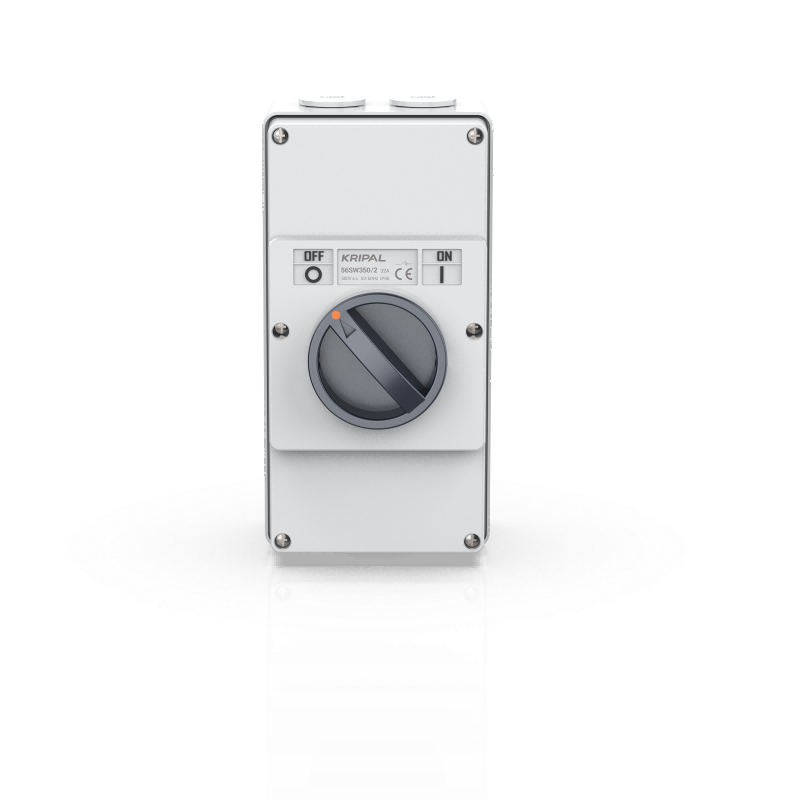
For fully exposed walls and outdoor isolator positions, the 56SW waterproof isolator switch covers 10 A to 63 A. It is rated IP66 across the range in both three-pole and four-pole versions. The published table gives rated operational voltage, utilization categories AC21A through AC23A, and cable cross-section limits for each type.
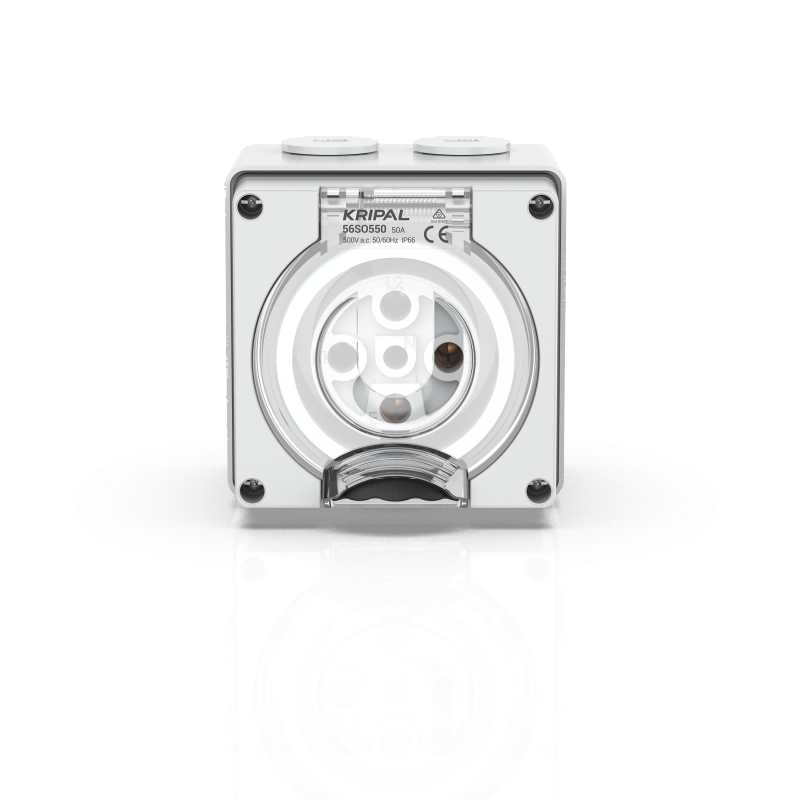 For exposed outdoor socket positions, the 56SO weatherproof socket outlet is IP66 rated and surface mounted. It runs from 10 A at 250 V up to 50 A at 500 V with five round pins. The cover closes securely when the plug is withdrawn, which preserves the rating between uses.
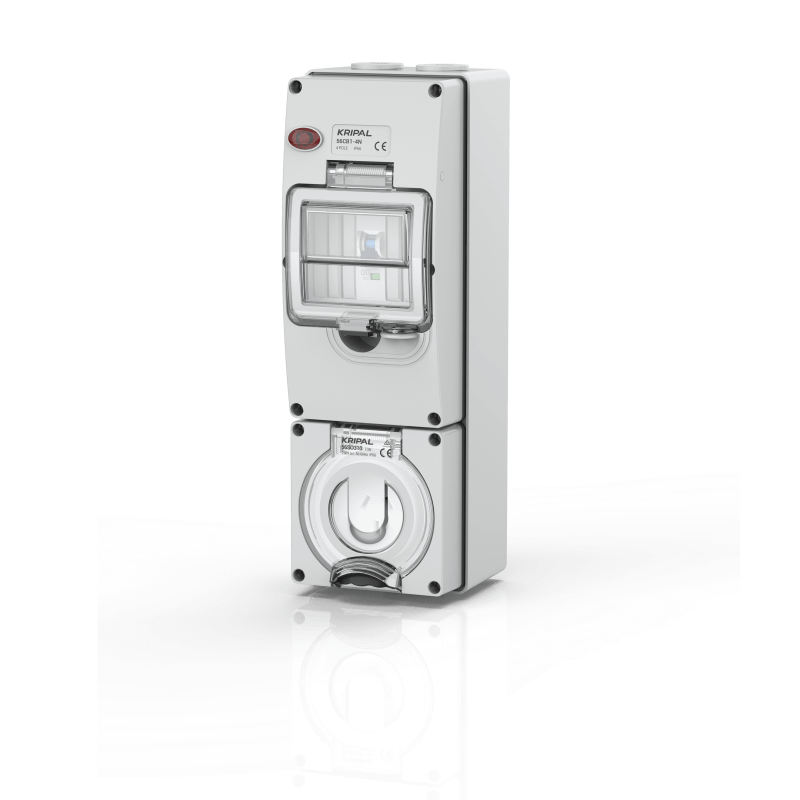 Where a single position needs both switching and socket outlets, the 56CV-E combination switched socket combines an IP66 enclosure with circuit protection. It is offered from 10 A to 50 A at both 250 V and 500 V. A fuse or RCD provides protection, and a neon indicator shows working status.
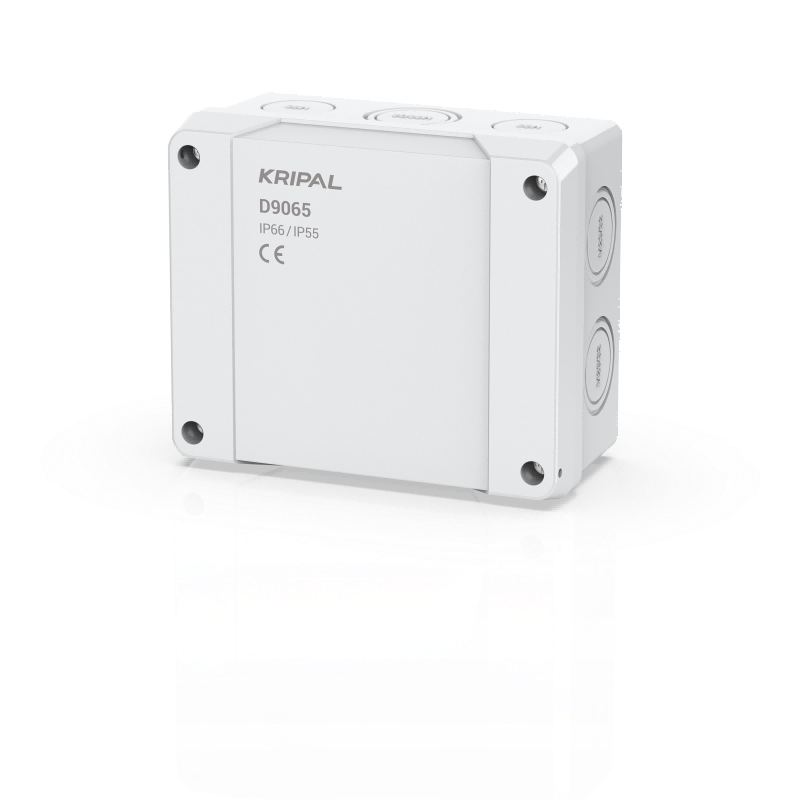 For cable jointing and terminations, the D90 terminal junction box comes in IP54 and IP65 versions. It is available with and without terminals, from 88 by 88 mm up to 200 by 160 mm. Matching the terminal current rating to the circuit is critical here.
Enclosure selection for isolators deserves separate attention. Our article on choosing an enclosure rating for outdoor isolator switches covers the interaction between the isolator, its housing, and the operating position.
For the wider range, the outdoor waterproof switch and socket range covers the families discussed here alongside junction boxes, control stations, and float switches. The waterproof switch range is the relevant starting point where the requirement is a wall-mounted switch.
How to Check That a Rating Actually Holds
An IP rating is a design claim, and like any design claim, it can be defeated by the installation. There are four checks worth carrying out on site before a job is signed off, and all of them take minutes.
- Check the gasket: Open the enclosure and confirm the gasket is present, correctly seated, and not pinched or stretched. This is the single most common defect.
- Check the gland: Confirm the gland or cord grip matches the installed cable diameter and that the sealing nut has been tightened onto the sheath.
- Check the closure: For socket outlets, confirm the lid or membrane closes fully with a plug inserted.
- Check the fixings: Confirm screws and mounting brackets are suitable for the environment. A stainless fixing on a coastal site outlives a plated one.
A hose test is sometimes used as a rough field check, but it should be treated as an indication rather than a verification. The standard test uses a defined nozzle, pressure, and duration; a garden hose does not reproduce those conditions. If formal verification is required, ask the supplier for the test report.
Ratings That Get Confused in Specifications
Several pairs of terms are used interchangeably in daily conversation but mean different things in a specification. Mixing them up is a common source of the wrong product arriving on site.
| Term Used | What It Actually Means | Practical Effect |
|---|---|---|
| Weatherproof | A marketing term, not a standard | Ask for the IP number instead |
| Waterproof | Not defined by a standard | An IP67 claim is verifiable |
| IPX4 | Water test only, solid protection not declared | Not a substitute for IP44 |
| IP66 | Dust tight plus powerful jets | Default for exposed outdoor positions |
| IP67 | Dust tight plus 30 mins immersion | Relevant at ground level/flood risk |
The X in a rating such as IPX4 means the solid protection digit was not tested or not declared. When a specification calls for outdoor use, an IPX rating is not sufficient on its own.
Specification Checklist
The list below is what a supplier needs in order to quote accurately rather than quote generically.
- Installation location description (e.g., direct rain exposure).
- Required IP rating, derived from the location.
- System voltage, current, and the number of poles.
- Whether the device switches under load or only isolates.
- Cable type and diameter for correct gland matching.
- Whether the cable must be connected while closed.
- Ambient conditions (coastal, high UV).
- Whether circuit protection is required inside.
- Mounting method (surface, post, or panel).
- Any local standard the installation must satisfy.
The One Rule Worth Remembering
Derive the rating from the location, then confirm that the product, its gasket, and its cable entry are all suitable for that location together. A correctly rated enclosure with an unmatched gland performs worse than a lower-rated one that is properly assembled. If the site is genuinely exposed, choose IP66 as the working default and reserve IP44 for positions with real overhead cover.
For project support, send us the location description, the voltage and current, the pole configuration, and the cable size. Our technical team can confirm the correct family and rating before an order is placed. That is the stage where the expensive mistakes in outdoor installations are usually avoided.