Search
Miniature Circuit Breakers (MCB) for Residential and Commercial Distribution | 6A-63A | 6kA-10kA
Electrical Circuit Protection-MCB
KRIPAL manufactures UKB5, UKB7, UKNT50, and UKBH series MCBs (1A-63A, 6kA/10kA breaking capacity per IEC/EN 60898-1) for residential, commercial, and industrial overcurrent and short-circuit protection. The thermal-magnetic trip unit ensures reliable overload and instant short-circuit protection (<0.1s) across B-curve (3-5 In), C-curve (5-10 In), and D-curve (10-20 In) options. Available in 1P to 4P configurations, they feature a standard 18mm/pole DIN-rail design with dual pin/fork busbar terminals for rapid multi-pole installation. Certified with CE and UKCA marks, KRIPAL MCBs are supplied globally to OEMs, panel builders, and wholesalers.
Get A Quote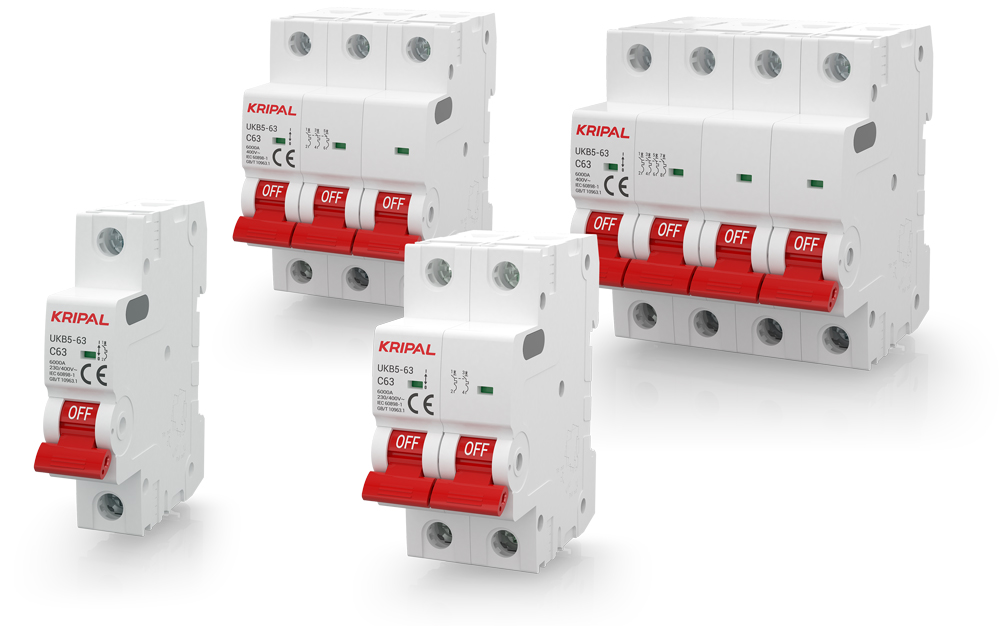
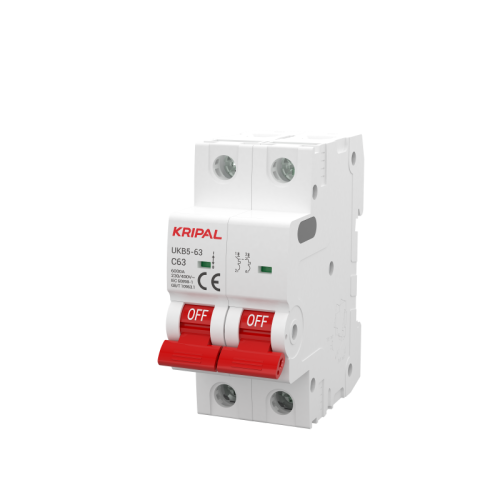


UKB5 MCB 6-63A 2Pole 6kA Semko CE Certified
The UKB5-63 series Miniature Circuit Breaker (MCB) is a core protection device designed for modern residential and commercial electrical installations.
Ask a Quote
UKB5 MCB 6-63A 1Pole 6kA Semko CE Certified
The UKB5-63 series Miniature Circuit Breaker (MCB) is a core protection device designed for modern residential and commercial electrical installations.
Ask a QuoteMCB Technical Guide: Protecting Final Circuits from Overload and Short Circuit
A miniature circuit breaker provides automatic overcurrent protection for final circuits in low-voltage electrical installations up to 440V AC. The MCB detects two types of fault: sustained overload (current slightly above the circuit rating for minutes to hours, caused by too many appliances on one circuit) and short-circuit (current tens of times the circuit rating for milliseconds, caused by a direct phase-to-neutral or phase-to-earth fault). The thermal element responds to overloads with a time delay that mimics the heating characteristic of the circuit cable, while the magnetic element responds to short-circuits with no intentional delay to minimize the let-through energy. This selection guide covers current rating, trip curve, pole count and breaking capacity to match your distribution board circuit requirements.
MCB Series Technical Specifications
Trip Curve Selection: B, C or D
The trip curve sets the magnetic trip threshold. B-curve (3-5 In) suits resistive loads with low inrush: lighting, heating, and cookers. C-curve (5-10 In) is the general choice for socket outlets, small motors up to 3 kW, and commercial loads with moderate electronic inrush. D-curve (10-20 In) handles high inrush currents from transformers, X-ray units, and motors above 3 kW. Selecting an incorrect curve causes either nuisance tripping or delayed protection where cables overheat before the magnetic trip activates.
Breaking Capacity and Supply Impedance
The breaking capacity (Icn) must exceed the prospective short-circuit current at the installation point. KRIPAL offers 6kA for standard domestic uses and 10kA for installations near transformers with lower supply impedance. The 10kA UKNT50 series features a reinforced arc chamber with extra splitter plates. If fault currents exceed 10kA, upstream backup protection using an HRC fuse or MCCB from the same manufacturer is required to ensure coordinated operation per IEC 60898-1 Annex E.
Pole Configuration for Circuits
Pole count matches circuit requirements: single-phase (230V) uses 1P or 1P+N, while three-phase (400V) uses 3P or 3P+N. 1P+N or 2P configurations safely switch both poles for caravan parks or medical systems. Multi-pole KRIPAL MCBs utilize an internal toggle linkage to mechanically couple all poles. An overload or short-circuit on any single pole trips all poles simultaneously, effectively preventing hazardous single-phasing conditions on three-phase motors.
Busbar Compatibility and Installation
KRIPAL MCBs feature dual-function terminals accepting cables up to 25 sq mm alongside pin or fork busbars. A single busbar feeds up to 12 to 24 MCBs per row, cutting installation time by about 60 percent. Busbars include IP2X finger-safe insulation per IEC 60529 along with protective end caps. In three-phase setups, a 4-pole busbar system (L1, L2, L3, N) feeds the MCBs sequentially, properly balancing loads across each distribution board row.
Specify MCBs for Your Distribution Board Production
- MCB Selection Tool: Provide your circuit schedule (load type, cable size, supply impedance) and we return the optimal MCB rating and curve for every circuit.
- Busbar Design Support: Request 3D models of our busbar-compatible MCBs for your distribution board layout, with recommended busbar lengths and phase allocation.
- OEM Volume Supply: Container-level pricing on MCB bulk packs (100 units per carton) with your choice of curve, rating and certification marking.
Final Circuit Protection in Residential, Commercial and Industrial Buildings
KRIPAL MCBs protect individual final circuits in low-voltage electrical installations across residential, commercial and industrial sectors. From a single lighting circuit in a domestic consumer unit to a motor feeder in a factory distribution board, the correct MCB selection ensures that a fault on one circuit does not disrupt the supply to healthy circuits.
Residential Consumer Unit Circuit Protection
A typical domestic consumer unit contains 8-16 KRIPAL B-curve MCBs (6A lighting, 16A immersion heater, 32A socket outlets, 32A shower, 40A cooker) fed from a split busbar with group RCD or RCBO protection for earth leakage. The 6kA breaking capacity is adequate for domestic installations where supply impedance exceeds 0.25 ohms, limiting prospective fault current below 1kA for a 230V single-phase supply. The busbar system allows installation in under 10 minutes during a consumer unit replacement, minimizing household supply disruption.
Commercial and Industrial Distribution Boards
Commercial distribution boards and main switch rooms close to basement transformers handle high short-circuit currents (up to 15kA), utilizing KRIPAL C-curve MCBs (10A lighting, 16A sockets, 32A AC, 63A sub-main) to handle 5-8x inrush currents from LED drivers and switch-mode power supplies. Industrial factory boards powering three-phase induction motors use KRIPAL D-curve MCBs (10A-63A), where the 10-20 In magnetic trip threshold avoids nuisance tripping during direct-on-line (DOL) starting, and 3P simultaneous isolation prevents single-phasing burnouts.
Renewable Energy Inverter AC Output Protection
Grid-tied solar PV inverters (3-100 kW) use KRIPAL C-curve 3P MCBs on the AC output circuit. Sized at 1.25 times the inverter’s maximum continuous output current per IEC 60364-7-712 (e.g., a 10 kW three-phase inverter outputting 14.5A uses a 20A MCB), it allows the inverter to export up to 110 percent of rated power during high-irradiance periods without tripping while protecting the cable. The MCB also serves as a lockable isolation switch within sight of the inverter for maintenance.
EV Home Charger Supply Circuit
A 7.4 kW single-phase EV home charger (32A continuous) is protected by a KRIPAL 40A B-curve MCB in the consumer unit, sized at 125 percent of the charger’s rated current per IEC 60364-7-722. The B-curve provides faster short-circuit disconnection in the event of a fault. The MCB is backed up by a Type B RCCB to provide reliable protection against smooth DC leakage currents generated by the charger’s power electronics, preventing the desensitization common in standard Type A RCCBs.
Specify MCBs for Your Project
- Circuit Protection Schedule: Send us your circuit schedule and we return a complete MCB bill of materials with ratings, curves and pole configurations.
- Discrimination Study: Request time-current curves for upstream/downstream MCB coordination to ensure a fault on a final circuit does not trip the distribution board incoming MCB.
- Bulk Pack Supply: Order MCBs in bulk packs of 100 per rating for your panel building operation, with individual carton labeling for your stores picking system.
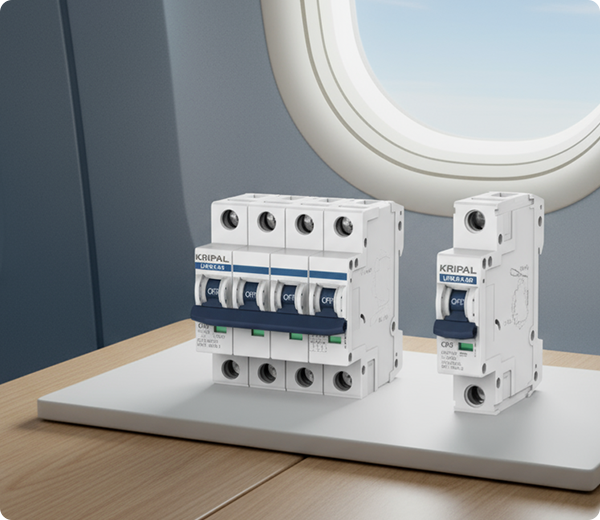
KRIPAL MCB Manufacturing: Precision Protection from Automated Production Lines
KRIPAL miniature circuit breakers are manufactured on high-speed automated assembly lines in Zhejiang where bimetal strips are precision-calibrated, magnetic coils are wound on CNC coil winders, and silver-graphite contacts are resistance-welded to copper carriers. Each MCB undergoes a calibration and instantaneous trip test before shipment to global electrical wholesalers and panel builders.
Automated Bimetal Calibration System
Bimetal strips for each current rating are individually calibrated on automated test stations that apply a controlled overload current while measuring deflection against a laser displacement sensor. Calibration data is recorded per unit, with trip time tolerances held within the IEC 60898-1 time-current band. Strips outside tolerance are automatically rejected.
CNC Magnetic Coil Winding and Impregnation
Solenoid coils for the instantaneous trip mechanism are wound on computer-controlled winding machines that maintain consistent turn count and winding tension across all pole configurations. Completed coils are vacuum-impregnated with high-temperature varnish and tested for turn-to-turn insulation integrity at 2500V before assembly into the MCB mechanism.
Silver-Graphite Contact Assembly
Contact tips made from silver-graphite (AgC) are resistance-welded to copper carriers under precisely controlled current, pressure, and duration parameters. Weld quality is verified on sample assemblies from each production shift by peel-force testing, with minimum peel strength exceeding 80N to prevent contact detachment under short-circuit conditions.
Production-Line Trip Testing
Every MCB undergoes two mandatory tests: a thermal calibration test at 1.45 times rated current (must trip within 1 hour per IEC 60898-1) and an instantaneous trip test at the specified magnetic trip threshold. Test results are logged against the individual serial number or production lot code, with full traceability to calibration data and component batch records.
Distributor Stock Holding Programs for MCBs
KRIPAL supports distributor inventory programs with agreed stock levels for standard MCB models from 1A to 63A across B, C, and D curves. Shipments are planned based on demand data, with scheduled replenishment to maintain stable supply and consistent fill rates.
Private Label and OEM Branding for MCBs
Laser-marked part numbers aligned with your catalog, OEM-branded packaging, and customized multilingual instruction sheets are available. Unbranded supply with neutral packaging is provided upon request for private label production of MCBs.
Multi-Region Certification and Compliance Support
CE, UKCA, and IEC 60898-1 EN 60898-1 compliance documentation is provided according to target export markets. Technical documentation files including EU Declarations of Conformity are maintained and updated in line with evolving regulatory requirements.
Direct Technical Access to KRIPAL Production Engineers
Your technical team communicates with the engineers who designed and calibrated your MCBs, not a distributor’s sales engineer reading from a catalog. Application questions including selectivity coordination and back-up protection receive answers within 24 hours during China business hours.
Frequently Asked Questions
Explore FAQ >Recent Blog
Explore Blog >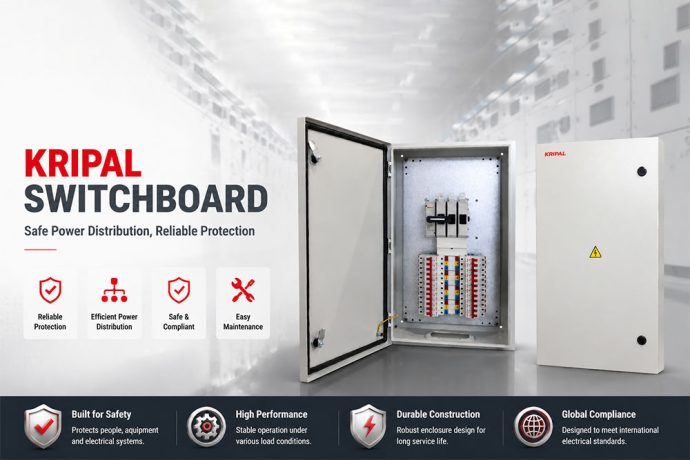
What Is a Switchboard? Types, Functions & Applications Explained
Explore the ultimate guide to switchboards. Learn about different types, key functions, and essential applications for efficient electrical power distribution and control.
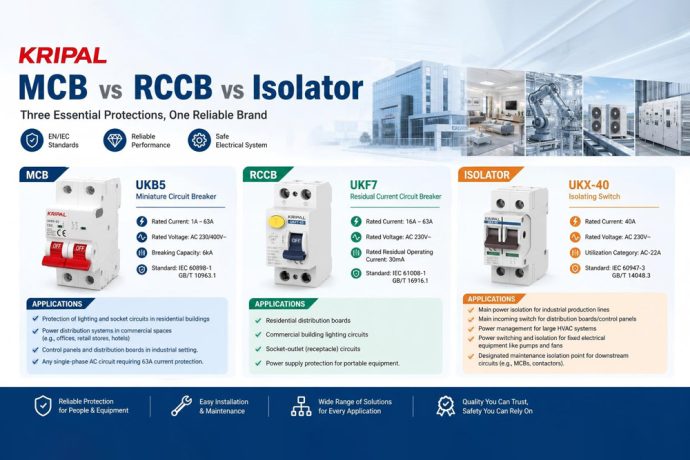
MCB vs RCCB vs Isolator: Differences, Functions, IEC Standards and Real Applications
Learn the key differences between MCBs, RCCBs, and isolators — their functions, IEC standards, real-world applications, and how they work together in modern electrical...
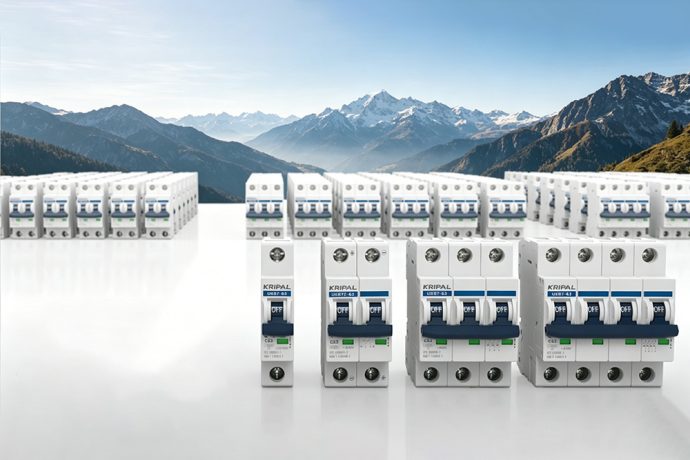
The 125% Rule in Electrical Load
Master the 125% electrical load rule for circuit breaker sizing: calculation, applications, pros & limitations per IEC & NEC standards.
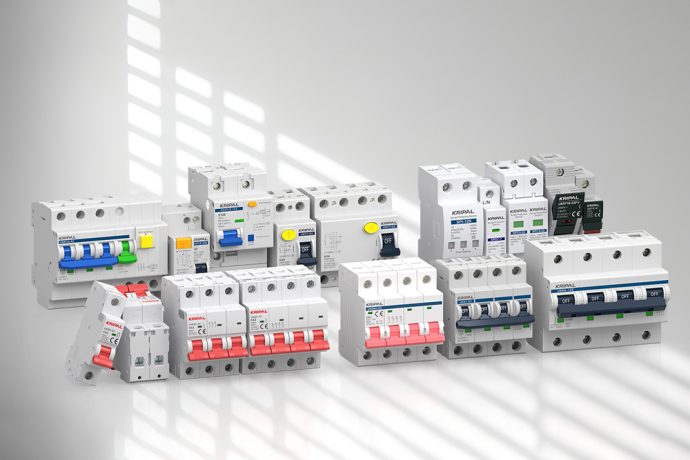
What Is the Difference Between MCB, RCD and RCBO?
What's the difference between MCB, RCD and RCBO? Compare overload, short circuit, and earth leakage protection. Choose the right device for your needs.
Direct from Manufacturer
How Can We Assist You?
Tell us a bit more so we can route your request to the right engineer. Get factory-direct pricing and custom specifications within 24 hours.