Search
MCB Accessories: Auxiliary Contacts Shunt Trips Busbars | DIN Rail Compatible
KRIPAL Miniature Circuit Breaker Accessories
KRIPAL manufactures a comprehensive range of MCB accessories for the UKB5, UKB7, UKNT50 and UKBH series, enabling extended functionality beyond basic overcurrent protection.The range includes auxiliary contacts (1NO+1NC or 2CO) for remote status signaling, shunt trip releases for remote tripping via fire alarms or E-stops, undervoltage releases (tripping at 35%-70% of nominal voltage to prevent motor auto-restart), pin and fork busbars for rapid multi-pole installation, terminal shrouds and blanking plates for IP2X protection, and padlock devices for safe maintenance.All tool-free clip-on accessories are fully compatible across the KRIPAL MCB range. CE, CB, and UKCA marked, they transform standard MCBs into functional control modules integrated with safety systems.
Get A Quote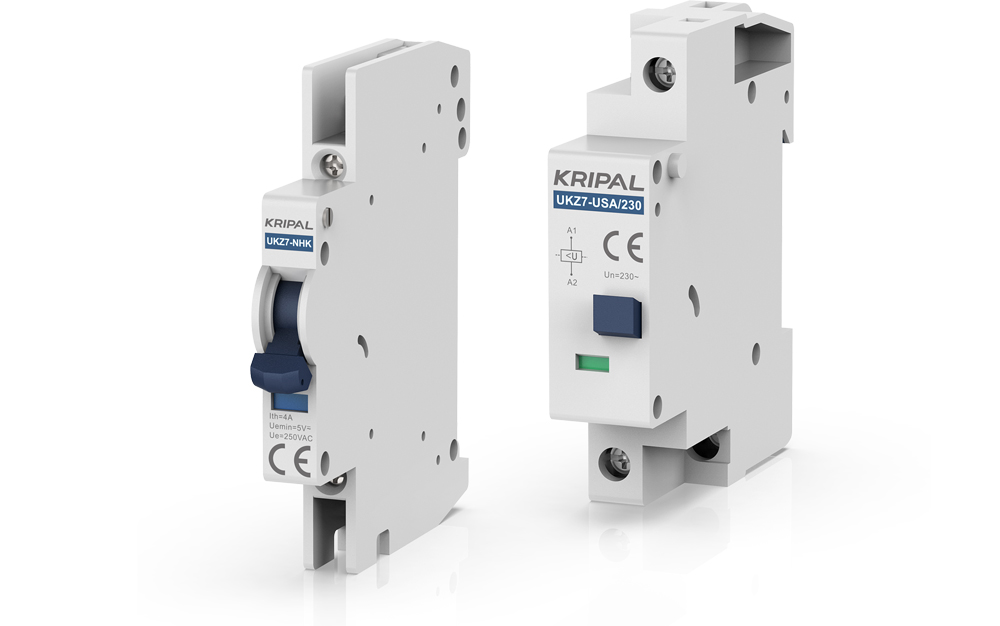
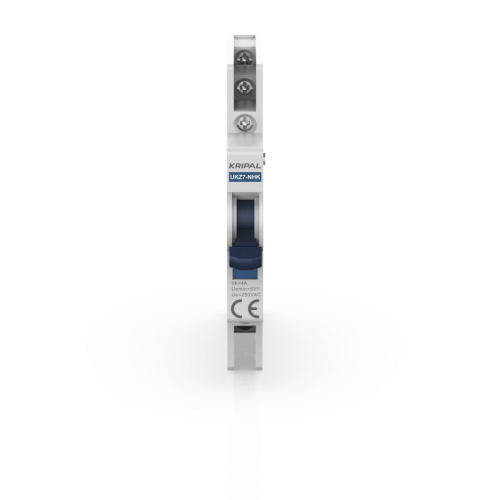
UKZ7-NHK Circuit Breaker Auxiliary Contact 250VAC Side-Mount
The UKZ7-NHK is a high-performance, side-mounting auxiliary contact attachment designed for circuit breakers.
Ask a QuoteMCB Accessory Guide: Remote Control and Status Monitoring
MCB accessories extend basic overcurrent protection into a complete circuit management solution. Auxiliary contacts signal MCB status to a PLC or BMS, enabling remote monitoring. Shunt trip releases allow the MCB to be tripped by external safety signals like fire alarms or emergency stops. Undervoltage releases protect equipment from automatic restart after power outages. Pin and fork busbars simplify multi-pole installation by replacing individual wire jumpers. This guide covers each accessory type, its function, and its integration into wider electrical installations.
MCB Accessories Technical Specifications
Auxiliary Contacts and Status Signaling
The auxiliary contact module clips onto the side of the MCB and is mechanically driven by the internal mechanism, providing a positive indication of the actual contact position (not just the handle position). The changeover contact (1NO+1NC or 2CO) is rated at 250V AC / 24V DC, suitable for connection to PLC digital inputs, building management system I/O modules, or indicator lamps. A mechanical indicator on the auxiliary contact housing shows the contact state at a glance. Multiple auxiliary contacts can be fitted to the MCB, allowing simultaneous signaling to multiple control and safety systems.
Shunt Trip and Undervoltage Releases
The shunt trip release is an electromagnetic module that mechanically trips the MCB when energized by an external voltage (such as 24V DC or 230V AC). It connects to fire alarm panels, emergency stop buttons, or process interlocks for automatic circuit disconnection during safety events. The undervoltage release (UVR) holds the MCB closed when the supply voltage is stable and trips the breaker when the voltage drops to 35% to 70% of nominal. The UVR prevents automatic motor restarts after power outages and protects sensitive equipment from brownouts.
Busbar Systems for Rapid Installation
KRIPAL MCB busbars are manufactured from high-conductivity copper with standard 18mm pitch spacing for direct installation into circuit breaker terminals. Both pin-type and fork-type configurations are available to suit different terminal designs. Busbars come in 1P, 2P, 3P, and 4P options with lengths tailored for consumer units from 4 to 24 ways, complete with insulating end caps for IP2X finger protection. Using a busbar system significantly reduces installation time and wiring clutter compared to individual wire jumpers.
Padlock Devices and Safety Lockout
The MCB padlock device clamps onto the MCB toggle, locking it securely in the OFF position and accommodating standard safety padlocks. This provides a reliable local lockout-tagout (LOTO) point for individual circuit isolation during maintenance, avoiding the need to shut down the entire distribution board. Compatible across all KRIPAL MCB frame sizes, the padlock device can be easily retrofitted to existing installations without tools or DIN-rail removal.
Extend Your MCB Functionality
- Accessory Compatibility Check: Tell us your MCB series and the required accessory functions, and we confirm compatibility and provide part numbers.
- Panel Integration Support: Request wiring diagrams for shunt trip and auxiliary contact integration with common fire alarm and BMS panels.
- OEM Bulk Supply: Order accessories in bulk alongside MCBs for your panel building operation.
Smart Distribution and Safety Interlock Applications
KRIPAL MCB accessories extend basic overcurrent protection into a connected, monitored, and remotely controllable circuit management module. From auxiliary contacts on critical server room circuits to shunt trips on commercial kitchen extraction fans interlocked with fire suppression systems, these accessories integrate standard MCBs into a wider building safety and automation infrastructure.
Safety System and Fire Alarm Integration
Commercial kitchen ventilation systems use MCBs fitted with shunt trip releases wired to fire suppression systems. Upon activation, a 24V DC signal trips the MCBs feeding extraction fans, cooking appliances, and gas valves within 50ms to cut oxygen and fuel. Meanwhile, auxiliary contacts on the same MCB signal the fire alarm panel that the power has been successfully isolated.
BMS Monitoring and Critical Circuit Protection
Critical building circuits—such as server room UPS inputs, security systems, and fire alarms—utilize MCBs with auxiliary contacts wired to building management system (BMS) digital inputs. The BMS monitors real-time circuit status and triggers an alert if an MCB trips, while the auxiliary contact directly reports the physical contact position for rapid maintenance dispatch.
Motor Restart Prevention and Safety Compliance
Industrial motor circuits driving conveyors, mixers, and machine tools use MCBs with undervoltage releases (UVR). If supply voltage drops to 35% to 70% of nominal during a brownout or generator switchover, the UVR trips the breaker. This prevents automatic motor restarts when power recovers, fulfilling IEC 60204-1 safety requirements to protect operators.
Distribution Board Installation and Maintenance Lockout
Panel builders use KRIPAL busbars to streamline multi-pole installations, reducing wiring time and elimination of cross-phase short risks. For ongoing upkeep, maintenance technicians use bright red MCB padlock devices to securely lock individual circuit breakers in the OFF position, satisfying local lockout-tagout (LOTO) procedures.
Specify MCB Accessories for Your Installation
- Accessory Selection Guide: Describe your functional requirements and we specify the correct accessories with wiring diagrams for integration.
- Panel Wiring Support: Request busbar cutting lengths and terminal torque specifications for your specific distribution board layout.
- OEM Bulk Supply: Order MCBs pre-fitted with accessories for JIT delivery to your panel assembly line.
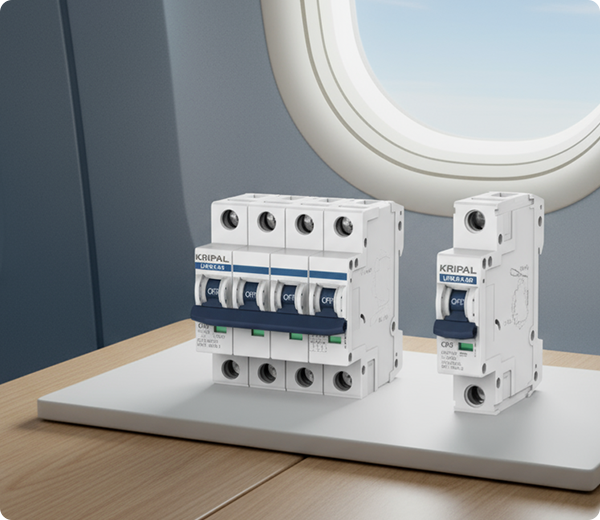
KRIPAL MCB Accessory Manufacturing: Clip-On Intelligence
KRIPAL MCB accessories—including auxiliary contacts, shunt trips, undervoltage releases, and busbars—are manufactured in a dedicated production line. Each component is assembled, functionally tested, and verified for mechanical compatibility across the full MCB range. Accessories ship with clear installation instructions and terminal markings to support global panel builder applications.
Auxiliary Contact and Signal Contact Assembly
Auxiliary contacts (OF) and signal contacts (SD) are assembled from silver-nickel contact elements in a miniature housing that clips directly onto the MCB body. Each assembled unit is tested for contact transition timing relative to the MCB main contacts, with make/break timing verified to meet specified advance/delay requirements for remote status monitoring.
Shunt Trip and Undervoltage Release Calibration
Shunt trip coils are wound and calibrated to operate within the specified voltage range (typically 70 to 110 percent of rated voltage). Undervoltage releases are calibrated to trip when voltage falls below 70 to 35 percent of rated and to prevent MCB closure below 85 percent. Each release mechanism is functionally tested across its operating voltage range.
Motor Operator and Remote Control Module Testing
Motor-driven remote operating mechanisms are assembled from a geared DC motor, limit switches, and manual override lever. Each motor operator undergoes a 500-cycle endurance test on the first article of each production batch, with subsequent units receiving a 50-cycle functional test verifying remote ON, OFF, and RESET operations.
Busbar Comb and Pin Compatibility Verification
Busbar combs and connecting pins are manufactured to precise pitch dimensions matching the MCB terminal spacing. Sample assemblies from each production lot are tested for insertion force, contact resistance at rated current, and short-circuit withstand in combination with MCBs at the rated conditional short-circuit current. Interoperability with all MCB frame sizes is verified.
Distributor Stock Holding Programs for MCB Accessories
KRIPAL supports distributor inventory programs with agreed stock levels for standard accessory models. Bulk packs of busbar combs, terminals, and common accessories are available with competitive pricing for volume distributors.
Private Label and OEM Branding for MCB Accessories
Neutral-packaged accessories with OEM part numbering and distributor-branded instruction sheets are available. KRIPAL supports the supply of accessories configured to match specific MCB product ranges for integrated distribution programs.
Multi-Region Certification and Compliance Support
CE, UKCA, and relevant IEC standard compliance documentation is provided for all accessory types according to target export markets. Technical documentation files are maintained and updated in line with evolving regulatory requirements.
Direct Technical Access to KRIPAL Production Engineers
Your technical team communicates with the engineers who designed and tested your MCB accessories, not a distributor’s sales engineer reading from a catalog. Application questions including accessory compatibility across product generations receive answers within 24 hours during China business hours.
Frequently Asked Questions
Explore FAQ >Direct from Manufacturer
How Can We Assist You?
Tell us a bit more so we can route your request to the right engineer. Get factory-direct pricing and custom specifications within 24 hours.