Search
Earth Leakage Relays ELR | Adjustable 30mA-30A | External CT | DIN Rail & Panel Mount
Industrial-Grade Factory Direct Supply
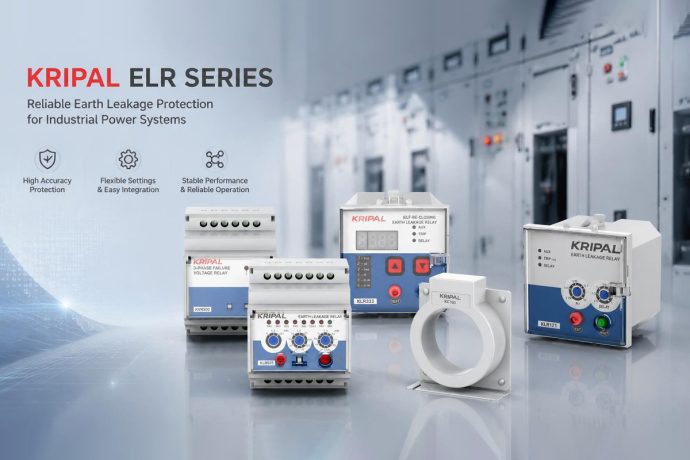
KKRIPAL manufactures earth leakage relays (ELRs) in the KLR series for earth fault detection and protection in low-voltage power distribution systems. The KLR works in conjunction with a separate KCT series current transformer (ZCT) to detect residual current flowing to earth, and provides an output contact that can trip a circuit breaker, sound an alarm or signal a SCADA system. Available with adjustable sensitivity from 0.03A to 30A and adjustable time delay from 0.05 to 10 seconds, the KLR provides the flexibility to configure earth fault protection for any application from personal protection (30mA) to equipment protection (1-30A) with selective coordination between upstream and downstream devices. The relay features a digital display showing the real-time earth leakage current, an LED indicator/bar graph for at-a-glance leakage level monitoring, and non-volatile memory or indication features such as trip current recording at the moment of trip. Powered from standard AC auxiliary supplies (such as 240V or 110V AC), the KLR supports panel mounting, DIN rail mounting, and screw mounting, connecting to the KCT via proper cabling. Compliant with IEC 60755 and relevant standards, KRIPAL KLR relays provide reliable earth leakage protection for industrial and commercial low-voltage switchgears.
Get A Quote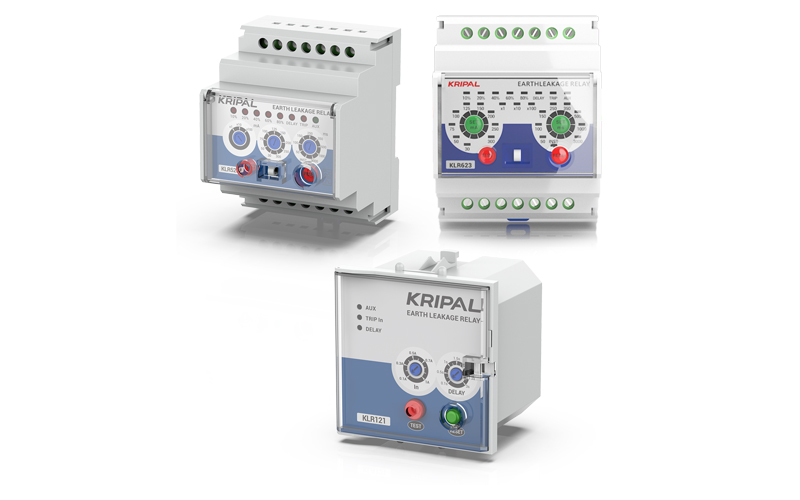
How to Select an Earth Leakage Relay
An earth leakage relay is a protection device that detects earth fault current using an external current transformer and provides an output signal to trip a circuit breaker, activate an alarm or log the event to a SCADA system. Unlike an RCCB which integrates the detection and tripping functions in one device, an ELR provides the detection and signaling functions separately from the circuit breaker, allowing earth leakage protection to be added to any circuit breaker (MCCB or ACB) simply by installing the ZCT on the circuit conductors and wiring the ELR output to the breaker’s shunt trip or trip unit input. This selection guide covers the ELR sensitivity range, time delay, ZCT selection, output configuration and integration with the circuit breaker.
KLR Earth Leakage Relay Technical Specifications
Sensitivity and Time Delay Configuration
The KRIPAL KLR series offers configurable residual current detection, available in versions with up to 25 selectable sensitivity settings ranging from 30mA (0.03A) to 30A, covering the full spectrum from personnel protection (30mA) to equipment protection (1-30A). For selective coordination between upstream and downstream protection devices, time delay settings are adjustable from instantaneous (0ms / 0.05s) up to 10 seconds across multiple step options. This multi-range adjustment allows engineers to tailor both tripping current and operating time to prevent nuisance tripping while ensuring fast response during severe earth faults.
ZCT Selection and Installation Guidelines
The KLR relay operates in conjunction with KRIPAL KCT series zero-phase current transformers (ZCT). Selecting the correct ZCT depends on system current ratings and conductor dimensions, ensuring that all phase conductors (and the neutral conductor in 4-wire systems) pass through the ZCT aperture in the same direction. KCT series sensors are designed with high-grade magnetic cores to deliver high accuracy (adjustable accuracy within ±5%) and reliable signal generation even at lower leakage currents. The ZCT secondary terminals connect directly to the relay via shielded wiring to ensure maximum immunity against electrical interference and external electromagnetic noise.
Output Configuration and Breaker Integration
KRIPAL KLR relays feature high-capacity output contacts, including tripping contacts rated at 6A 250V AC and safety / 50% pre-fault alarm contacts rated at 5A 250V AC . The primary trip contact is wired to the circuit breaker’s shunt trip coil or contactor control circuit to isolate the fault automatically. On specific models (such as KLR332E or KLR523E), a 50% pre-fault contact provides early warning signals to a panel lamp, PLC, or SCADA system before actual tripping occurs . Manual reset, remote reset, and remote test inputs are also supported for seamless integration into industrial control systems.
Digital Display and Fault Status Monitoring
The KLR series front panel is equipped with a digital display (7-segment LED) for real-time earth leakage current monitoring, along with LED status indicators for Auxiliary Power, Time Delay, and Trip status . Multi-level LED indicators provide visual feedback on leakage levels. In the event of an earth fault trip, the relay stores and displays the actual leakage current value recorded at the exact moment of trip, assisting maintenance teams in fast fault diagnosis and troubleshooting. The unit also incorporates built-in digital harmonic filtering and ZCT disconnection detection for enhanced operational reliability.
Specify Earth Leakage Relays for Your Protection Scheme
- ELR and ZCT Selection: Provide your circuit breaker size and earth leakage protection requirements, and we will specify the optimal KRIPAL KLR model and matching KCT series ZCT.
- Integration Drawings: Request wiring schematics for KLR relay connection to MCCB shunt trip coils or ACB trip unit inputs.
- OEM Supply: Source KLR relays and KCT ZCTs pre-wired and tested with your switchgear, MCCBs, or ACBs for plug-and-play switchboard integration.
Applications of Earth Leakage Relays
KRIPAL KLR series earth leakage relays provide flexible earth fault protection for any low-voltage circuit breaker by adding earth leakage detection and signaling capability to a standard MCCB or ACB. From 30mA personnel protection on laboratory and branch circuits to 30A equipment protection on main distribution incomers and industrial generators, the KLR plus KCT ZCT combination provides reliable earth leakage protection across various current levels and system configurations.
Generator Earth Fault Protection & Insulation Monitoring
A 2000 kVA standby generator utilizes a KRIPAL KLR series ELR connected to a 210mm KCT series ZCT installed around the generator’s three-phase output conductors. The relay is set to a 5A sensitivity threshold with a 2-second time delay. Over time, generator stator winding insulation degrades due to severe thermal cycling and vibration. Earth leakage current provides the earliest physical indication of insulation breakdown long before a catastrophic phase-to-earth short circuit occurs. The KLR trip contact (rated at 6A 250V AC) is wired directly to the generator ACB’s shunt trip to isolate the unit upon critical fault detection. Additionally, its integrated 50% pre-fault contact activates an early alert via the BMS, enabling maintenance teams to schedule insulation testing and winding repairs during planned downtime rather than suffering an sudden outage during grid failures.
Heavy Duty Motor & Submersible Pump Fault Protection
Industrial motors and submersible pumps operate under extreme environmental stress where dust, vibration, and water ingress through worn mechanical seals cause rapid winding insulation failure. A 500 kW conveyor motor or water treatment pump feeder utilizes a KRIPAL KLR series ELR paired with an appropriate KCT ZCT (such as 110mm or 70mm aperture). Set to 1A or 100mA sensitivity, the relay detects earth leakage current and trips the main MCCB via shunt trip faster than conventional thermal-magnetic overcurrent protection. The pre-alarm output (typically set at 50% of the trip threshold) alerts operators to seal degradation or moisture entry weeks before full failure. The KLR’s digital display allows field engineers to monitor real-time leakage currents during routine maintenance, enabling proactive equipment replacement.
Data Center & Critical Power Distribution Fire Prevention
In data center environments, KRIPAL KLR series ELRs are deployed on UPS output feeders supplying server room PDUs to provide continuous residual current monitoring. Set to a 300mA threshold with a 1-second time delay, the system is wired in an alarm-only configuration (non-tripping). The 300mA setting remains below the critical threshold where earth leakage energy across cable insulation can ignite surrounding materials, delivering reliable fire prevention for critical infrastructure. Multi-level LED bar graphs and real-time current displays on the KLR front panel allow technicians to quickly trend leakage growth across PDU transformers or power supply units. The alarm-only option prevents a single faulty server power supply from tripping an entire PDU, avoiding unexpected and costly server room downtime.
Port Crane & Outdoor Shore Power Safety Protection
Container port quay cranes are energized via flexible shore supply cables connected to power distribution pillars fitted with KRIPAL KLR series ELRs. Operating with a 1A trip threshold and a fast 0.2-second time delay, the relay protects personnel from electric shock hazards caused by mechanically damaged supply cables energizing the crane structure. Upon detecting earth fault current via the KCT ZCT, the KLR relay immediately trips the main shore supply MCCB, de-energizing the circuit before operators or ground crew come into contact with dangerous voltage. Following a trip event, the relay’s non-volatile memory displays the exact leakage current at the moment of trip, helping electrical engineers distinguish between progressive insulation degradation and sudden mechanical damage along the cable route.
Add Earth Leakage Protection to Your Installation
- Protection Scheme Design: Our engineers design a tailored earth leakage protection scheme using KRIPAL KLR relays and KCT series ZCTs for every protection level in your installation.
- ZCT Specification: Provide your cable dimensions and circuit breaker details, and we specify the correct KCT ZCT diameter and sensitivity settings.
- OEM Integration: Source KLR relays and KCT ZCTs pre-assembled and tested with your switchboard for factory-tested earth leakage protection.
KRIPAL Earth Leakage Relay Manufacturing
KRIPAL earth leakage relays are manufactured in an ESD-protected electronics assembly workshop where microprocessor-based detection circuits are assembled on automated surface-mount PCB lines, paired with calibrated KCT series zero-phase current transformer (ZCT) interfaces, and verified for precise tripping. Each ELR undergoes strict sensitivity and time delay testing to ensure reliable earth fault protection in low-voltage (LV) power distribution systems.
Surface-Mount PCB Assembly and Conformal Coating
ELR printed circuit boards are assembled on automated SMT placement and reflow soldering lines with AOI (Automated Optical Inspection) after soldering. Assembled PCBs are conformally coated with high-grade protective coating against moisture, dust, and chemical contamination in severe industrial environments. Coating coverage is fully verified under UV inspection.
Zero-Phase Transformer Interface Calibration
Each ELR is calibrated with reference KCT series ZCTs across the rated sensitivity range. Primary injection current at the trip threshold (adjustable from 30mA to 30A across 25 selectable settings) is verified against front-panel digital displays or settings, with calibration data stored in non-volatile memory. Multiple KCT aperture sizes and transformation ratios are fully verified during factory testing.
Time Delay and Output Relay Verification
The adjustable time delay function (0ms up to 10 seconds, depending on model) is verified by injecting a residual leakage current and measuring precise relay operating time. The heavy-duty output relay contacts (silver alloy contacts, rated 6A at 250V AC) are tested for contact resistance, operating speed (max 15ms), and dielectric withstand between coil and contacts.
EMC Immunity Testing on Production Samples
Sample ELRs from each production batch undergo rigorous EMC immunity testing per IEC standards: electrostatic discharge, radiated RF fields, electrical fast transients, and surge immunity. This ensures production units maintain trip accuracy in electrically noisy environments such as VFD-driven motor circuits and heavy industrial installations.
Distributor Stock Holding Programs for Earth Leakage Relays
KRIPAL supports distributor inventory programs with agreed stock levels for standard KLR series ELR models with matched KCT ZCTs. Digital display and LED bar-graph versions are available, with scheduled shipments planned based on demand data and customer replenishment requirements.
Private Label and OEM Branding for Earth Leakage Relays
Custom front-panel overlays with OEM branding, distributor part numbering, customized instruction manuals, and packaging options are available. Neutral-packaged supply is provided for private label programs.
Multi-Region Certification and Compliance Support
CE, UKCA, and compliance documentation per IEC 60755 and IEC 60947 standards are provided according to target export markets. EMC compliance certificates are readily available for all KLR series models.
Direct Technical Access to KRIPAL Electronics Engineers
Your technical team communicates directly with the electronics engineers who designed the KLR detection algorithms and hardware. Application queries, including earth fault protection coordination with upstream and downstream breakers, receive expert responses within 24 hours during China business hours.
Frequently Asked Questions
Explore FAQ >Recent Blog
Explore Blog >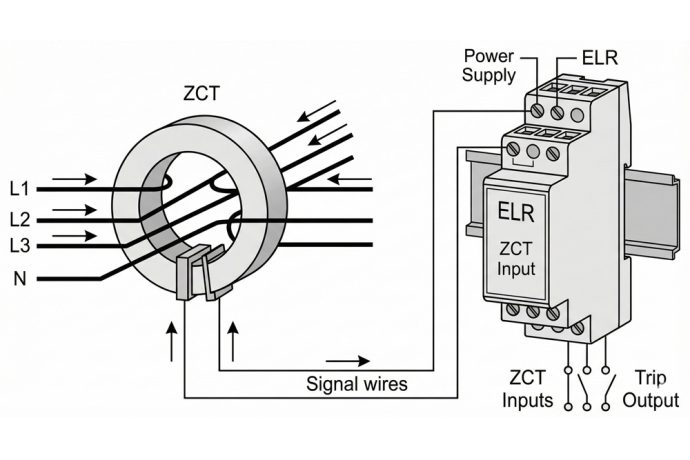
Earth Leakage Relays and Zero‑Phase Current Transformers
Understand how Earth Leakage Relays and Zero Phase Current Transformers work together for effective electrical circuit protection and safety.
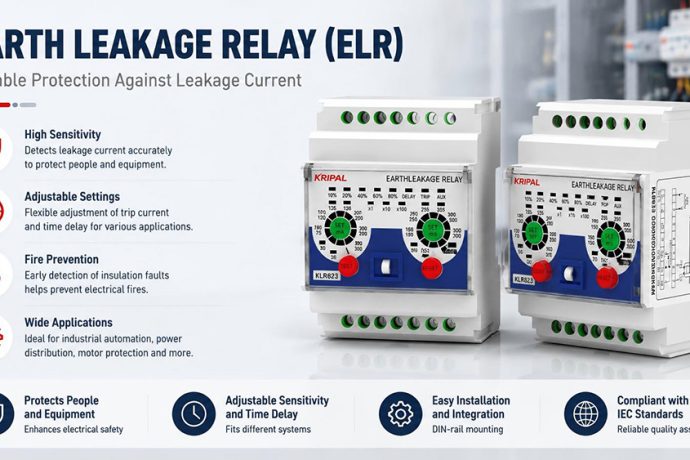
Understanding Earth Leakage Relays: Types, Working Principle, and Key Advantages
Discover how earth leakage relays (ELRs) detect ground faults to prevent electric shocks and fires. Learn about their types, benefits, and troubleshooting tips.
ELR vs ELCB: Differences, Working Principles and Selection Guide for Industrial Power Systems
Discover the differences between ELR and ELCB. Learn how earth leakage relays work, their applications, and how to choose the right protection for your...
Direct from Manufacturer
How Can We Assist You?
Tell us a bit more so we can route your request to the right engineer. Get factory-direct pricing and custom specifications within 24 hours.