Search
MCCB Accessories Motor Operators Shunt Trips Rotary Handles | UKM30 Series
Factory-made accessories for smarter power protection
KRIPAL manufactures a comprehensive range of MCCB accessories for the UKM30 series, enabling extended functionality beyond basic overcurrent protection. The accessory range includes shunt trip releases for remote tripping via external control signals, undervoltage releases paired with dedicated power modules for precise undervoltage protection and prevention of unintended reclosure, motor operators (MD and MDX series) for automated remote opening and closing via PLC or SCADA systems, and CS1 rotary handle mechanisms with padlock facilities to lock the breaker in the open/closed position for safe isolation. The lineup also features auxiliary contacts for status signaling, alarm contacts for trip indication, terminal blocks (JX series), phase barriers, and plug-in/rear-wiring conversion kits for rapid maintenance without disconnecting main busbars. All accessories feature modular clipping or direct mounting designed for full compatibility across UKM30 frame sizes up to 1600A. CE and UKCA marked, KRIPAL MCCB accessories empower switchboard manufacturers to build fully integrated power distribution panels from a single trusted supplier ecosystem.
Get A Quote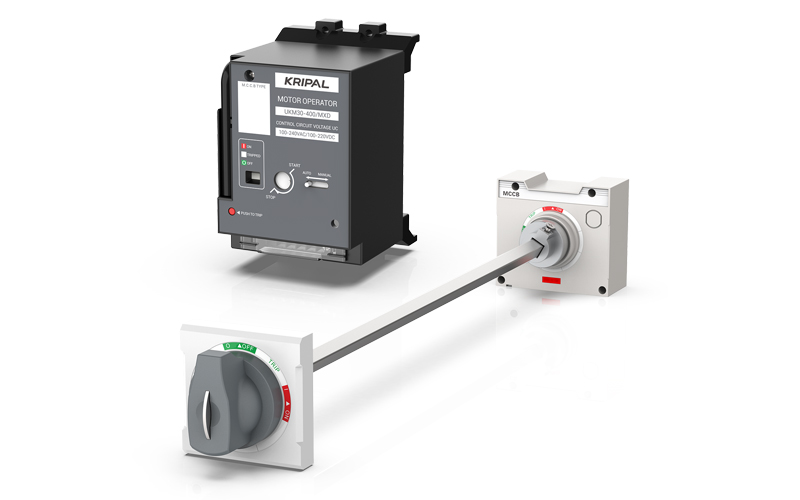
MCCB Accessory Guide: Remote Operation and Safety Integration
MCCB accessories extend the basic protection function into a complete circuit management solution that integrates with building control, monitoring, and safety systems. A motor operator enables the MCCB to be remotely controlled from a PLC or SCADA system, supporting automated load transfer, peak shaving, and remote circuit restoration. Shunt trip and undervoltage releases integrate the MCCB with fire alarm systems and emergency stop circuits for rapid automated shutdown. Auxiliary and alarm contacts provide real-time status feedback for remote monitoring. For local control, rotary handle mechanisms equipped with padlock facilities provide safe isolation and meet stringent safety requirements for switchboard access. This selection guide covers each accessory type, its electrical ratings, mechanical compatibility, and typical industrial applications.
UKM30 MCCB Accessories Technical Specifications
Motor Operators for Remote Control
The UKM30 motor operator enables automated remote switching via PLC or SCADA control systems. Available in MD (solenoid-driven) and MDX (motor/gear-driven) series, it supports operating voltages including AC 110V–230V / DC 110V–220V (MDX) and AC 230V/400V (MD). Featuring operating speeds under 0.8 seconds and mechanical durability up to 15,000 cycles, the operator includes visible ON, OFF, and TRIP indicators. Integrated padlock facilities allow operators to lock the breaker safely during maintenance, while manual local control remains accessible if power fails. Typical applications include automatic transfer switches (ATS) and remote restoration in unstaffed substations.
Rotary Handle and Door Interlock Mechanisms
The CS1 series rotary operating mechanism utilizes a low-friction gear-and-rack drive to ensure smooth operation and long service life. Connected through a standard 150mm square shaft (customizable to 400mm), it transfers rotation to the MCCB while providing clear ON, OFF, and TRIP status display on the cabinet exterior. Available with Type A (square) or Type B (round) handles, the assembly incorporates padlock facilities in open or closed states to guarantee strict lockout-tagout (LOTO) safety. Designed for switchboard door interlocking, it offers optional IP65 seals for harsh industrial environments.
Shunt Trip and Undervoltage Release Integration
The shunt trip release enables immediate remote tripping upon receiving signals from fire alarms or emergency stop buttons. For voltage monitoring, the undervoltage release works with a modular power module (mountable on the MCCB side or independently). Rated for AC 110V–400V and DC 24V–110V, the UVR automatically trips the breaker within 10–30ms when voltage drops to 35%–70% Ue. It prevents reclosure below 35% Ue and allows closing only when voltage recovers to 85% Ue or higher, protecting motor equipment from brownout damage.
Auxiliary Contacts and Plug-In/Withdrawable Kits
Internal status monitoring relies on auxiliary contacts for open/close indication and alarm contacts for fault trip signaling. These accessories route through side-mounted JX series terminal blocks for organized switchboard wiring. For rapid maintenance, plug-in bases and rear-wiring conversion kits transform fixed MCCBs into plug-in units. Utilizing heavy-duty plug-in terminals and rear busbar studs, this architecture permits technical teams to swap circuit breaker units quickly without disconnecting primary busbars or main cable connections, minimizing critical downtime during system overhauls.
Specify Accessories for Your MCCB Installation
- Accessory Schedule: Provide your MCCB list and our engineering team will specify the correct accessories with exact part numbers for each device.
- Switchboard Layout Support: Request 2D panel layout drawings showing rotary handle cutout positions, shaft dimensions, and interlock mounting details.
- OEM Supply: Source UKM30 MCCBs pre-fitted with your specified accessories, factory-tested and ready for immediate switchboard integration.
Remote Switching for Automatic Transfer and Substation Automation
KRIPAL UKM30 MCCB accessories transform a basic overcurrent protection device into a connected, remotely controllable, and safety-integrated circuit management system. From the motor operator on a generator incomer in an automatic transfer switch (ATS) to the rotary handle and door interlock on a switchboard feeder, these accessories serve as the vital interface between the MCCB, the building management system, and the operator.
Automatic Transfer Switch with Motor Operators
An automatic transfer switch (ATS) panel utilizes two UKM30 MCCBs equipped with MD or MDX motor operators: one on the utility incomer and one on the generator incomer. When the ATS controller detects a utility supply failure, it sends a control signal to open the utility MCCB. Upon receiving open status verification from the auxiliary contacts, the controller starts the generator and sends a close command to the generator MCCB. Mechanical and electrical interlocks prevent simultaneous connection of both sources, eliminating hazardous power back-feeding. Integrated padlock facilities on the motor operators ensure safe isolation during ATS system maintenance.
Fire Alarm and Safety Integration via Shunt Trips
Main LV switchboards integrate shunt trip releases on UKM30 MCCBs feeding HVAC, elevator, and ventilation circuits. Upon detecting a fire condition, the fire alarm panel outputs a triggering signal to the shunt trip coil, instantaneously opening the MCCBs to cut power to mechanical systems that could spread smoke. Simultaneously, side-mounted alarm contacts routed through JX series terminal blocks send immediate fault trip confirmation back to the main control panel. When severe undervoltage occurs during emergency outages, the undervoltage release and power module ensure rapid automated tripping within 10–30ms, preventing unsafe automatic reclosure until voltage normalizes.
Operator Safety Interlocks and SCADA Remote Monitoring
For factory switchboards, CS1 series rotary handles feature door interlock mechanisms and padlock facilities across all UKM30 feeder MCCBs. Operators must turn the breaker to OFF before opening panel doors, while padlock locking guarantees lockout-tagout (LOTO) safety. Simultaneously, the SCADA system monitors feeder status using auxiliary contacts (ON/OFF status) and alarm contacts (fault trip status). This dual-signal feedback allows control room operators to distinguish clearly between a manual shutdown for routine service and an automatic trip caused by an electrical fault, ensuring rapid and precise maintenance dispatching.
Drawout Configurations for Critical Power Continuity
In data centers and healthcare facilities, UKM30 MCCBs are deployed with plug-in bases and rear-wiring conversion kits on critical UPS output feeders. If an MCCB requires rating upgrades or routine maintenance, the plug-in architecture allows technical teams to rack out and swap the breaker unit quickly without disconnecting primary busbars or rear main cables. Utilizing heavy-duty plug-in terminal blocks and robust rear connection studs, this solution reduces device replacement time from hours to minutes, significantly mitigating critical power downtime and helping industrial facilities achieve maximum power availability and operational resilience.
Specify MCCB Accessories for Your Switchboard
- Integration Design: Our application engineers design the accessory configuration for each MCCB in your switchboard, including wiring schematics for motor operator and shunt trip circuits.
- Factory Assembly: Order MCCBs pre-assembled with all specified accessories, factory-tested and shipped with individual test certificates.
- OEM Partnership: Dedicated accessory stockholding and JIT delivery for switchboard manufacturers with ongoing UKM30 production requirements.
KRIPAL MCCB Accessory Manufacturing: Precision Integration
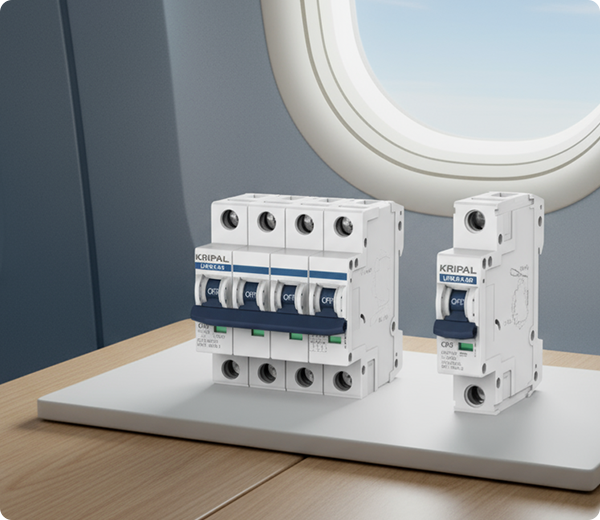
KRIPAL MCCB accessories—including motor operators, shunt trips, undervoltage releases, CS1 rotary handles, and plug-in conversion kits—are manufactured in a dedicated accessories production cell. Each accessory type is assembled, functionally tested, and mechanically verified for complete compatibility across the full UKM30 frame size range for global switchboard builder applications.
Motor Operator Assembly with Auto/Manual Selector
Motor operators (MD and MDX series) are assembled from high-torque motors, gear-and-cam assemblies, and manual override mechanisms with padlock facilities. Each unit is functionally tested for remote switching and verified for mechanical interlocks that prevent simultaneous manual and electrical operation. Endurance testing up to 15,000 operations is performed according to frame sizes to ensure long-term stability.
Shunt Trip and Undervoltage Release Production Testing
Shunt trip coils are wound in-house and verified for rapid response across rated control voltages. Undervoltage releases paired with modular power modules are calibrated to trip automatically within 10–30ms when voltage drops to 35%–70% Ue. Reclosure is prevented below 35% Ue and permitted only when voltage recovers above 85% Ue. Every unit is tested for mechanical alignment with applicable UKM30 frames.
Rotary Handle and Door Interlock Verification
Direct-mount and door-mounted CS1 rotary handles with standard 150mm square shaft extension kits are assembled with padlock mechanisms and door interlock features. Sample handle assemblies from each batch undergo mechanical endurance testing and verification of the door interlock function that prevents door opening when the MCCB is in the ON position. IP65 handle variants undergo water-jet seal testing.
Plug-In and Rear-Wiring Kit Assembly
Plug-in base modules and rear-wiring conversion kits are fabricated with heavy-duty silver-plated contact clusters rated for the full MCCB current range up to 1600A. Each kit undergoes contact resistance verification using a four-wire micro-ohmmeter after repeated insertion cycles. The safety interlock mechanism that prevents breaker insertion or removal while energized is verified on every unit.
Distributor Stock Holding Programs for MCCB Accessories
KRIPAL supports distributor inventory programs with agreed stock levels for standard accessory models across all UKM30 frame sizes. Bulk packaging and pre-configured accessory kits for common switchboard panel builds are available for volume distributors.
Private Label and OEM Branding for MCCB Accessories
Neutral-packaged accessories with OEM part numbering and distributor-branded installation instructions are available. KRIPAL supports the customized supply of accessories configured to match specific MCCB product ranges for integrated distribution programs.
Multi-Region Certification and Compliance Support
CE, UKCA, and relevant IEC standard compliance documentation is provided for all accessory types according to target export markets. Technical files and product certificates are maintained to support evolving regulatory requirements worldwide.
Direct Technical Access to KRIPAL Production Engineers
Your technical team communicates directly with the engineers who designed and tested your MCCB accessories. Application inquiries—including accessory retrofitting and wiring configurations for field-installed UKM30 MCCBs—receive dedicated responses within 24 hours during business hours.
Frequently Asked Questions
Explore FAQ >Recent Blog
Explore Blog >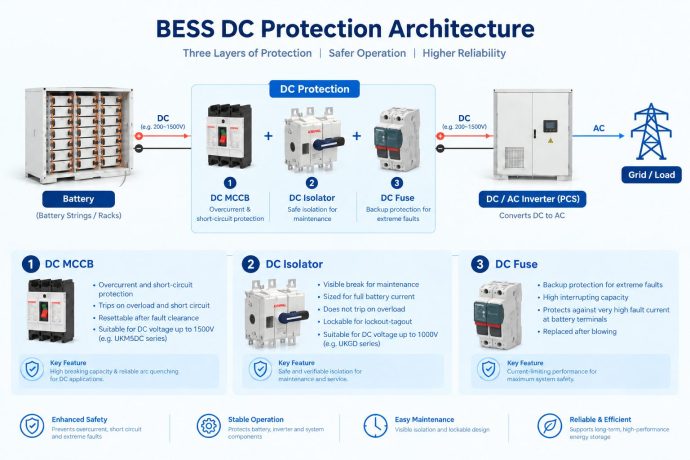
BESS DC Protection: How to Select MCCBs, Isolators and Fuses
Learn how to select BESS DC MCCBs, isolators, and fuses by voltage, current, fault current, interrupting rating, and protection coordination.
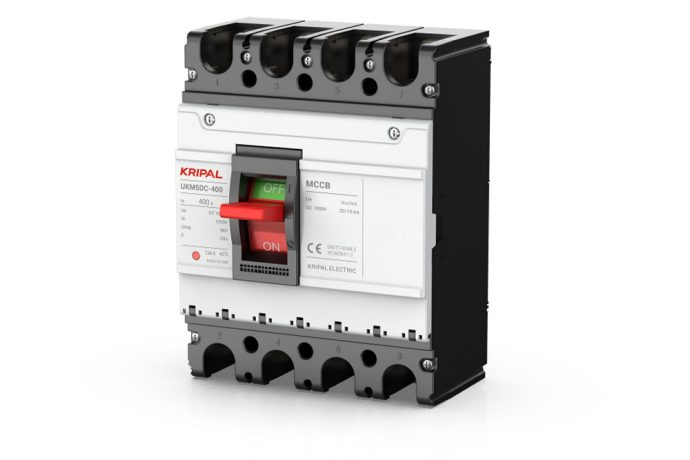
What are the Difference of MCCB and ACB?
Compare MCCB and ACB on breaking capacity, cost, maintenance & applications, learn core differences to select the right circuit breaker.
High Voltage vs Low Voltage: Key Differences, Safety Standards & Applications
Compare high voltage and low voltage electrical systems — key differences in safety standards, energy efficiency, applications, and equipment selection. A comprehensive guide covering...
Direct from Manufacturer
How Can We Assist You?
Tell us a bit more so we can route your request to the right engineer. Get factory-direct pricing and custom specifications within 24 hours.