Search
Zero Current Transformers (ZCT) for Earth Leakage Relays | 40mm-200mm ID
In-House Production for Precise Fault Monitoring
KRIPAL manufactures zero-sequence current transformers (ZCTs) for earth leakage detection in low-voltage distribution systems, designed for integration with the KLR523 earth leakage relay and residual current circuit breakers. The ZCT is a toroidal or rectangular transformer through which phase conductors (and neutral, if present) pass. It generates a secondary signal proportional to the vector sum of primary currents—remaining zero normally and triggering a response when an earth leakage occurs.KRIPAL KCT series ZCTs offer internal diameters from 40mm to 200mm (with rectangular window sizes up to 500mm x 45mm) to accommodate compact wiring, heavy-duty cables, and busbars. Designed with residual current sensing from 300mA up to 30A, the series delivers accurate measurement (5P/10P) across fault protection applications.Each ZCT features dedicated secondary connection terminals and robust mounting brackets for secure installation. Built with high-permeability magnetic cores and flame-retardant casings, KRIPAL ZCTs ensure reliable detection across operating temperatures from -25°C to +40°C.
Get A Quote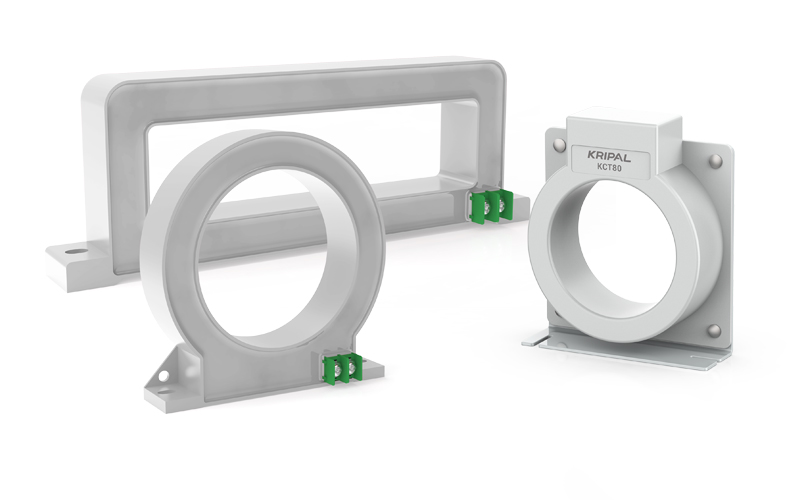
How to Select a Zero Current Transformer
A zero-sequence current transformer (also called a residual current transformer or core-balance CT) is the primary sensing element in an earth leakage protection system. It operates on the principle that the vector sum of currents flowing through all conductors within the ZCT aperture is zero under normal conditions. When an earth fault occurs, this magnetic balance is disturbed, inducing a secondary voltage proportional to the earth leakage current. As a passive component requiring no auxiliary power supply, a quality ZCT delivers high operational reliability and long service life. This selection guide covers critical factors including internal diameter, core material, sensitivity, and installation requirements.
ZCT Series Technical Specifications
Internal Diameter Selection by Conductor Size
The ZCT internal diameter must accommodate all circuit conductors with adequate clearance for insulation. As a general rule, the total cross-sectional area of conductors should not exceed 40% of the ZCT aperture area to ensure optimal magnetic field uniformity. For standard circuits, a 40mm ZCT (KCT40) handles up to 250A; a 100mm ZCT (KCT100) supports up to 630A; and a 200mm ZCT (KCT200) accommodates heavy cables up to 1000A. For busbars or multi-cable systems up to 5000A, rectangular window sizes (e.g., KCT3045 to KCT5045) are available. KRIPAL provides dimension charts in the KLR523 earth leakage relay datasheets. All phase conductors and neutral must pass through the ZCT in the same direction facing the load side.
Core Material and Sensitivity Matching
The magnetic core permeability directly determines the minimum detectable earth leakage current. KRIPAL ZCTs use high-permeability magnetic cores optimized for residual current inputs ranging from 300mA to 30A (with output parameters like 300mA/80mV, 3A/80mV, and 30A/80mV). These cores ensure high accuracy classes (5P/10P) to prevent false tripping or non-operation during transient surges. Each KCT series ZCT is labeled with its corresponding rated burden (e.g., internal 560Ω or external 5.6Ω/0.5Ω) and must be properly paired with the KLR523 leakage relay sensitivity settings.
Installation and Electromagnetic Interference Protection
The ZCT must be installed with conductors centered in the aperture and secured with mounting brackets to prevent movement from magnetic forces during fault conditions. Conductors should approach perpendicular to the aperture plane to ensure uniform magnetic coupling. Secondary wiring connects directly via robust connection terminals using twisted shielded cables. Secondary cabling should be routed at least 200mm away from heavy power cables carrying over 100A and avoid long parallel runs to minimize interference. For extended wiring runs, impedance and signal attenuation should be verified with KRIPAL technical support.
Common Installation Errors and Prevention
The most common ZCT installation errors include: passing the protective earth (PE) conductor through the ZCT (which cancels the leakage signal as return current flows back through the PE), running the neutral conductor outside or in the reverse direction, and improper grounding of cable shielding on the load side. KRIPAL provides detailed installation guides showing correct configurations for 3-phase 3-wire, 3-phase 4-wire, and single-phase distribution systems to ensure fault-free operation.
Specify ZCTs for Your Earth Leakage Protection
- ZCT Sizing: Provide your cable/busbar sizes and circuit configuration, and our technical team will specify the optimal ZCT internal diameter and mounting specifications.
- Installation Review: Send a photograph or schematic of your proposed ZCT installation location, and our engineers will verify the conductor path and layout before you commission the system.
- OEM Supply: Source KRIPAL ZCTs pre-configured with integrated mounting brackets and standard terminal blocks for streamlined switchboard and panel assembly.
Applications of Zero Current Transformers
KRIPAL ZCTs serve as the core sensing element across KRIPAL earth leakage protection systems, installed around circuit conductors precisely where leakage monitoring is required. From a compact 40mm ZCT on single-phase or low-current control circuits to a heavy-duty 200mm (or rectangular 500mm) unit on 5000A generator incomers and main busbars, KRIPAL ZCTs deliver reliable, passive detection that enables connected relays and circuit breakers to make accurate protection decisions.
Main Switchboard & Busbar Earth Leakage Detection
A factory main switchboard utilizes a KCT rectangular ZCT (e.g., KCT3045) installed around four incoming copper busbars (L1, L2, L3, N) from a 2500 kVA transformer, integrated with a KLR523 earth leakage relay set to 1A. The wide rectangular window provides safe clearance for busbars and support insulators. Mounted on a solid frame with secondary wiring routed in dedicated conduits to the KLR523 relay, the full sensing chain is verified during factory acceptance testing by injecting calibrated test currents.
Motor Control Center (MCC) Feeder Protection
A 200 kW pump motor feeder uses a 100mm ZCT (KCT100) placed around three-phase motor cables, wired directly to a KLR523 protection relay. Installed inside the MCC cubicle, phase conductors are fed through the KCT100 aperture before terminating at the circuit breaker load terminals. The ZCT’s robust connection terminals route secondary signals to the relay, while integrated test functionality verifies precise detection and tripping across 300mA to 3A earth fault thresholds.
Data Center & Sensitive Equipment Earth Leakage Monitoring
A data center server rack PDU uses a compact 40mm ZCT (KCT40) surrounding the single-phase supply cable (L+N), connected to a KLR523 relay with Modbus telemetry. The high-permeability magnetic core enables accurate sensing at low residual currents (30mA-300mA alarm thresholds) without false tripping. Enclosed within the PDU panel, the KLR523 unit transmits live leakage data to the DCIM platform, enabling per-rack insulation monitoring and predictive maintenance without complex external wiring.
Generator Neutral & System Retrofit Applications
A 1000 kVA generator system utilizes a 150mm ZCT (KCT150) installed directly around the neutral-earthing conductor, connected to a KLR523 relay. On systems with neutral-grounding resistors, this setup directly measures total generator leakage using a single conductor. For switchboard retrofits, circuit conductors are routed through solid-core KCT series ZCTs during scheduled maintenance windows, delivering long-term stability and precise protection across operating temperatures from -25°C to +40°C.
Specify ZCTs for Your Protection System
- ZCT Selection: Provide your circuit configuration and cable/busbar dimensions, and we will specify the correct ZCT model with mounting accessories.
- Installation Support: Our engineers review your proposed ZCT locations and provide installation guidance to avoid common setup errors.
- OEM Supply: Source KRIPAL ZCTs in bulk with standardized mounting brackets and integrated terminal blocks for efficient switchboard and panel assembly.
KRIPAL Zero Current Transformer Manufacturing
KRIPAL zero current transformers are manufactured in a dedicated toroidal core winding workshop where high-permeability magnetic cores are wound with precision secondary turns on automated machines. Each ZCT undergoes transformation ratio verification, insulation testing, and linearity measurement for earth leakage detection applications with window sizes from 40mm to 200mm (and rectangular sizes up to 500mm x 45mm).
Toroidal Core Material Selection and Processing
ZCT cores are fabricated from high-permeability magnetic alloys, wound into toroidal form, and heat-treated to achieve optimal magnetic characteristics. Core permeability is verified before winding to maintain consistent ratio accuracy across production batches. High-permeability cores ensure high accuracy classes (5P/10P) and superior sensitivity for residual current inputs from 300mA to 30A.
Precision Secondary Winding on Automated Machines
Secondary turns are wound on computer-controlled toroidal winding machines that maintain exact turn ratios (e.g., standard 1/210 ratio or customized options) and uniform distribution around the core. Winding resistance and inductance are verified on every completed unit. Secondary connections are wired directly to robust, clearly marked terminal blocks for secure field installation.
Transformation Ratio and Linearity Verification
Each ZCT is tested for ratio accuracy by injecting a calibrated primary residual current and measuring secondary output (such as 300mA/80mV, 3A/80mV, and 30A/80mV). Linearity is measured across the full primary residual current range to ensure the ZCT maintains accurate performance across the paired KLR523 leakage relay sensitivity settings.
Insulation and Mechanical Integrity Testing
KRIPAL ZCTs undergo rated power-frequency withstand voltage testing at 3kV between the secondary winding and the external enclosure. The flame-retardant casing and solid-core structure are visually inspected to guarantee complete encapsulation, high mechanical strength, and reliable operation across operating temperatures from -25°C to +40°C.
Distributor Stock Holding Programs for ZCTs
KRIPAL supports distributor inventory programs for standard KCT series ZCTs with window diameters from 40mm to 200mm. Matched ZCT and KLR523 relay pairs are available as coordinated earth leakage protection packages, with scheduled replenishment based on market demand.
Private Label and OEM Branding for ZCTs
OEM-part-numbered ZCTs with custom nameplates, distributor-branded packaging, and matched calibration certificates are available. Neutral-packaged supply is provided for private label switchboard component programs.
Multi-Region Certification and Compliance Support
Compliance documentation for IEC standards and low-voltage switchgear directives is provided. Individual ZCT calibration certificates detailing measured ratio and linearity data are available for project acceptance and third-party witness testing.
Direct Technical Access to KRIPAL Winding Engineers
Your technical team communicates directly with the engineers who design and manufacture your ZCTs. Application questions including ZCT sizing for specific cable diameters, busbar dimensions, and environmental conditions receive professional responses within 24 hours during China business hours.
Frequently Asked Questions
Explore FAQ >Direct from Manufacturer
How Can We Assist You?
Tell us a bit more so we can route your request to the right engineer. Get factory-direct pricing and custom specifications within 24 hours.