Search
Knowledge Center
Rotary Isolator vs Toggle Isolator: Which Switch Disconnector Is Best for Your Panel?
Compare rotary and toggle isolator switches: mechanism design, operating feel, panel space, mounting options and how to choose the right switch disconnector.
 July 06, 2026
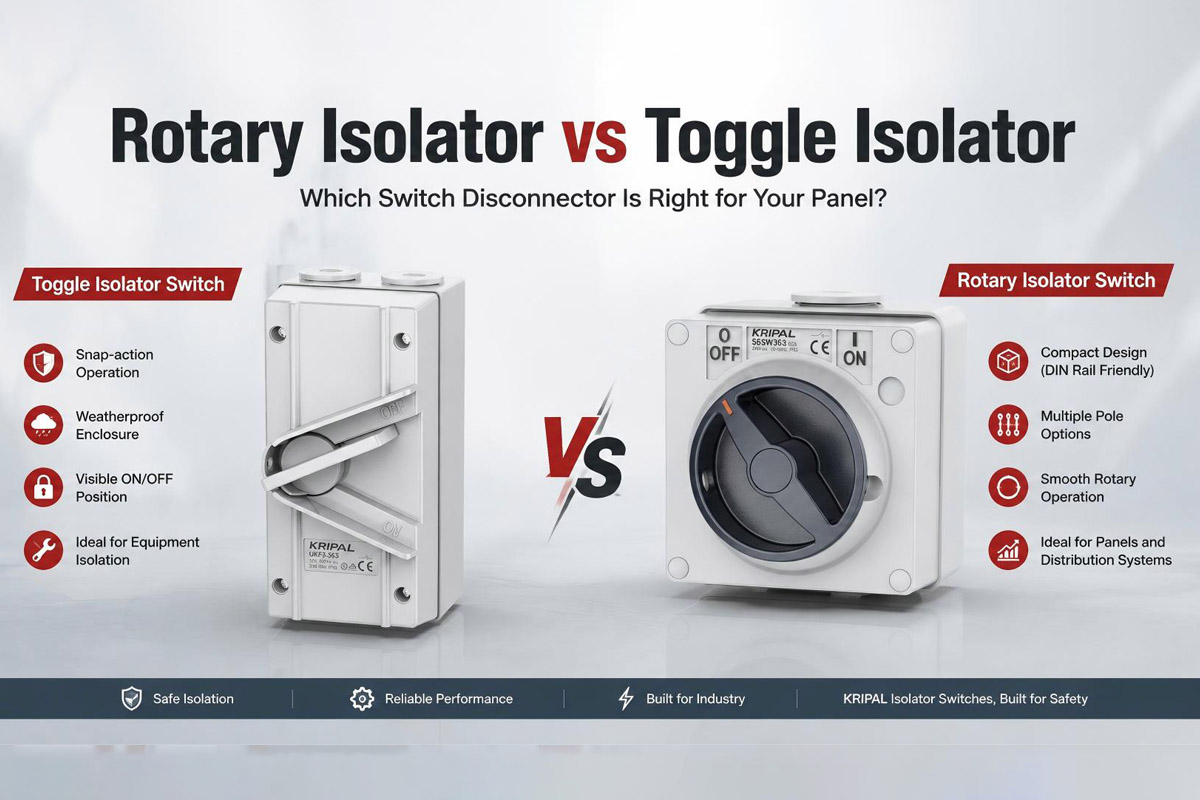
When selecting an isolator switch for an electrical panel, the mechanism design directly affects installation, operation, space utilization, and application suitability. Two common designs used in low-voltage electrical systems are the rotary isolator switch and the toggle isolator switch.
Both types perform the same essential function: safely disconnecting electrical circuits for maintenance, inspection, and equipment isolation. However, their internal mechanisms, mounting methods, and typical applications are different.
This guide explains the key differences between rotary and toggle isolators, including mechanism design, operating characteristics, panel integration, and how to choose the right isolator switch for your application.
How Rotary and Toggle Isolator Mechanisms Work
Rotary
Rotary Isolator Switch
A rotary isolator switch uses a rotating shaft and cam-driven mechanism to open and close electrical contacts. When the handle is turned, the internal mechanism moves the contact system between the ON and OFF positions.
Most rotary isolators use multiple contact chambers arranged along the operating shaft. This design allows manufacturers to develop multi-pole configurations, such as 2P, 3P, 4P, and other specialized configurations, without significantly increasing the overall width of the device.
Rotary isolator switches are commonly available for a wide range of applications, from compact DIN rail mounted distribution devices to high-current industrial switch disconnectors.
Toggle
Toggle Isolator Switch
A toggle isolator switch operates through a lever and pivot mechanism. Moving the toggle handle activates internal linkages that open or close the contacts with a positive snap-action movement.
Many toggle isolators are designed for local equipment isolation, especially where a visible handle position and simple operation are required. They are commonly found in outdoor equipment, HVAC systems, pumps, machinery, and other applications where an enclosed isolator is preferred.
Operating Feel and Switching Characteristics
The operating experience of an isolator switch depends on its internal mechanism and contact design.
Rotary Isolator
Rotary isolators generally provide smooth and consistent operation throughout the handle movement. The rotating mechanism provides clear ON/OFF positions and allows easy integration with padlockable handles for lockout/tagout (LOTO) safety procedures.
Because of their compact mechanical design, rotary isolators are often selected for applications requiring frequent operation, multiple poles, or installation inside distribution panels.
Toggle Isolator
Toggle isolators typically provide a quick snap-action operation. The sudden movement of the mechanism gives the operator clear tactile feedback, which can be useful when working with gloves or in environments where the switch position needs to be easily confirmed.
For outdoor or machine-mounted applications, this positive switching action can improve user confidence during operation.
Rotary Isolator vs Toggle Isolator Comparison
| Feature | Rotary Isolator Switch | Toggle Isolator Switch |
|---|---|---|
| Operating Mechanism | Rotating shaft with cam mechanism | Lever and pivot snap-action mechanism |
| Handle Movement | Rotary ON/OFF rotation | Toggle movement through a fixed angle |
| Common Pole Options | 1P, 2P, 3P, 4P and specialized configurations | Usually 1P to 4P |
| Typical Current Range | Available from small ratings to high-current industrial versions | Commonly used for low and medium current applications |
| Mounting Options | DIN rail, panel mount, enclosed versions | Panel mount and enclosed versions |
| Outdoor Application | Requires suitable IP-rated enclosure | Many models include weatherproof enclosure options |
| Best Application | Distribution panels, industrial control systems, high-density installations | Equipment isolation, outdoor units, local disconnect applications |
Space Requirements Inside Electrical Panels
Panel space is an important consideration when selecting an isolator switch.
Rotary Isolator Space Advantages
- Rotary isolators usually have a narrow and compact design, making them suitable for distribution boards and control panels where multiple devices are installed side by side.
- DIN rail versions can be mounted together with MCBs, RCCBs, contactors, and other modular devices on a standard 35mm DIN rail. This makes rotary isolators a popular choice for panel builders who need efficient use of cabinet space.
- Panel-mounted rotary isolators also typically require a simple circular shaft opening, which simplifies enclosure fabrication.
Toggle Isolator Space Considerations
- Toggle isolators usually have a larger front operating area because of the lever mechanism and enclosure design.
- However, many enclosed toggle isolators are supplied as complete weatherproof assemblies. This can reduce installation work because the installer does not need to select and assemble a separate enclosure.
- For outdoor equipment such as air conditioners, pumps, and machinery, the integrated enclosure design can be a practical advantage.
Mounting Options and Installation Differences
DIN Rail Mounting
Rotary isolator switches are widely used in DIN rail distribution systems because their compact vertical design fits naturally with modular electrical equipment.
They are commonly installed alongside:
- Miniature circuit breakers (MCBs)
- Residual current devices (RCCBs)
- Contactors
- Protection devices
Toggle mechanisms are less commonly used in modular DIN rail systems because their physical structure is better suited for panel or enclosure mounting.
Panel Mounting
Both rotary and toggle isolators can be panel mounted, but the installation method is different. Rotary isolators generally use a shaft and handle assembly, requiring a circular mounting opening. Toggle isolators normally require a rectangular cutout that matches the handle and bezel design. The best choice depends on the panel structure, available space, and installation environment.
IEC 60947-3 Standard and Safety Considerations
When selecting an isolator switch for industrial and commercial applications, compliance with electrical standards is an important factor.
Low-voltage switch disconnectors and isolator switches are commonly designed according to IEC 60947-3, which defines requirements for switches, disconnectors, switch disconnectors, and fuse combination units.
Key Selection Factors
- Rated operational voltage (Ue)
- Rated current (Ie)
- Number of poles
- Utilization category, such as AC-22A or AC-23A
- Short-time withstand capability
- Suitable enclosure protection rating (IP rating)
Choosing a switch disconnector that matches the electrical load and installation environment ensures reliable isolation performance.
Which Isolator Switch Should You Choose?
Choose a Rotary Isolator Switch When:
- Your electrical panel requires compact DIN rail installation.
- Multiple poles such as 3P or 4P are needed.
- The installation requires efficient panel space utilization.
- The switch will be operated regularly.
- You need integration with industrial distribution systems.
- Higher current ratings are required.
Choose a Toggle Isolator Switch When:
- The application requires local equipment isolation.
- The switch will be installed outdoors or in exposed environments.
- A complete weatherproof enclosure is preferred.
- Operators need clear tactile ON/OFF indication.
- The application involves HVAC equipment, pumps, or machinery.
Frequently Asked Questions
Q: Can a rotary isolator switch be used outdoors?
Yes. Rotary isolators can be used outdoors when installed in a suitable IP-rated enclosure. Many manufacturers also provide enclosed rotary isolator versions designed specifically for outdoor applications, such as the UKF series waterproof isolating switches.
Q: Which isolator switch has a longer service life?
Both rotary and toggle isolators can provide reliable service when selected correctly. Rotary isolators are often preferred for applications requiring frequent switching, while toggle isolators are commonly used for equipment isolation.
Q: Are DIN rail isolators always rotary types?
Most DIN rail isolators use rotary mechanisms because this design fits better with modular distribution systems. However, the exact mechanism depends on the manufacturer and product design.
Q: Can toggle isolators be locked in the OFF position?
Many toggle isolators include padlock facilities that allow the switch to be secured in the OFF position, supporting maintenance safety procedures.
Find the Right Isolator Switch for Your Application
Selecting the correct isolator switch improves electrical safety, simplifies installation, and ensures reliable operation.
Whether you need a compact DIN rail rotary isolator for a distribution panel or an enclosed toggle isolator for outdoor equipment, choosing the correct switch disconnector design is essential.
Explore the full range of KRIPAL AC isolator switches, including DIN rail mounted rotary isolators and robust enclosed isolator solutions for industrial and commercial applications. Our team is happy to review your panel requirements.
Related Resources
Explore Knowledge Center >
Need a matching KRIPAL product?
Share voltage, quantity and destination. An engineer will reply with options and lead time.