Search
Knowledge Center
Emergency Stop Button vs Isolator Switch: Key Differences, Standards and Applications
Compare emergency stop buttons and isolator switches: EN ISO 13850 vs EN 60947-3, wiring principles, safety functions and why panels often need both devices.
 July 01, 2026
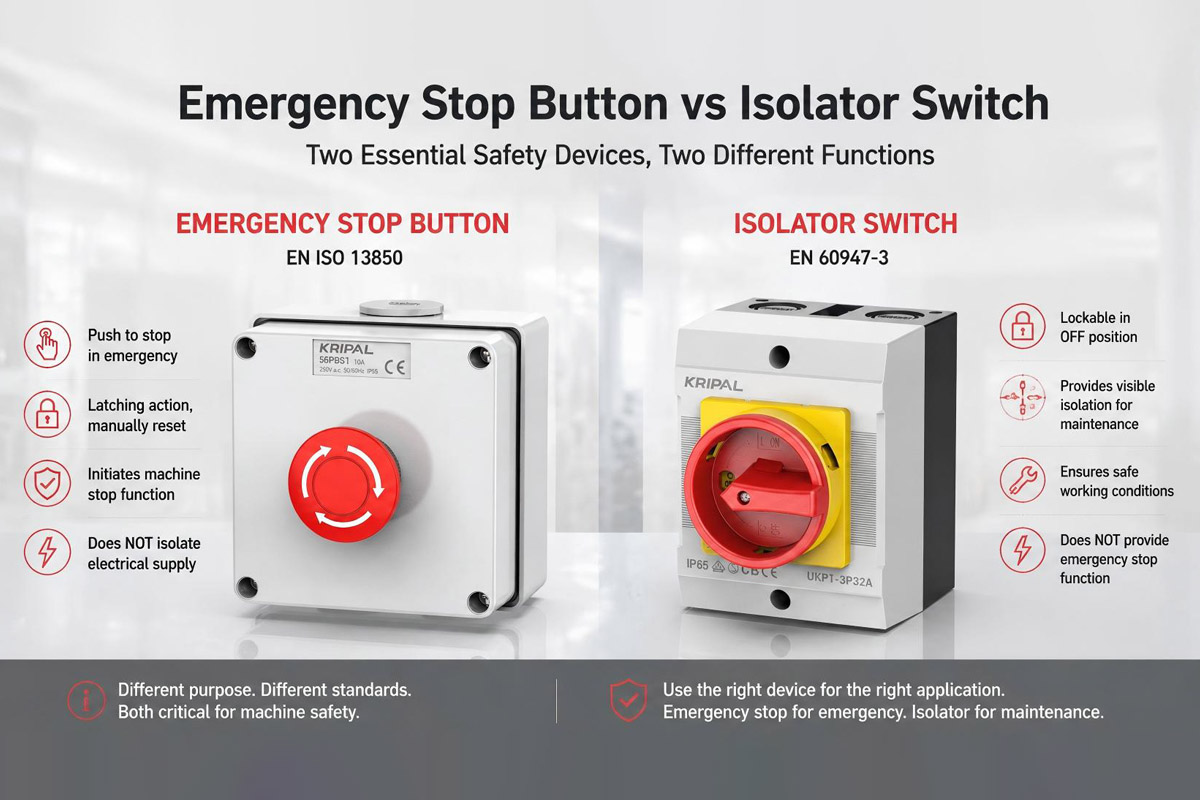
What Is an Emergency Stop Button?
An emergency stop button (also called an E-stop or emergency pushbutton) is a manually operated safety device used to initiate an emergency stop function when a dangerous situation occurs.
According to EN ISO 13850, emergency stop devices must have specific design features, including:
- Red actuator on a yellow background
- Latching operation after activation
- Manual reset before the machine can restart
The emergency stop button does not directly isolate the electrical supply. Instead, it sends a safety stop command to the machine control system, which then removes or controls hazardous motion through devices such as safety relays, contactors, or drives.
After an emergency stop is activated, some electrical parts may still remain energized, including incoming terminals, control circuits, or auxiliary components.
What Is an Isolator Switch?
An isolator switch, also known as a switch disconnector or disconnect switch, is a mechanical switching device designed to safely disconnect electrical circuits.
According to EN 60947-3, an isolator switch provides a reliable isolation function between the power supply and downstream equipment. It is commonly used before maintenance work, allowing technicians to disconnect power and apply lockout-tagout (LOTO) procedures.
Typical features include:
- Manual ON/OFF operation
- Clear switching position indication
- Lockable OFF position
- Suitable utilization categories for different loads
Unlike contactors, isolator switches are not designed for frequent switching operations. Their primary purpose is safe electrical isolation rather than routine control.
Emergency Stop Button vs Isolator Switch: Key Differences
The two devices are complementary, not interchangeable.
| Feature | Emergency Stop Button | Isolator Switch |
|---|---|---|
| Main purpose | Stop hazardous machine operation | Disconnect electrical power |
| Main standard | EN ISO 13850 | EN 60947-3 |
| Operation | Push to activate, manual reset | Rotary ON/OFF operation |
| Safety function | Initiates emergency stop function | Provides electrical isolation |
| Provides electrical isolation | Normally not used for isolation | Designed for padlock locking in OFF position |
| Typical application | Emergency situations during operation | Maintenance and servicing |
| Load switching | Safety control circuits | Power circuits |
Safety Integrity Levels
Emergency stop functions are considered safety-related parts of machine control systems. Their required performance level is determined through machine risk assessment according to EN ISO 12100 and EN ISO 13849-1. Depending on the level of risk, an emergency stop circuit may require safety features such as redundant contacts, safety monitoring, fault detection, and an appropriate Performance Level (PL) to ensure reliable operation under fault conditions.
An isolator switch serves a different purpose. It does not detect hazards or perform automated safety functions. Instead, it provides a reliable means of electrical isolation through manual operation. Its effectiveness depends on correct switching procedures, proper isolation, and compliance with maintenance practices such as lockout-tagout (LOTO).
Functional Difference and Wiring Principle
Although both an emergency stop button and an isolator switch can stop machine operation, they perform different safety functions and operate in different parts of the electrical system.
Emergency Stop Wiring Concept
An emergency stop button is connected to the machine safety control circuit. When the emergency stop is activated, it sends a safety signal to devices such as safety relays, safety controllers, contactors, or motor drives. The control system then removes or controls hazardous motion, allowing the machine to reach a safe state.
A typical emergency stop circuit includes an emergency stop button, a safety relay or safety controller, and switching devices that control the machine movement. However, activating an emergency stop does not necessarily disconnect the incoming power supply, and some electrical circuits may remain energized depending on the machine design.
Isolator Switch Wiring Concept
An isolator switch is installed in the power supply path to provide electrical disconnection between the supply source and downstream equipment. A typical arrangement includes the power supply, isolator switch, circuit protection device, and machine load.
When the isolator switch is turned OFF and locked, the downstream circuit is disconnected from the power supply, allowing maintenance personnel to perform safe isolation procedures after verifying the absence of voltage.
The key difference is that an emergency stop button is designed to stop hazardous machine movement during an emergency, while an isolator switch is designed to provide reliable electrical isolation for maintenance and servicing.
When Should You Use Each Device?
An emergency stop button is used when a machine presents a potential hazard during operation and immediate stopping is required to protect operators or prevent equipment damage. It is commonly applied in machinery such as conveyor systems, robots, press machines, and automated production equipment, where hazardous movement must be stopped quickly in an emergency situation.
An isolator switch is used when safe access to electrical equipment is required for maintenance, repair, inspection, or cleaning. Before working on the equipment, the technician turns the isolator switch to the OFF position, locks it if required, and verifies that the circuit is de-energized to ensure safe working conditions.
Because emergency stop buttons and isolator switches address different safety requirements, many industrial control panels include both devices. The emergency stop provides rapid machine stopping during hazardous situations, while the isolator switch provides reliable electrical disconnection for maintenance activities.
Why Are Emergency Stop Buttons and Isolator Switches Installed Together?
In many industrial control cabinets, the emergency stop button is mounted on the panel door near the isolator handle.
This arrangement provides two separate safety functions:
- The emergency stop allows operators to quickly stop dangerous machine movement.
- The isolator switch allows maintenance personnel to disconnect power safely.
Their physical proximity does not mean they are interchangeable. They are connected to different circuits and designed according to different standards.
KRIPAL Solutions
For emergency stop buttons, KRIPAL recommends pairing its isolator switches with certified e-stop pushbuttons from reputable control component manufacturers to create a complete panel safety solution. The isolator handles power isolation per EN 60947-3, and the e-stop handles emergency stopping per EN 13850. Combining both in a single panel design ensures compliance with both the Machinery Directive and relevant installation standards.
Browse our range of isolator switches for your panel builds, including AC isolator switches for machinery supply disconnection. For complete control panel solutions, see our contactors and relays and the enclosed UKF series waterproof isolating switches.
Frequently Asked Questions
Q: Can I use an isolator switch as an emergency stop?
No. A standard isolator switch is not designed or tested to function as an emergency stop device according to EN ISO 13850. It does not provide the required emergency stop actuator design or safety control function. Only devices specifically designed for emergency switching applications should be used for that purpose.
Q: Can an emergency stop button replace an isolator switch?
No. An emergency stop button initiates a machine stop function but does not provide a reliable isolation function or a lockable OFF position required for maintenance. After an emergency stop is activated, some parts of the electrical system may still remain energized. A dedicated isolator switch is required for safe lockout-tagout procedures.
Q: Does every machine need both an emergency stop and an isolator?
Not necessarily. The requirement depends on the machine design and risk assessment according to EN ISO 12100. However, machinery electrical equipment generally requires a supply disconnecting device according to EN 60204-1. Many industrial machines use both devices because they provide different safety functions.
Q: What color should an isolator switch handle be?
EN 60947-3 does not specify a mandatory handle color for standard isolator switches. The important requirement is that the ON and OFF positions are clearly marked. When used as an emergency switching device, red actuator and yellow background identification may apply according to EN 60204-1.
Q: What is the difference between utilization categories AC-15 and AC-21A?
AC-15 applies to control circuit switching with electromagnetic loads such as contactors, relays, and solenoids. AC-21A applies mainly to resistive and slightly inductive loads under normal conditions, while AC-22A and AC-23A are used for mixed and motor loads. The isolator switch rating must match the actual application.
Q: Can I add a padlock to an emergency stop button for lockout?
Some emergency stop devices may accept padlock accessories, but this does not mean they provide electrical isolation. An emergency stop button is generally not designed or verified to provide isolation according to EN 60947-3. For maintenance safety, a dedicated isolator switch with a lockable OFF position should be used.
Reliable Machine Isolation from KRIPAL
For reliable machine isolation and industrial control panel applications, choose KRIPAL isolator switches designed for safe and dependable electrical disconnection. Tell us your voltage, current, pole configuration, and enclosure requirements and our engineers will recommend a suitable model. You can also contact us directly for technical support.
Related Resources
Explore Knowledge Center >
Need a matching KRIPAL product?
Share voltage, quantity and destination. An engineer will reply with options and lead time.