Search
Knowledge Center
MCB vs RCCB vs Isolator: Differences, Functions, IEC Standards and Real Applications
Learn the key differences between MCBs, RCCBs, and isolators — their functions, IEC standards, real-world applications, and how they work together in modern electrical systems.
 May 27, 2026
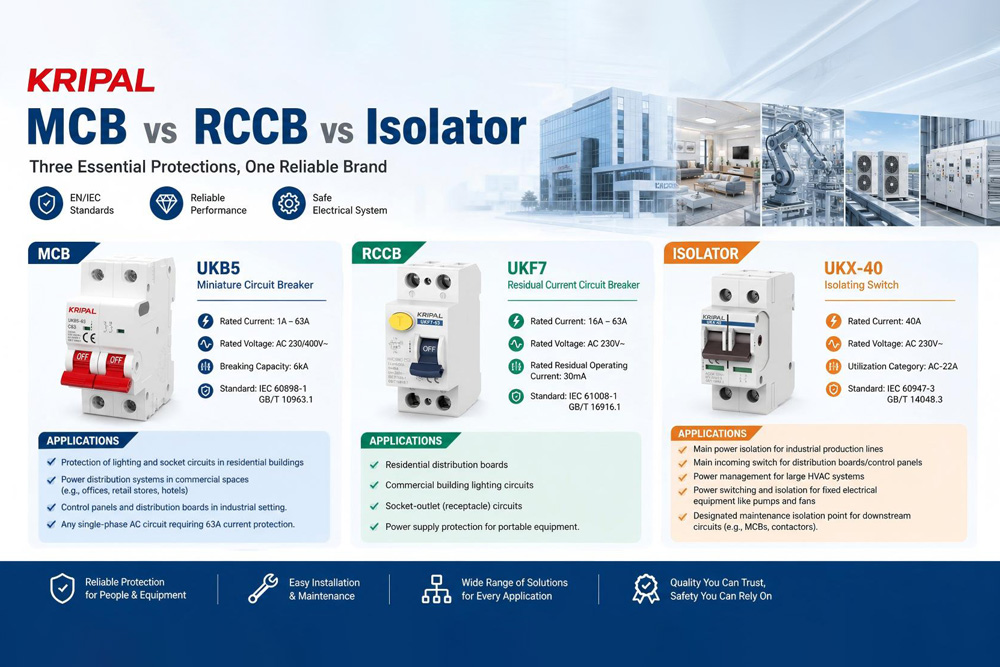
Electrical safety relies on more than just turning power on and off. Modern electrical systems use several protective devices that work together to protect people, equipment, and wiring from different types of faults. Among the most common devices are MCBs, RCCBs, and isolators.
Although they are often installed in the same distribution board, they perform very different functions. Understanding how each device works can help when designing, maintaining, or upgrading an electrical installation.
Key Takeaways
- An MCB protects electrical circuits from overloads and short circuits.
- An RCCB protects people from electric shock caused by earth leakage currents.
- An isolator provides a safe way to disconnect a circuit from the power supply for maintenance and servicing.
- MCBs and RCCBs can trip automatically when a fault occurs, while isolators are operated manually.
- These devices are designed to work together rather than replace one another.
Why Electrical Systems Use Multiple Protection Devices
Electrical faults can occur for many reasons. A circuit may draw too much current, a short circuit may develop due to damaged insulation, or leakage current may flow through an unintended path to earth.
Since different faults require different protection methods, a single device is not designed to provide complete protection. This is why electrical panels often include a combination of MCBs, RCCBs, and isolators. Each device addresses a specific safety concern and contributes to the overall reliability of the installation.
What Is an MCB?
An MCB, or Miniature Circuit Breaker, is a protective device designed to automatically disconnect power when excessive current flows through a circuit.
Two common situations can cause an MCB to trip:
Overload Protection
An overload occurs when too many electrical loads are connected to the same circuit. The current exceeds the circuit’s rated capacity, causing conductors to heat up. If left unchecked, excessive heat can damage insulation and increase the risk of fire.
The thermal mechanism inside an MCB detects this condition and disconnects the circuit.
Short Circuit Protection
A short circuit occurs when live conductors come into direct contact with each other or with a neutral conductor, creating a sudden surge of current.
The magnetic mechanism inside the MCB reacts almost instantly, disconnecting the circuit before significant damage occurs.
Common Applications of MCBs
MCBs are widely used in:
| Application Area | Typical Use |
| Residential Distribution Boards | Protects electrical circuits in homes from overloads and short circuits. |
| Commercial Buildings | Provides circuit protection for retail spaces, schools, and public facilities. |
| Offices | Safeguards power distribution for computers, office equipment, and lighting systems. |
| Small Industrial Installations | Protects machinery, control panels, and low-voltage industrial circuits. |
| Lighting Circuits | Prevents damage caused by overloads or faults in lighting systems. |
| Socket Outlet Circuits | Ensures safe operation of power outlets and connected appliances. |
MCBs are available in various current ratings, allowing them to protect different types of circuits effectively. MCBs used in residential and commercial systems are typically manufactured in compliance with IEC 60898-1 standards, ensuring standardized tripping curves and safety performance.
What Is an RCCB?
An RCCB, or Residual Current Circuit Breaker, is primarily used for protection against electric shock, and may also help reduce the risk of fire caused by earth leakage currents.
Unlike an MCB, an RCCB does not monitor overloads or short circuits. Instead, it continuously compares the current flowing through the live conductor with the current returning through the neutral conductor.
Under normal conditions, these currents are equal.
If some current leaks to earth due to damaged insulation, faulty equipment, or accidental contact with live parts, the balance changes. Once the leakage current exceeds the RCCB’s sensitivity level, the device disconnects the circuit within milliseconds.
How RCCBs Improve Safety
RCCBs provide protection against:
- Electric shock
- Indirect contact with faulty equipment
- Earth leakage faults
- Potential fire hazards caused by leakage currents
Typical sensitivity ratings include 30mA for personal protection and higher ratings for equipment or fire protection applications.
Common Applications of RCCBs
RCCBs are commonly installed in:
| Application Area | Typical Use |
| Residential Homes | Provides protection against electric shock and earth leakage faults in household electrical systems. |
| Commercial Buildings | Enhances electrical safety for employees, customers, and equipment in commercial environments. |
| Industrial Facilities | Helps protect personnel and electrical installations from ground fault hazards. |
| Outdoor Electrical Installations | Improves safety for outdoor circuits exposed to weather and environmental conditions. |
| Wet Environments (Bathrooms and Kitchens) | Reduces the risk of electric shock in areas where water and electricity may come into contact. |
RCCBs are designed according to IEC 61008-1, which defines their sensitivity to residual current and disconnection time requirements for human safety.
What Is an Isolator?
An isolator is a manually operated switching device used to completely disconnect a circuit or piece of equipment from its power source.
Unlike MCBs and RCCBs, an isolator is not designed to detect faults or provide automatic protection. Its primary purpose is safe isolation.
When maintenance, inspection, or repair work needs to be carried out, the isolator provides a physical isolation point and secure disconnection point, ensuring that no electrical current can accidentally reach the equipment.
Why Isolators Are Used
Electrical equipment often requires periodic servicing. Simply switching off an appliance may not provide complete assurance that the circuit is fully disconnected.
An isolator provides a dedicated means of separation from the electrical supply, helping maintenance personnel work safely.
Common Applications of Isolators
| Application Area | Typical Use |
| Air Conditioning Systems | Provides a safe disconnection point for HVAC equipment during maintenance and servicing. |
| Solar Power Systems | Enables safe isolation of solar panels, inverters, and combiner boxes for inspection and emergency shutdown. |
| Industrial Machinery | Allows complete power disconnection of heavy machinery to ensure technician safety during repairs. |
| Motor Control Circuits | Isolates motors and control panels from the power supply for routine maintenance and troubleshooting. |
| Distribution Panels | Serves as the main incoming isolation switch, allowing the entire board to be safely de-energized for work. |
| Generator Installations | Provides visible disconnection between generators and load circuits for safe maintenance and fuel servicing. |
Isolators comply with IEC 60947-3, which governs switching devices used for safe electrical isolation in industrial and commercial installations.
Why Is an Isolator Needed If an MCB and RCCB Are Already Installed?
This is one of the most common questions in electrical installations.
At first glance, it may seem that an MCB or RCCB can simply be switched off whenever maintenance is required. However, their primary purpose is protection rather than isolation.
An MCB is designed to interrupt overload and short-circuit currents. An RCCB is designed to disconnect power during earth leakage faults. While both can be manually operated, they are not always intended to serve as dedicated isolation devices.
An isolator provides a clearly defined disconnection point specifically intended for maintenance and servicing. It allows technicians to verify that equipment has been completely separated from the power supply before work begins.
For this reason, many electrical standards and installation practices recommend using an isolator alongside protective devices rather than relying on MCBs or RCCBs alone.
MCB vs RCCB vs Isolator: Key Differences
| Feature | MCB | RCCB | Isolator |
| Main Function | Overload and short-circuit protection | Earth leakage protection | Safe circuit isolation |
| Automatic Operation | Yes | Yes | No |
| Manual Switching | Yes | Yes | Yes |
| Protects Against Overload | Yes | No | No |
| Protects Against Short Circuit | Yes | No | No |
| Protects Against Electric Shock | No | Yes | No |
| Used for Maintenance Isolation | Limited | Limited | Yes |
| Typical Installation Location | Distribution boards | Distribution boards | Equipment and supply circuits |
How These Devices Work Together
A modern electrical installation often uses all three devices together.
- The MCB protects wiring from excessive current.
- The RCCB monitors leakage currents and protects people from electric shock.
- The isolator provides a safe means of disconnecting equipment for inspection and maintenance.
Because each device addresses a different safety requirement, combining them creates a more complete protection system than using any single device alone.
Choosing the Right Device
Selecting the right device depends on the purpose of the circuit.
- If protection against overloads and short circuits is required, an MCB is typically used.
- If personnel protection against earth leakage currents is required, an RCCB is added.
- If equipment needs to be safely disconnected for maintenance, an isolator should be installed.
In many practical installations, all three devices are used together to achieve both operational safety and maintenance safety.
Conclusion
MCBs, RCCBs, and isolators each serve a distinct role within an electrical system. An MCB protects circuits from overloads and short circuits, an RCCB protects against earth leakage faults and electric shock, and an isolator provides a safe method for disconnecting equipment from the power supply.
Rather than competing devices, they complement one another. Understanding their functions and differences makes it easier to design safer electrical systems and select the appropriate protection for residential, commercial, and industrial applications.
Looking for the right MCB, RCCB, or isolator? Explore our product range and feel free to contact us if you need help choosing the best solution.
Frequently Asked Questions
Q Can an RCCB replace an MCB?
No. An RCCB does not provide overload or short-circuit protection. An MCB is still required to protect the circuit from excessive current.
Q Can an MCB protect against electric shock?
Not directly. An MCB reacts to overcurrent conditions, while electric shock protection is typically provided by an RCCB or RCBO.
Q Can an isolator be used instead of an MCB?
No. An isolator is only designed for manual disconnection and does not provide automatic fault protection.
Q Do all electrical installations require an RCCB?
Many modern electrical standards require RCCB protection for specific circuits, particularly those serving socket outlets, outdoor equipment, and wet areas.
Q Why do solar systems use isolators?
Solar installations often include isolators to allow panels, inverters, and associated equipment to be safely disconnected during maintenance or emergency situations.
Q What happens if there is earth leakage but no RCCB installed?
The fault may remain undetected until it causes equipment damage, electric shock, or other safety issues. An RCCB is designed to detect such leakage currents and disconnect power quickly.
Q Which device should be switched off before maintenance?
The dedicated isolator should generally be used when available, as it is specifically intended to provide safe electrical isolation during maintenance work.
Related Resources
Explore Knowledge Center >
Need a matching KRIPAL product?
Share voltage, quantity and destination. An engineer will reply with options and lead time.