Search
Knowledge Center
How to Wire an RCD (Residual Current Device): Principles, Wiring Guide and Installation Tips
Learn how to wire an RCD correctly: Type AC/A/B selection, RCCB and RCBO wiring rules, common mistakes, and testing methods.
 July 16, 2026
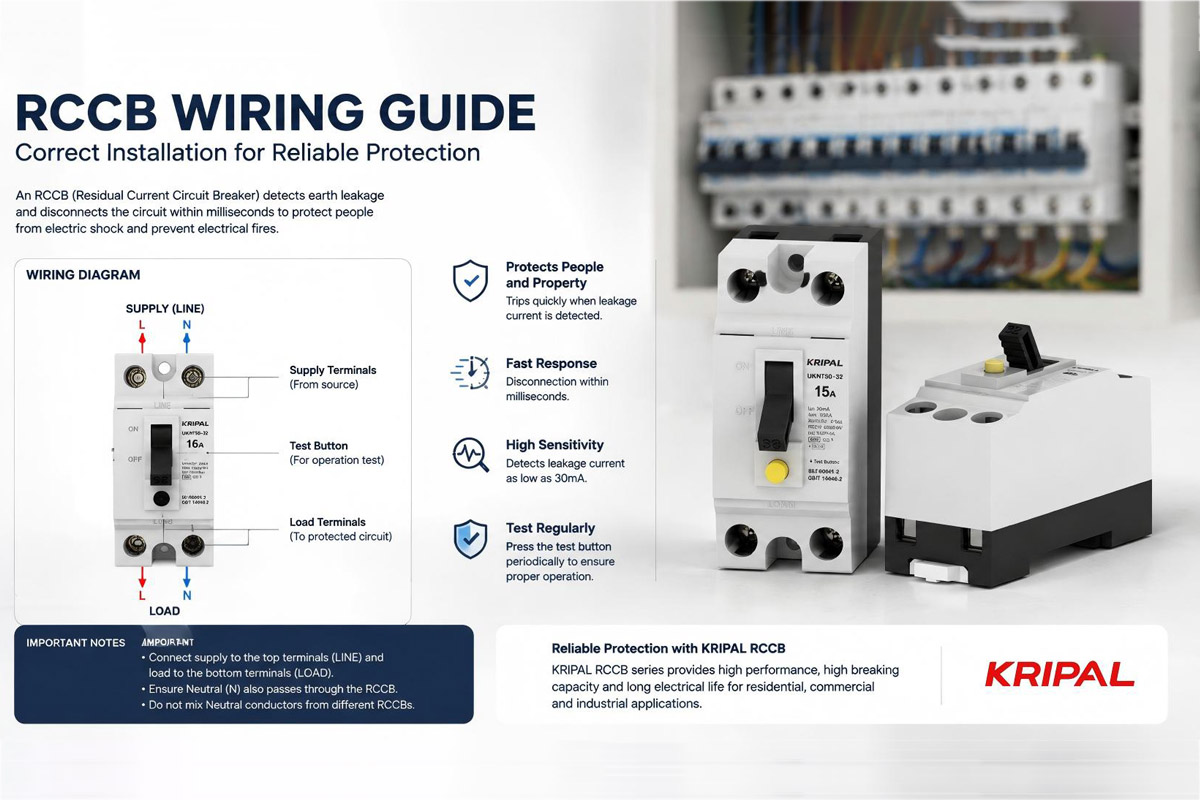
A Residual Current Device (RCD) is one of the most important electrical safety devices used in modern low-voltage installations. Unlike circuit breakers that protect cables and equipment from overloads and short circuits, an RCD is designed to detect dangerous earth leakage currents and quickly disconnect the power supply to reduce the risk of electric shock and electrical fires.
An RCD continuously compares the current flowing through the Line conductor with the current returning through the Neutral conductor. When an imbalance occurs, typically caused by current flowing to earth through a person, damaged insulation, or faulty equipment, the device trips and disconnects the circuit within a very short time.
Correct wiring is essential because the RCD protection function depends on proper current paths through the sensing system. Incorrect connection of Line, Neutral, or load terminals may prevent the device from detecting leakage currents correctly.
This guide explains how RCDs work, the differences between RCD types, correct wiring methods, and key installation considerations.
How Does an RCD Detect Earth Leakage?
Inside every RCD is a sensitive current transformer based on a toroidal magnetic core. The Line and Neutral conductors pass through the center of this core. During normal operation, the current flowing to the electrical load through the Line conductor is equal to the current returning through the Neutral conductor. Because the two currents generate opposite magnetic fields, the magnetic flux inside the toroidal core cancels out.
As a result, the sensing coil detects no residual current and the RCD remains switched on. However, when an earth leakage fault occurs, part of the current no longer returns through the Neutral conductor. Instead, it flows through an alternative path, such as protective earth (PE), a metal enclosure, or a person.
This difference between outgoing and returning current creates residual magnetic flux inside the toroidal core. The sensing coil detects this imbalance and activates the tripping mechanism, disconnecting the circuit.
For additional protection applications, a 30mA RCD is commonly used because this level of residual current can significantly reduce the risk of dangerous electric shock.
RCD Types: Choosing the Correct Residual Current Protection
Not all RCDs detect the same types of leakage currents. With the increasing use of electronic equipment, LED drivers, variable speed drives, and power converters, selecting the correct RCD type has become increasingly important.
Type AC RCD
Type AC RCDs are designed to detect sinusoidal alternating residual currents. They have been widely used in traditional electrical installations for many years and remain suitable for certain applications where only standard AC leakage currents are expected.
However, with the increasing use of modern electronic equipment such as LED drivers, switching power supplies, and other power electronic devices, residual currents containing pulsating DC components may occur. In these situations, a Type AC RCD may not provide the same level of detection capability as newer RCD technologies.
For this reason, many modern electrical installation practices recommend Type A RCDs instead of Type AC devices for general applications where electronic loads are commonly installed.
Type A RCD
Type A RCDs are designed to detect both sinusoidal AC residual currents and pulsating DC residual currents. Compared with Type AC devices, Type A provides improved protection performance for modern electrical installations where electronic components are widely used.
Today, many residential, commercial, and industrial applications include equipment with built-in electronic circuits, such as household appliances, lighting systems, charging equipment, and power control devices. These loads may generate pulsating DC leakage currents under fault conditions, making Type A RCDs a more suitable choice for many general-purpose applications.
When selecting an RCD, the device type should always be matched with the characteristics of the connected equipment and the requirements of applicable electrical standards.
Type B RCD
Type B RCDs provide detection capability for AC residual currents, pulsating DC residual currents, and smooth DC residual currents. They are mainly used in applications where pure DC leakage currents may occur and where conventional Type AC or Type A devices may not provide adequate protection.
Typical applications include electric vehicle charging systems, photovoltaic installations, energy storage systems, and certain industrial equipment such as variable frequency drives. Because the requirements vary depending on the equipment design, the appropriate RCD type should be selected according to the manufacturer’s recommendations and relevant installation standards.
RCD Wiring Guide: Supply and Load Terminals
Most RCDs have clearly marked supply and load terminals.
Typical markings include:
- Supply / Line In
- Load / Line Out
- Neutral terminals
The incoming power supply should be connected according to the manufacturer’s wiring diagram, while outgoing cables supplying the protected circuits should be connected to the load terminals.
Some RCD models are designed for specific connection directions, while others may allow different installation orientations. Therefore, installers should always check the product markings and technical documentation before wiring.
Incorrect terminal connection, especially incorrect Neutral routing, can prevent the RCD from detecting leakage currents properly.
How to Wire an RCBO (Combined RCD and MCB)
An RCBO combines two protection functions in one device:
- Overcurrent protection from an MCB
- Residual current protection from an RCD
Because an RCBO monitors both Line and Neutral current balance, correct Neutral wiring is especially important.
For a typical single-phase RCBO installation:
1. Connect Supply Line
The incoming Line conductor is connected to the RCBO supply terminal according to the manufacturer’s instructions.
2. Connect the Neutral Fly Lead
Many RCBOs include a built-in Neutral fly lead.
This wire must be connected to the main Neutral bar because it provides the reference path required by the internal residual current detection system.
3. Connect Load Line
The outgoing Line conductor supplying the final circuit connects to the RCBO load terminal.
4. Connect Load Neutral
The protected circuit Neutral conductor must connect directly to the RCBO Neutral output terminal.
It should not be connected directly to the main Neutral bar.
If the load Neutral bypasses the RCBO sensing system, the returning current will not pass through the internal transformer, and earth leakage protection will not operate correctly.
Common RCD Installation Mistakes
1. Incorrect Neutral Connection
One of the most common RCBO wiring mistakes is connecting the protected circuit Neutral to the wrong Neutral bar.
This can cause:
- Immediate tripping
- Failure to detect leakage
- Incorrect operation of multiple RCD circuits
2. Mixing Neutral Conductors Between Different RCDs
When several RCDs or RCBOs are installed in the same distribution board, each protected circuit must maintain its own correct Line and Neutral path.
Mixing Neutral conductors between different protection devices can cause unwanted tripping.
3. Selecting the Wrong RCD Type
Using an unsuitable RCD type may reduce protection reliability, especially in installations containing modern electronic equipment.
Always consider the characteristics of the connected load before selecting Type AC, Type A, or Type B protection.
RCD Testing and Maintenance
After installation, the RCD test button should be checked regularly according to local regulations and manufacturer recommendations.
The test button creates an internal simulated leakage current and confirms that the mechanical tripping mechanism operates.
However, the test button alone does not verify:
- Actual trip current
- Trip time
- Complete installation performance
During professional commissioning, an electrical tester should be used to measure RCD trip characteristics and confirm that the device operates within required limits.
For installations requiring multiple levels of protection, coordination should also be considered. Time-delayed Type S RCDs may be used upstream to maintain selectivity, allowing downstream protection devices to clear faults first.
Frequently Asked Questions
What is the difference between an RCD and an RCBO?
An RCD provides residual current protection only, while an RCBO combines residual current protection with overload and short-circuit protection.
Can an RCD protect against overload?
No. An RCD detects earth leakage currents but does not replace an MCB or fuse for overload protection.
Should I choose Type A or Type AC RCD?
For many modern installations containing electronic equipment, Type A is generally recommended because it can detect both AC and pulsating DC residual currents.
Why does my RCD keep tripping?
Frequent tripping may be caused by insulation faults, leakage from connected equipment, incorrect Neutral wiring, or excessive cumulative leakage current.
Conclusion
Correct RCD wiring is essential for reliable electrical protection. Understanding the operating principle of toroidal current detection, selecting the correct RCD type, and following proper Line and Neutral connection methods are key factors in ensuring installation safety.
For modern residential, commercial, and industrial applications, Type A and Type B RCD solutions are increasingly important due to the growth of electronic loads and renewable energy systems.
By applying correct wiring practices and performing proper testing after installation, electricians can ensure that residual current protection works effectively and provides reliable protection for people and electrical systems.
Explore KRIPAL RCD/RCCB and RCBO protection devices, or contact our engineering team for application support.
Related Resources
Explore Knowledge Center >
Need a matching KRIPAL product?
Share voltage, quantity and destination. An engineer will reply with options and lead time.