



Knowledge Center
Mini Contactor vs Standard Contactor: Ratings, Applications and Selection Guide
Guide to selecting mini contactors vs standard contactors: understand AC-1 vs AC-3 ratings, UKC1 series motor capacity (up to 7.5 kW), and panel coordination.
 August 24, 2026
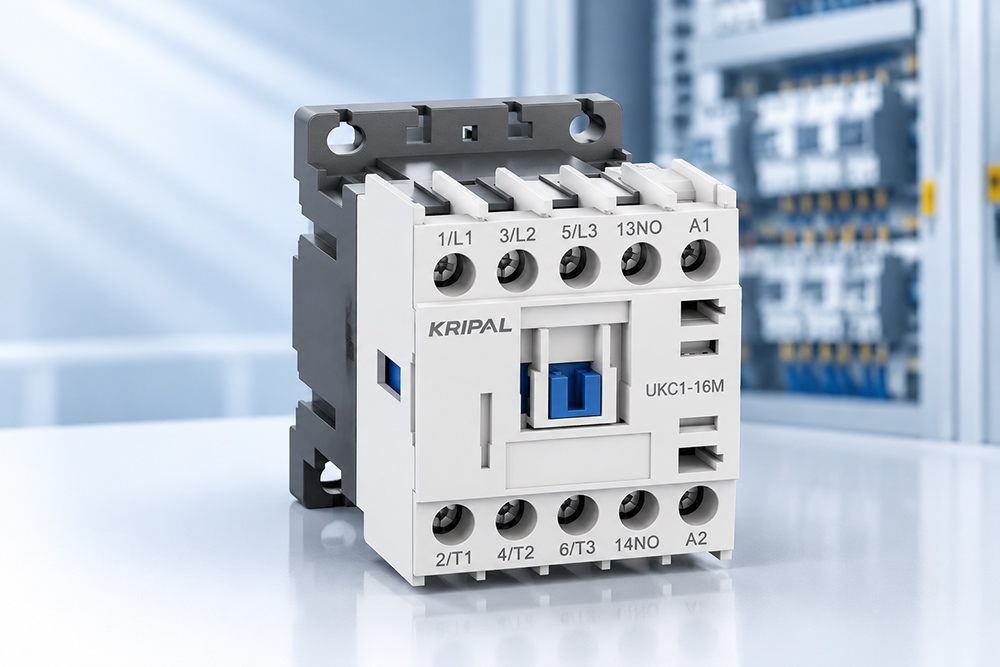
A compact motor control panel does not always need a standard-size industrial contactor. When a machine contains multiple small motors, pumps, fans, or auxiliary loads, mini contactors can help reduce installation space while maintaining the switching performance required by the application.
However, choosing a mini contactor is not simply a matter of selecting a smaller device with a suitable current rating. Its AC-3 operational current, motor power rating, electrical endurance, coil characteristics, and compatibility with overload protection must all be considered.
So, when should engineers choose a mini contactor instead of a standard contactor? This guide explains the differences, key selection criteria, and practical applications, using KRIPAL mini contactors as examples.
What Is a Mini Contactor?
A mini contactor is a compact electromagnetic switching device designed primarily for controlling smaller electrical loads, particularly three-phase motors. It performs the same fundamental switching function as a conventional industrial contactor but uses a more compact frame to reduce the space required inside an electrical control panel.
Mini contactors are commonly used in machine control panels, HVAC equipment, small pump systems, and industrial automation assemblies where multiple motor circuits must fit into limited installation space.
Unlike standard contactors, which cover a broader range of motor ratings and industrial switching applications, mini contactors are generally intended for applications within a more limited operational range. Their suitability must therefore be determined by the manufacturer’s rated values rather than physical dimensions alone.
KRIPAL Mini Contactor Range
KRIPAL offers the UKC1 mini contactor series, with four main AC coil models:
6 A
9 A
12 A
16 A
The corresponding DC coil models are designated UKD1-6M, UKD1-9M, UKD1-12M, and UKD1-16M.
The series provides three main contact poles, auxiliary contact configurations, and AC/DC coil options, making it suitable for compact motor control and switching applications.
The compact frame is particularly useful in control panels containing multiple motor starters, where installation space, wiring accessibility, and accessory compatibility need to be considered together.
Understanding Mini Contactor Ratings: AC-1 vs AC-3
One of the most important considerations when selecting a mini contactor is understanding the difference between its thermal current rating and operational current under a specific utilization category.
A contactor’s current rating cannot be interpreted independently of its application.
AC-1 and AC-3 Ratings
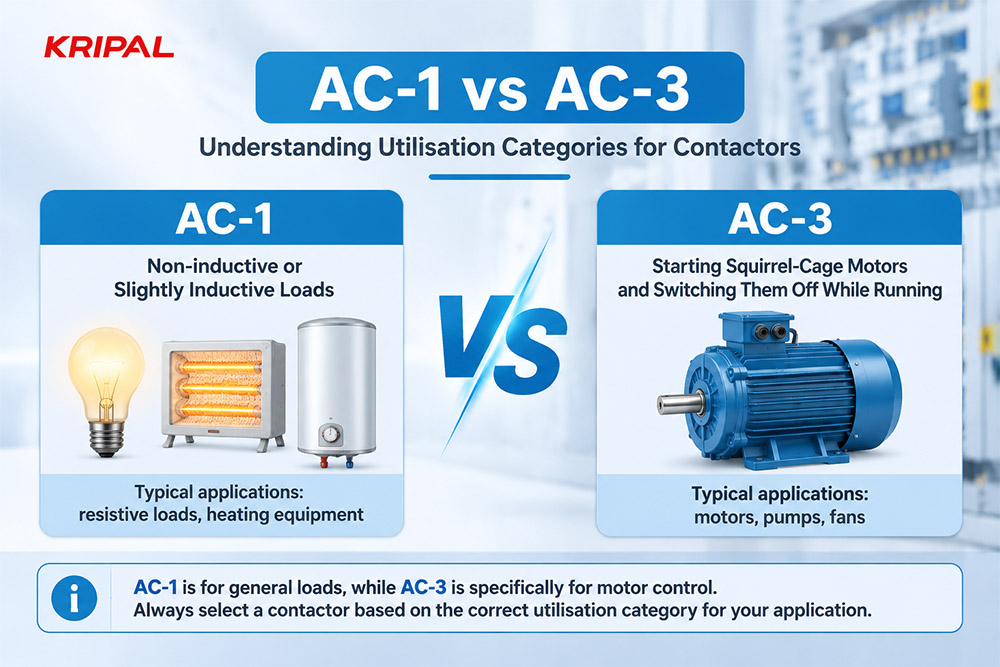
AC-1 applies primarily to non-inductive or slightly inductive loads, while AC-3 is intended for starting squirrel-cage motors and switching them off while running.
Motor starting creates significantly different electrical conditions from switching a resistive load. Consequently, a contactor’s AC-1 current rating should not be used as the sole basis for motor selection.
For example, KRIPAL’s mini contactor range has an AC-1 rating of 20 A, while its AC-3 ratings vary according to the model and operating voltage.
The following table shows the published AC-3 motor ratings at 380–440 V:
| KRIPAL Model | AC-3 Rated Current | Motor Power at 380–440 V |
|---|---|---|
| UKC1-6M | 6 A | 2.2 kW |
| UKC1-9M | 9 A | 4 kW |
| UKC1-12M | 12 A | 5.5 kW |
| UKC1-16M | 16 A | 7.5 kW |
These values demonstrate why engineers should select a contactor according to its AC-3 rating at the actual operating voltage rather than relying on its AC-1 current or thermal current alone.
For applications involving frequent starting, inching, or plugging, the required utilization category must also be checked. AC-3 ratings should not automatically be applied to AC-4 operating conditions.
Example: Selecting a Mini Contactor for a 4 kW Motor
Consider a three-phase motor rated at 4 kW and operating at 400 V.
A practical selection process would include:
1Check the motor’s rated full-load current on its nameplate.
2Confirm that the contactor’s AC-3 rating covers the motor’s operating requirements.
3Verify that the selected contactor is rated for the actual supply voltage.
4Check the starting frequency and expected electrical endurance.
5Confirm compatibility with the thermal overload relay and upstream short-circuit protection.
According to KRIPAL’s catalogue, the UKC1-9M is rated at 4 kW under AC-3 at 380–440 V. It is therefore a relevant candidate for this application, subject to verification of the motor current, operating conditions, and complete starter coordination.
Where Are Mini Contactors Used?
Mini contactors are particularly useful in installations where several relatively small motors or electrical loads need independent switching.
Machine Control Panels
Industrial machinery often contains multiple small motors controlling conveyors, fans, auxiliary pumps, and other mechanical components.
Using compact contactors can help reduce the space occupied by individual motor control circuits. This is particularly valuable in machine control panels with a high number of starters.
KRIPAL UKC1 mini contactors provide 6 A to 16 A AC-3 ratings, covering a range of smaller motor applications.
HVAC and Pump Control Systems
Heating, ventilation, and air-conditioning equipment frequently uses small motors for fans, circulation pumps, and auxiliary equipment. Mini contactors can provide motor switching within compact control enclosures, provided their ratings match the motor load and operating duty.
For pump applications, engineers should also consider starting frequency, motor starting characteristics, and the possibility of frequent switching.
Compact Industrial Automation Systems
Automation panels often require multiple contactors to control independent motors and auxiliary circuits. A compact contactor arrangement can help simplify panel layouts and improve component accessibility. Auxiliary contacts can also support control circuits, electrical interlocking, and status feedback, depending on the available configuration.
Mini Contactor vs Standard Contactor: Key Differences
Mini and standard contactors perform similar switching functions, but their physical dimensions, rating ranges, and accessory configurations can differ significantly.
The correct choice depends on the actual application rather than the assumption that a larger contactor is always better.
| Selection Criterion | Mini Contactor | Standard Contactor |
|---|---|---|
| Physical dimensions | Compact frame | Generally larger frame |
| Motor power range | More limited, series-dependent | Wider range in many product families |
| AC-3 rating | Depends on model | Depends on model |
| Electrical endurance | Manufacturer-specific | Manufacturer-specific |
| Auxiliary contacts | Series-specific options | Often broader accessory options |
| Panel installation | Useful where space is limited | Requires more installation space |
| Typical applications | Small motors and compact panels | Wider industrial motor applications |
A mini contactor is a practical choice when its electrical ratings, switching duty, and accessory configuration meet the application requirements. A standard contactor may be more appropriate when higher motor ratings, more extensive auxiliary contact arrangements, or specific industrial switching requirements are involved.
Importantly, physical frame size alone does not determine electrical endurance. Engineers should compare the manufacturer’s published electrical life data under equivalent operating conditions.
Important Selection Considerations and Limitations
Although mini contactors offer space-saving advantages, several technical factors should be checked before replacing a standard contactor.
Short-Circuit Coordination
A contactor is only one component of a motor starter assembly. Its ability to withstand short-circuit conditions depends on the coordination of the complete combination. Under IEC 60947-4-1, Type 1 and Type 2 coordination describe different levels of performance following a short circuit.
Type 1 coordination allows the starter to require repair or replacement after a short circuit, provided it does not create a danger to people or installations.
Type 2 coordination requires the starter to remain suitable for further service, although limited contact welding that can be separated is permitted.
The contactor, overload relay, and specified short-circuit protective device (SCPD) must therefore be selected as a coordinated combination. Always consult the manufacturer’s tested coordination tables for the applicable operating voltage and prospective short-circuit current. A suitable breaker current rating alone does not establish Type 1 or Type 2 coordination.
Electrical Endurance and Switching Frequency
Electrical endurance is another important consideration, particularly in applications involving frequent motor starting and stopping.
KRIPAL’s catalogue provides the following published performance data for its mini contactor range:
These figures should be interpreted according to the catalogue’s specified test conditions, not as guaranteed service life under every installation condition.
Actual contactor life depends on the utilization category, load characteristics, switching frequency, operating environment, and electrical installation.
For demanding applications, engineers should consult the manufacturer’s endurance curves and verify the expected number of operations.
Auxiliary Contacts and Accessory Compatibility
Auxiliary contacts are used in control circuits for electrical interlocking, signaling, and feedback.
Before selecting a mini contactor, check the available auxiliary contact blocks, their contact arrangements, and mounting positions. KRIPAL’s mini contactor range provides compatible auxiliary accessories, including AU-1M, AU-2M, and AU-4M configurations.
Thermal overload relays are also available for motor protection. The UK-12M series provides different current adjustment ranges, allowing engineers to match the relay to the motor’s rated current. The exact accessory combination should be confirmed against the relevant product model and catalogue.
Coil Voltage Selection
The coil voltage must match the control circuit supply. KRIPAL mini contactors are available with AC and DC coil options. The catalogue also identifies standard, low-loss, and wide-voltage coil configurations. Available AC coil voltages include common control voltages such as 24 V, 110 V, 220–230 V, and 380–400 V, alongside other specified options. DC coil versions are also available in different voltage configurations. Always confirm the exact coil voltage and coil type when ordering. An incorrect coil specification can prevent reliable operation even when the main contact ratings are suitable.
Installation and Panel Design Considerations
A compact contactor can reduce the space required for motor control components, but the complete panel layout still needs to meet electrical and thermal requirements.
DIN Rail and Mounting Arrangement
KRIPAL mini contactors are designed for compact panel installation, with mounting arrangements and dimensions specified in the product catalogue. When arranging several motor starters, allow sufficient space for wiring, accessory installation, maintenance, and heat dissipation.
A well-organized layout should also make it easy to identify individual motor circuits during inspection and troubleshooting.
Terminal and Cable Selection
Cable selection must consider conductor ampacity, installation conditions, protective device coordination, and the conductor cross-section permitted by the contactor terminals. The selected cable must be compatible with the terminal design and installation instructions. Correct conductor preparation, stripping length, and tightening torque are essential for maintaining reliable electrical connections. If the required conductor size exceeds the terminal’s approved capacity, an appropriate connection arrangement or a different contactor model should be considered.
Spare Parts and Maintenance
When a control panel contains many compact motor starters, standardizing contactor models and accessories can simplify maintenance and spare parts management.
Using compatible auxiliary blocks and overload relays across the panel can also reduce replacement complexity.
However, replacement devices must always be checked for electrical ratings, dimensions, coil voltage, and accessory compatibility rather than selected by appearance alone.
How KRIPAL Supports Compact Motor Control Applications
KRIPAL provides mini contactor solutions for compact motor control applications, including the UKC1 series with AC-3 ratings from 6 A to 16 A.
The product range includes AC and DC coil options, reversing mini contactors, auxiliary contact accessories, and compatible thermal overload relays.
For machine builders, panel manufacturers, and electrical equipment distributors, these components offer flexibility when designing compact motor starter assemblies.
By selecting the appropriate contactor rating, coil configuration, and motor protection accessories, engineers can develop space-efficient control panels without compromising the electrical requirements of the application.
Explore the KRIPAL contactor range to find a suitable configuration for your motor control project, or contact our engineering team for complete starter coordination charts and technical drawings.
Frequently Asked Questions
What is the difference between a mini contactor and a standard contactor?
The main difference is the physical frame size and the product-specific rating and accessory range. Mini contactors are designed for compact applications, while standard contactors generally cover a wider range of industrial motor ratings.
Can a mini contactor control a three-phase motor?
Yes. A mini contactor can control a three-phase motor when its AC-3 operational current and motor power rating are suitable for the motor and supply voltage.
What is the AC-3 rating of a KRIPAL mini contactor?
KRIPAL UKC1 mini contactors are available in 6 A, 9 A, 12 A, and 16 A AC-3 ratings. At 380–440 V, their corresponding motor power ratings are 2.2 kW, 4 kW, 5.5 kW, and 7.5 kW.
Can a mini contactor be used with a thermal overload relay?
Yes. Compatible thermal overload relays can be used to provide motor overload protection. The relay’s adjustable current range must match the motor’s rated current, and the complete starter combination must be correctly coordinated.
Are KRIPAL mini contactors available with DC coils?
Yes. The UKD1 mini contactor series provides DC coil versions alongside the AC coil UKC1 series. The required coil voltage should be confirmed when selecting the product.
When should I choose a standard contactor instead?
Choose a standard contactor when the motor exceeds the mini contactor’s published ratings, when the application requires a different switching duty, or when the required accessories and coordination arrangements are not available for the mini series.
Related Resources
Explore Knowledge Center >
Need a matching KRIPAL product?
Share voltage, quantity and destination. An engineer will reply with options and lead time.
