



Knowledge Center
High Altitude Effects on Electrical Switching and Protective Devices
Learn how high altitude affects low-voltage circuit breakers, DC isolators, insulation, and cooling. Selection guide for solar PV and industrial panels.
 August 15, 2026
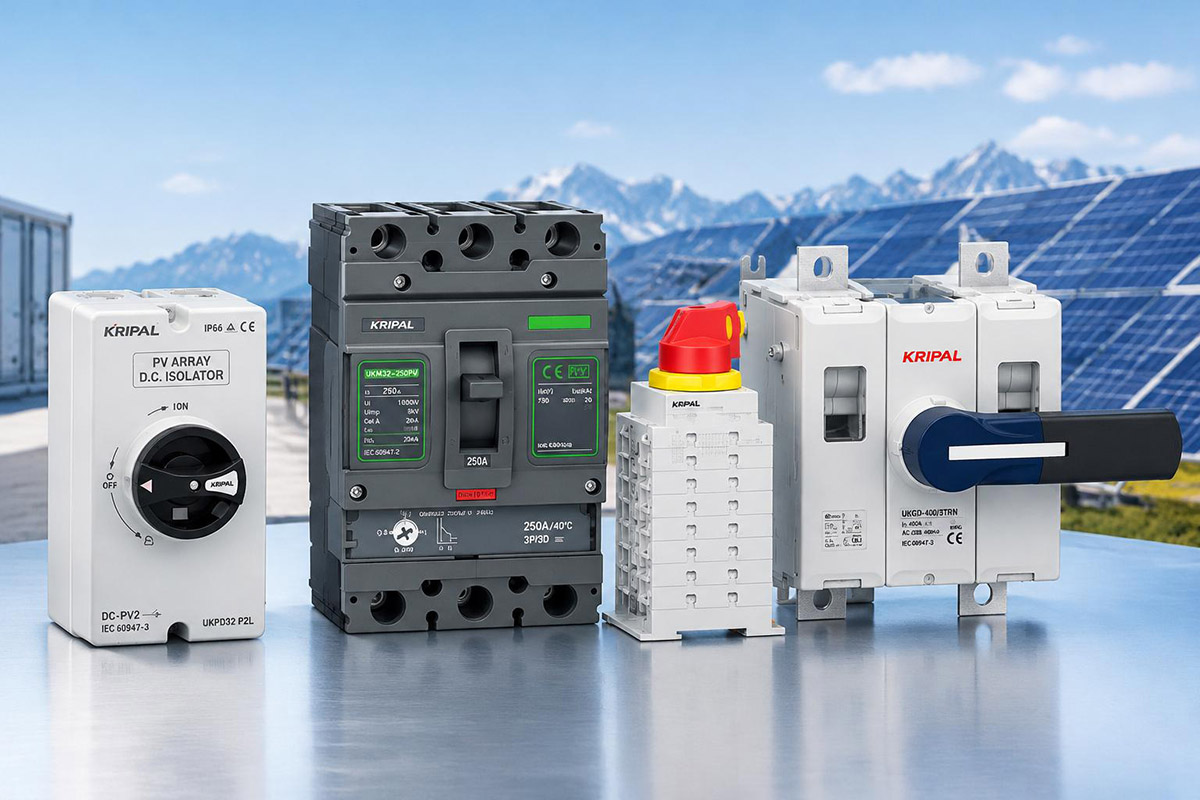
A device rated for 1,000 V under standard operating conditions cannot automatically be assumed to retain the same performance at 3,000 meters above sea level. As altitude increases, air density decreases, potentially affecting insulation performance, heat dissipation, and the behavior of arcs inside electrical switching devices.
For low-voltage circuit breakers, DC isolators, and other protective devices, these effects can influence the selection of rated voltage, continuous current, and short-circuit performance. The extent of the change depends on the product design and the manufacturer’s specified operating conditions.
This guide explains which electrical characteristics may require altitude correction, where high-altitude installations create particular challenges, and what to verify before specifying switching and protective devices for a plateau or mountain project.
Why Altitude Changes Electrical Behavior
Altitude affects electrical equipment primarily through changes in air pressure and density. Many industrial low-voltage devices are designed for operation up to 2,000 meters under specified conditions. Above this reference altitude, one or more ratings may require correction, depending on the product and the manufacturer’s technical documentation.
Insulation Strength and Electrical Clearance
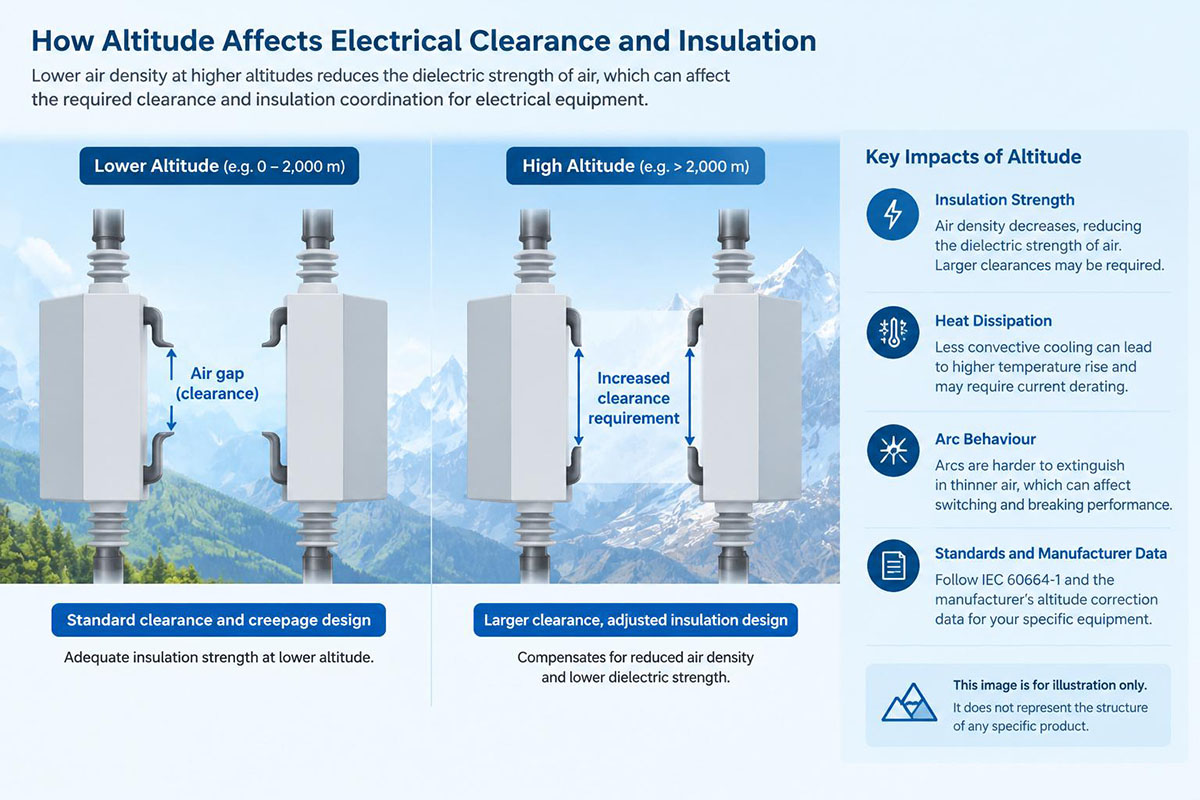
As air density decreases, the dielectric performance of an air gap can change. A clearance that provides adequate insulation at a lower altitude may not provide the same withstand capability at a higher altitude.
The relevant parameters include rated operational voltage, rated insulation voltage, rated impulse withstand voltage, and the clearances within the equipment. Their relationships are governed by the device design and the applicable insulation-coordination requirements.
Clearance and creepage distance must not be treated as interchangeable. Clearance is the shortest distance through air between conductive parts, whereas creepage is the shortest path along an insulating surface. Air-density changes directly affect the assessment of air clearances; creepage requirements also depend on factors such as insulation material, pollution conditions, and the applicable product standard.
For this reason, altitude assessment should follow the relevant standards and the manufacturer’s instructions rather than applying one correction factor to every insulation parameter.
Heat Dissipation and Continuous Current
Electrical devices generate heat during normal operation. The heat must be transferred from conductors, terminals, and internal components to the surrounding environment.
At higher altitudes, reduced air density can affect convective heat transfer. Depending on the equipment design and installation conditions, this may increase temperature rise and require a reduction in continuous current.
The required correction is not necessarily the same for every device. It can depend on ambient temperature, enclosure ventilation, terminal connections, mounting arrangements, and the manufacturer’s thermal test data.
When specifying equipment for a high-altitude installation, verify both the permitted ambient temperature and any altitude-related current correction. Do not assume that a correction published for one product family applies to another.
Arc Behavior and Short-Circuit Performance
When switching or interrupting current, electrical contacts may produce an arc. The design of the contact system, arc chute, and other arc-control features determines how the device manages this event.
Reduced air density can influence arc behavior in air-based switching devices. However, the effect on short-circuit breaking capacity is product-specific. Some devices may require a correction, while others may retain their published breaking capacity within a specified altitude range.
Short-circuit breaking capacity must therefore be verified separately from continuous current and insulation ratings. It should not be assumed to decrease by the same percentage as either of those parameters.
Which Electrical Ratings May Change?
Not every published figure responds to altitude in the same way. Applying one general derating factor to all parameters can lead to an unnecessarily expensive selection or an unsafe one.
| Published Parameter | Potential Effect of Altitude | What to Verify |
|---|---|---|
| Rated operational voltage | May require correction or restriction | Permitted operating voltage at the installation altitude |
| Rated insulation voltage & impulse withstand | Insulation coordination may require adjustment | Manufacturer’s insulation data and applicable standard |
| Clearance requirements | May need to increase | Applicable altitude correction and product construction |
| Creepage distance | Depends on insulation design and environmental conditions | Material, pollution conditions, and product-standard requirements |
| Continuous current rating | May require derating | Manufacturer’s current correction and temperature limits |
| Short-circuit breaking capacity | Product-specific; may or may not require correction | Published breaking capacity at the relevant altitude and voltage |
| Operating ambient temperature | Product-specific | Permitted temperature range and combined derating requirements |
| IP rating | Not directly changed by altitude alone | Original ingress-protection rating and actual environmental exposure |
An IP rating describes protection against access to hazardous parts and the ingress of solid foreign objects and water under specified test conditions. It does not establish suitability for every high-altitude environment, nor does it confirm resistance to low pressure, condensation, temperature cycling, or other environmental stresses.
The Altitude Threshold That Applies
An altitude of 2,000 meters is a common reference point in low-voltage equipment specifications and insulation-coordination guidance. It is not a universal guarantee that every device requires no correction below that altitude or that every device requires the same correction above it.
The applicable limit depends on the product standard, equipment design, and published operating conditions. A device intended for operation at 1,500 meters may require no altitude-specific correction if the installation remains within all its specified conditions, but this should be confirmed against the relevant product documentation.
Above the manufacturer’s stated reference altitude, check the voltage-related and current-related requirements separately. Also verify whether short-circuit performance, ambient temperature limits, or other characteristics have specific restrictions.
Requesting a single overall derating percentage is rarely the best starting point. A more useful specification identifies the installation altitude and asks the manufacturer to confirm the applicable ratings for the exact device and operating conditions.
Where High-Altitude Installations Appear
High-altitude electrical installations are not limited to mountain research facilities. Mining, renewable energy, telecommunications, and industrial infrastructure projects may all require equipment to operate above the standard reference altitude. Design considerations differ by application:
Mining and Quarrying
Mines and quarries may use conventional low-voltage switchgear in locations where reduced air density affects equipment performance. Electrical rooms can provide a more controlled environment, but ordinary heating or air conditioning does not restore atmospheric pressure to sea-level conditions.
Where switchgear operates in an unpressurized building or enclosure, the equipment must be assessed against the actual operating altitude and ambient conditions. The review should include insulation coordination, continuous current, short-circuit ratings, and any relevant temperature limitations.
Solar Farms on Plateaus
Photovoltaic installations at high altitude require particular attention to both system voltage and equipment insulation.
Low module temperatures can increase the open-circuit voltage of a PV string. The maximum string voltage must therefore be calculated using the module manufacturer’s temperature data and the project’s minimum design temperature.
At the same time, reduced air density may affect the insulation performance of switching and protective devices. These are separate design considerations that must be checked together. A system voltage that is acceptable for the PV modules does not automatically establish that every connected DC breaker, fuse holder, or isolator is suitable for the installation altitude.
For a system using equipment rated up to 1,500 V DC, confirm the device’s permitted operating voltage at the actual altitude, together with its insulation characteristics and switching or interruption ratings. Explore KRIPAL’s DC protection devices for solar PV systems to identify relevant product families.
| Installation Type | Main Consideration | First Check |
|---|---|---|
| Industrial control panel at altitude | Insulation and heat dissipation | Voltage-related requirements and continuous current |
| Mine or quarry | Switchgear operating conditions | Insulation, temperature, and short-circuit performance |
| Plateau PV installation | Maximum cold-weather string voltage & suitability | Maximum system voltage and altitude-specific product data |
| Telecom or relay station | Continuous operation & limited maintenance access | Current rating, temperature rise, and manufacturer limits |
| Battery energy storage system | DC voltage, fault current, and switching conditions | DC device ratings, interruption capability, and altitude limits |
Specifying Equipment for a High-Altitude Site
The specification process should begin with the conditions at the actual equipment location, not simply the elevation of the project entrance or surrounding region.
Where equipment is installed in a pressure-controlled enclosure, internal operating conditions may differ from those outdoors. However, the effect should only be credited where the enclosure and its pressure-control system are specifically designed and verified for that purpose.
Asking the Right Questions
When contacting a supplier, provide the information needed to assess the complete application:
- Installation altitude in meters above sea level.
- System voltage and maximum expected operating voltage.
- Maximum continuous load current and expected ambient temperature.
- Prospective short-circuit current and required breaking capacity.
- Device type, exact model, pole configuration, and installation arrangement.
- For PV systems, the calculated maximum string voltage at minimum design temperature.
- For battery systems, DC fault conditions and required switching or isolation functions.
Ask the supplier to confirm which published ratings remain valid, which require correction, and whether any operating restrictions apply at the stated altitude.
A useful response should identify relevant product documentation and provide corrected ratings or applicable limits where manufacturer data are available. A general statement that a device is suitable for high altitude is not enough for a technically defensible specification.
Alternatives to Derating
If a device cannot meet project requirements after applicable corrections, several options may be considered. A higher-rated device may provide the required voltage or current margin, provided that its actual switching, interruption, and insulation ratings are suitable. A different device design may also be appropriate if its published altitude limits better match the installation.
For large installations, an engineered environmental solution may be evaluated where technically and economically justified. A standard air-conditioned room should not be assumed to eliminate altitude effects because cooling alone does not restore atmospheric pressure.
The final choice should be based on verified equipment performance, installation requirements, available panel space, and total project cost.
KRIPAL Equipment for High-Altitude Applications
KRIPAL low-voltage switching and protection products can be considered for suitable industrial, photovoltaic, and battery energy storage applications. However, suitability for a high-altitude installation must be established for the specific product and its operating conditions.
DC Molded Case Circuit Breakers
When evaluating a DC molded case circuit breaker for a high-altitude PV or battery application, confirm its rated operational voltage, pole configuration, continuous current, short-circuit breaking capacity, and permitted operating altitude.
For suitable applications, review the KRIPAL UKM32PV DC molded case circuit breaker and verify ratings for the exact pole configuration and operating conditions.
For multi-pole DC devices, the permitted voltage and switching arrangement must follow the manufacturer’s wiring diagrams and technical documentation. Ratings published for one pole configuration must not automatically be applied to another.
DC Switch Disconnectors
A DC switch disconnector serves a different function from a circuit breaker. Its suitability depends on the required isolation and switching duty, rated operational voltage, utilization category, and applicable current ratings.
For photovoltaic applications, verify the manufacturer’s stated DC utilization category and permitted switching arrangement. Also confirm altitude limits and any restrictions on insulation or operational voltage.
A published short-time withstand current, where specified, describes a particular withstand condition. It should not be confused with rated operational current or the device’s ability to interrupt fault current.
For both DC circuit breakers and DC switch disconnectors, use the current KRIPAL product datasheet and applicable certification documents to establish final selections. Do not infer altitude suitability solely from nominal voltage or current printed on the product.
The broader coordination of circuit breakers, isolators, and fuses in battery energy storage systems is covered in our guide to DC protection for battery energy storage systems.
Securing Your System Against High-Altitude Conditions
High-altitude installations require a coordinated review of insulation, thermal performance, and switching or interruption capability. Relevant corrections are product-specific, and no single factor should be applied indiscriminately to every electrical rating.
Before finalizing a design, establish operating conditions at the equipment location, calculate the system’s maximum operating voltage where applicable, and request manufacturer data for the exact device and altitude.
For PV and battery energy storage projects, verify the DC switching arrangement, short-circuit requirements, and coordination between protective devices. A product selected solely from its standard voltage and current ratings has not necessarily been verified for the complete installation conditions.
Frequently Asked Questions
As altitude increases, air pressure and air density decrease. Lower air density reduces the dielectric strength of air gaps (affecting insulation clearance) and reduces convective cooling capability (affecting heat dissipation and continuous current ratings).
An altitude of 2,000 meters above sea level is the common standard reference threshold in IEC standards. Operating above 2,000 meters typically requires verifying insulation coordination, continuous current ratings, and voltage limits.
No. Ordinary air conditioning controls ambient temperature but does not restore atmospheric air pressure. Unless the enclosure or room is specifically pressure-sealed and pressurized, air-density effects on insulation and arc extinction still apply.
Cold high-altitude environments increase PV module open-circuit voltage, while reduced air density decreases the insulation withstand voltage of switching devices. Both factors must be evaluated together when specifying 1,000 V or 1,500 V DC equipment.
Need Technical Selection Support for High-Altitude Electrical Projects?
Related Resources
Explore Knowledge Center >
Need a matching KRIPAL product?
Share voltage, quantity and destination. An engineer will reply with options and lead time.
