Search
Knowledge Center
Which Certification Do You Need: UL, CE, or IEC? An Exporters Guide
Compare UL, CE, IEC, UKCA, and RCM requirements by market. Learn what each mark means and how to verify a supplier’s electrical certifications.
 July 18, 2026
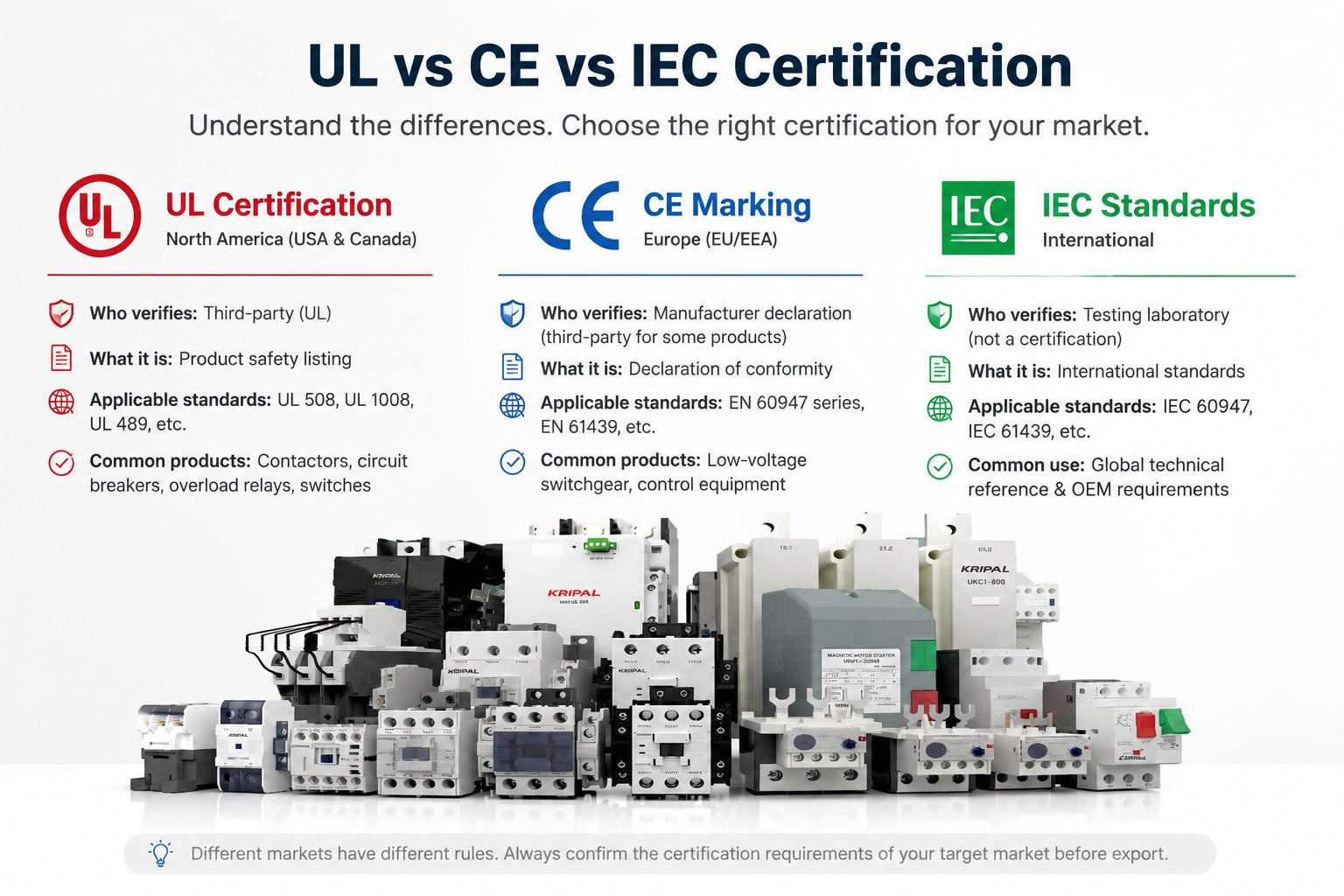
The Three Marks
Certification marks are often used interchangeably, but they mean very different things.
UL is a product safety certification for the North American market, performed by an independent testing laboratory.
CE is a conformity declaration for the European market, based on harmonized standards and self-declaration.
IEC is a set of international standards, not a certification in itself, that national systems adopt and enforce.
The common thread is that none of them means “the product is good.” They mean “the product was tested or declared against a specific set of requirements.” The difference is who does the verifying, and that is the detail that catches importers.
UL: The North American Safety Mark
UL, or Underwriters Laboratories, is a Nationally Recognized Testing Laboratory in the United States. A UL-listed product has been tested by an independent lab against UL standards. The manufacturer then operates under a follow-up inspection program, where the lab audits production periodically to confirm the product still matches the tested design. That ongoing audit is what separates a UL listing from a one-off test report.
Why UL Requires Third-Party Testing
The standard that applies depends on the product family. Contactors are covered by UL 508. Transfer switches by UL 1008. Circuit breakers by UL 489. When you see a UL mark on a product like our UL-listed UKC1 contactors or UKH thermal overload relays, the file number on the label can be looked up in UL’s online database. The lookup confirms the listing is active and covers the specific model range.
The Cost and Timeline of UL Certification
For exporters, the practical questions are cost and time. A UL certification project for a new product typically runs three to six months, depending on how much testing the standard requires and how prepared the manufacturer is. The cost covers the sample testing, the technical review, and the ongoing follow-up inspection fees, which are annual. It is not a one-time payment, and it is tied to the factory address. Moving or adding a production facility requires formal UL notification, a factory audit, and a documentation update; unreported production at a new site invalidates the listing.
The alternative for small exporters is often a partnership with a manufacturer who already holds the listing. That is why you will see established suppliers advertise UL-listed ranges rather than offering to certify anything from scratch. The listing already exists; you are buying into it by sourcing that product line.
For exporters, the important detail is that UL certification is tied to the manufacturer and the production facility. You cannot self-certify to UL. You cannot claim a UL listing without the testing and the follow-up program. If a supplier claims UL but cannot produce a file number, or the number comes back to a different facility, treat the claim as marketing rather than certification.
CE: The European Conformity Mark
CE marking is different in a way that surprises many buyers. It is not awarded by a testing body. The manufacturer declares conformity with the applicable European directives and harmonized standards, affixes the CE mark, and carries legal responsibility for the declaration. For low-voltage equipment, the relevant directive is the Low Voltage Directive (2014/35/EU), and the harmonized standards are the EN versions of the IEC standards, such as EN 60947 for switching devices. The EMC Directive (2014/30/EU) also applies. The RoHS Directive is also legally required for most electrical equipment sold within the EU.
Self-Declaration vs Notified Body
Some product categories require a notified body, a third-party assessment, before CE marking is permitted. This applies mainly to medical devices, machinery with specific hazards, and other regulated categories. Most low-voltage switchgear falls under self-declaration, but the manufacturer must hold the technical documentation proving compliance. A national authority can demand to see that file at any time.
Important note for non-EU manufacturers: you must appoint an EU-based Authorized Representative to fulfill regulatory obligations, including providing market authorities access to your technical documentation.
What Goes into the Technical File
The technical file behind a CE declaration is not optional paperwork. It typically contains the product description, the drawings, the list of harmonized standards applied, the test reports, and the risk assessment. For a switch or contactor, the file usually runs tens of pages, and it has to be kept for at least ten years after the last unit is placed on the market.
The practical implication for importers is that a CE mark is only as good as the documentation behind it. Ask for the Declaration of Conformity and the test reports before you commit. A CE-marked product from a supplier who cannot produce the technical file is a compliance risk, not compliance proof. The liability for placing a non-compliant product on the EU market sits with the importer, not the factory.
IEC: The Standards Layer Under Everything
IEC standards are international specifications published by the International Electrotechnical Commission. They are not a certification mark on the product. They are the technical requirements that national certification systems adopt and adapt.
How IEC Becomes National Law
The pattern is consistent around the world. The United States adopts many IEC standards with national deviations into UL and other US standards. Europe adopts them as EN standards for CE purposes. Australia and New Zealand adopt them as AS/NZS standards. India, the Middle East, and much of Asia adopt them with national annexes.
So when someone says IEC-certified, they usually mean tested to IEC standards. Whether that test is accepted depends on the destination country and whether its national system recognizes the report. An IEC test report from a recognized laboratory carries weight in technical reviews everywhere. It is not a substitute for the national mark where one is required.
When an IEC Report Is Enough
There is one situation where an IEC report genuinely is enough: when the buyer is an OEM who will integrate the component into their own certified product. A control panel builder in Germany can accept an IEC 60947-4-1 test report for a contactor and certify the panel as a whole under the Machinery Directive. The component does not need its own national mark because it is covered by the panel’s assessment. This is common practice in the industrial control market, and it is why IEC reports remain commercially valuable even where they are not a legal substitute for a mark.
Certification by Destination Market
| Destination | Primary Mark | Governing Standard | Notes |
|---|---|---|---|
| United States | UL | UL 508 / UL 489 / UL 1008 | Lab tested, follow-up inspection |
| Canada | CSA or UL-C | CSA C22.2 / UL | Interchangeable in many cases |
| European Union | CE | EN 60947 + LVD/EMC | Self-declaration plus technical file |
| United Kingdom | UKCA | BS EN 60947 | UKCA required for new designs |
| Australia / New Zealand | RCM | AS/NZS 60947 | Electrical safety + EMC registration |
| Middle East | Varies by country, IEC reports widely accepted | IEC 60947 national adoptions | Gulf states often accept IEC reports with local approval |
The Middle East row is worth emphasis for exporters. The GCC countries frequently accept IEC test reports from recognized laboratories for low-voltage equipment, which shortens the approval cycle significantly. The same report will not clear the US border, where UL remains the practical requirement for most switchgear.
How to Verify a Supplier’s Certification
Certification claims are easy to print and hard to verify, but the verification itself takes minutes once you know what to ask for. We run this same check on our own suppliers, and it is the process we recommend to any buyer of electrical components.
The Five-Step Verification Process
Ask for the certificate and check the manufacturer name, the facility address, the product model range, and the expiration date. The name on the certificate must match the factory you are buying from.
Look up the file number in the issuing body’s database. UL’s online certification directory accepts the file number and shows the active listing, the facility, and the product categories covered.
Compare the listed models with the products you are buying. A certificate covering contactors that does not list your specific model range does not cover your product.
Ask for the test report, not just the certificate. The report shows the tested parameters, which matters for products like transfer switches where the tested breaking capacity defines the safe application.
Confirm the factory doing the follow-up inspection matches the factory on the certificate. A UL listing from factory A does not cover a product made in factory B. This mismatch is the most common fraud pattern in certification claims.
Red Flags That Should Stop the Order
Beyond the five steps, there are patterns that should end the conversation immediately. A supplier who sends a certificate image with the file number blacked out is hiding something. A certificate that lists models but no test report, and cannot explain why, is a claim without evidence. A supplier who says the listing is pending and will arrive with the shipment is asking you to pay for hope. And a supplier who offers to print any certification you want on the product for a small fee is selling counterfeit products, which will be seized at customs and can land you in legal trouble in both the origin and destination countries.
We publish our certificates and test reports for the UL-listed contactor and relay ranges, and we can share the technical documentation behind the CE declarations on request. That transparency is standard practice at KRIPAL, and it is what you should expect from any supplier.
FAQ
Is CE certification accepted in the United States?
No. CE is a European conformity mark. The US market requires UL or another NRTL listing for most electrical equipment, and a CE mark alone will not satisfy US inspectors.
Can I sell IEC-tested products in the European Union?
IEC test reports support CE self-declaration when the standards are harmonized as EN versions. The CE mark itself must be applied through the EU conformity process. The IEC report is evidence for the file, not a substitute for the mark.
What is the difference between UL listed and UL recognized?
UL listed applies to complete products evaluated for their end use. UL recognized applies to components intended for use inside another product. A relay that is UL recognized for use in a control panel is not automatically a listed product for standalone sale.
Does a CE mark require third-party testing?
For most low-voltage switchgear, no. The manufacturer self-declares conformity and holds the technical file. Some product categories require notified body involvement, so confirm the category before assuming self-declaration applies.
How do I verify a UL file number?
Use UL’s online certification directory. Search by the file number or manufacturer name, and confirm the listing is active and the facility matches your supplier. The file number is printed on the product label.
What certification do I need to export electrical components to Australia?
The RCM mark, covering electrical safety and EMC compliance, based on AS/NZS versions of the IEC standards. Level 3 equipment needs certification by a recognized body. Level 2 and Level 1 equipment can be self-declared with the right documentation.
How long does UL certification take?
Typically three to six months for a new product, including sample testing, technical review, and the first follow-up inspection. The timeline depends on the product standard and how ready the manufacturer is.
Summary
The certification you need depends on the destination market, the product category, and the verification model each market uses. UL for North America. CE for Europe. RCM for Australia. IEC test reports as the supporting layer everywhere else, and as a complete solution when you are selling components to an OEM. Ask your supplier for the certificate, the file number, and the test report, and verify them in the issuing body’s database before you order. We do the same on our side at KRIPAL, and we can provide the documentation for our UL-listed contactors and CE-declared switchgear on request. Contact us with your target markets, and we will confirm what your product needs.
Related Resources
Explore Knowledge Center >
Need a matching KRIPAL product?
Share voltage, quantity and destination. An engineer will reply with options and lead time.