Search
Knowledge Center
Motor Protection Circuit Breaker (MPCB) Selection Guide vs. Traditional Starters
How to select a Motor Protection Circuit Breaker: MPCB vs traditional starters, IEC 60947-4-1 Type 1 and Type 2 coordination, thermal and magnetic settings.
 July 11, 2026
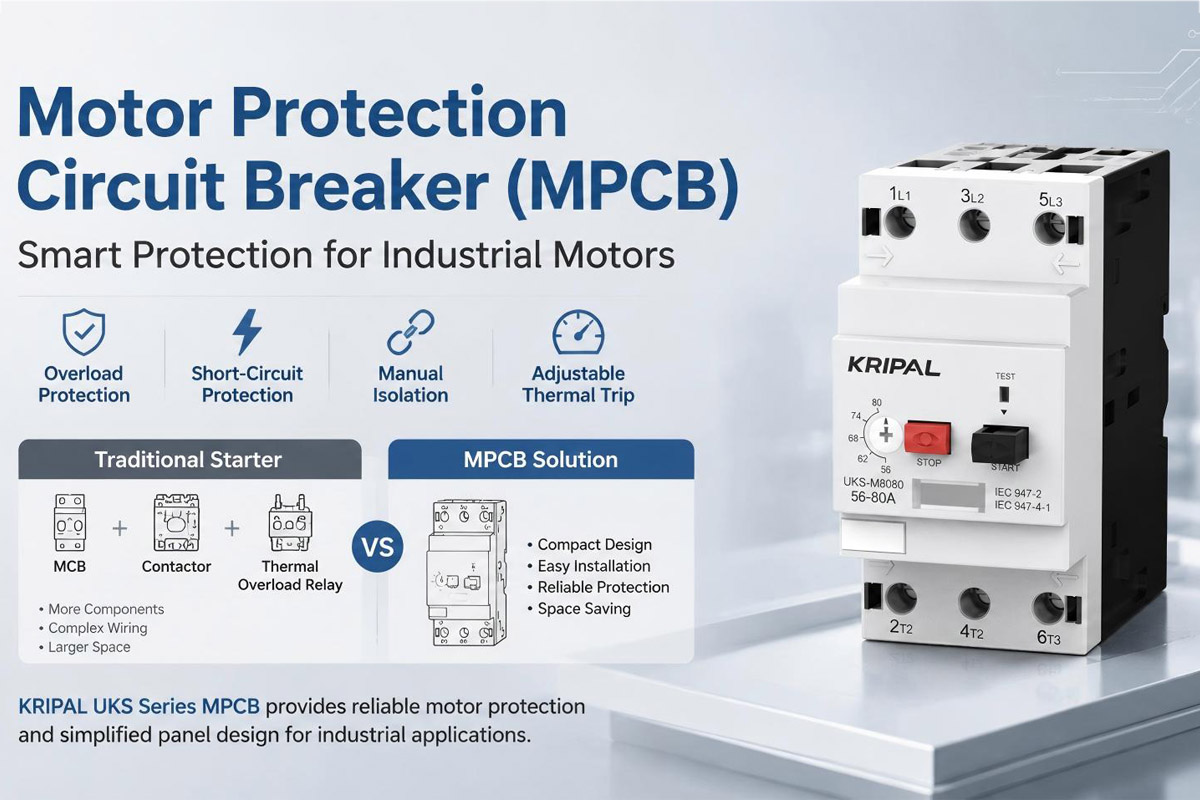
When an industrial AC motor starts, it draws a temporary inrush current several times higher than its normal operating current. The motor protection device must allow this normal starting current while still responding quickly to overloads, phase failures, and short circuits.
Traditional motor protection systems use separate devices, including an MCB or fuse for short-circuit protection, an AC contactor for motor switching, and a thermal overload relay for overload protection. A Motor Protection Circuit Breaker (MPCB) combines overload protection, short-circuit protection, and manual isolation into one compact device, simplifying motor starter design and reducing installation complexity.
However, an MPCB does not completely replace contactors in applications requiring frequent remote switching, PLC control, or automatic motor operation. In many industrial systems, an MPCB is combined with a contactor to provide a complete motor protection and control solution. This guide explains the differences between MPCBs and traditional motor starters, IEC 60947-4-1 coordination requirements, and how to select the right MPCB for industrial motor applications.
Architectural Comparison: MPCB vs Traditional Motor Starter
The Traditional Chain: MCB + Contactor + Thermal Overload Relay
The traditional motor starter design uses separate components, with each device performing a dedicated function.
The upstream circuit breaker or fuse provides short-circuit protection by disconnecting extremely high fault currents. The contactor provides electrical switching and allows the motor to be controlled remotely through a PLC, push buttons, or automatic control systems. The thermal overload relay continuously monitors motor current and trips the contactor when a sustained overload condition occurs.
This architecture remains widely used because of its flexibility. For example:
- A different control voltage can be accommodated by replacing only the contactor coil.
- The overload setting can be adjusted independently when changing motor sizes.
- Additional control functions can easily be integrated.
However, the disadvantages include:
- More components inside the control panel
- More wiring connections
- Larger installation space
- More potential points of failure
Depending on the selected components, a traditional starter assembly may require significantly more DIN rail space compared with an integrated MPCB solution.
The Modern Solution: Motor Protection Circuit Breaker (MPCB)
A Motor Protection Circuit Breaker combines several protection functions into a single compact device.
Typical MPCB functions include:
- Adjustable thermal overload protection
- Instantaneous magnetic short-circuit protection
- Manual motor switching and isolation
Unlike a standard MCB, an MPCB is specifically designed for motor applications. Its adjustable thermal protection allows engineers to match the device setting with the motor nameplate current.
A major advantage of an MPCB is simplified panel design. By integrating multiple functions into one unit, engineers can reduce wiring complexity, save installation space, and improve maintenance efficiency.
KRIPAL UKS series MPCBs are designed for industrial motor protection applications, providing adjustable overload protection and reliable short-circuit protection for motor control systems.
However, engineers should remember that an MPCB does not replace a contactor when remote switching is required. In many industrial applications, the preferred solution remains:
MPCB + Contactor = Complete Motor Starter
MPCB vs Traditional Starter: Requirement Comparison
| Requirement | Traditional Starter | MPCB Solution |
|---|---|---|
| Overload protection | Yes | Yes |
| Short-circuit protection | Yes | Yes |
| Remote motor control | Yes | Requires contactor |
| Panel space | Larger | More compact |
| Wiring complexity | Higher | Lower |
| Maintenance | More components | Simplified |
Understanding IEC 60947-4-1 and Motor Starter Coordination
When selecting motor protection equipment, engineers must consider short-circuit coordination requirements defined by IEC standards.
IEC 60947-4-1 specifies requirements for low-voltage contactors and motor starters, including coordination between switching devices and protective devices during short-circuit conditions.
Two coordination levels are commonly used.
Type 1 Coordination
Type 1 coordination provides basic protection during a short circuit. During a fault, the motor starter must safely interrupt the current without causing danger to people or surrounding equipment. However, some damage to components may occur.
Possible results after a Type 1 fault include:
- Contact welding
- Mechanical damage
- Replacement of starter components
Type 1 coordination is suitable for applications where occasional replacement after a severe fault is acceptable.
Type 2 Coordination
Type 2 coordination provides a higher level of protection and is commonly preferred in industrial applications where equipment availability is important.
Under Type 2 coordination:
- The fault must be safely cleared
- The starter components should remain functional
- Limited contact welding is acceptable only if contacts can be easily separated without permanent damage
Achieving Type 2 coordination requires testing between specific protective devices and starter components. When selecting an MPCB system, engineers should always verify manufacturer coordination tables to ensure the complete combination meets the required short-circuit performance.
For industrial motor applications, KRIPAL UKS series MPCBs can be selected together with suitable upstream protection devices according to coordination requirements.
How to Select the Right Motor Protection Circuit Breaker
Selecting an MPCB requires matching the motor characteristics with the protection device settings.
1. Check the Motor Nameplate Current
The first step is identifying the motor’s full-load current (FLC or FLA) from the motor nameplate.
Always select the current value according to:
- Actual operating voltage
- Motor connection method
- Manufacturer specifications
2. Choose the Correct MPCB Current Range
Select an MPCB whose adjustable thermal range covers the motor’s rated current.
For example, if a motor operates at 22A full-load current, an MPCB with an adjustable range of approximately 20–25A would normally be appropriate.
Avoid selecting an oversized MPCB because excessive adjustment range may reduce overload protection accuracy.
3. Set the Thermal Protection
The thermal adjustment should normally match the motor nameplate current according to manufacturer recommendations.
Factors that may influence the setting include:
- Motor service factor
- Ambient temperature
- Installation conditions
- Motor manufacturer requirements
The goal is to provide reliable overload protection while avoiding unnecessary trips during normal operation.
4. Verify Short-Circuit Breaking Capacity
The MPCB breaking capacity must be suitable for the available fault current at the installation point.
Important parameters include:
- Icu: Rated ultimate short-circuit breaking capacity
- Ics: Rated service short-circuit breaking capacity
For example, if the prospective short-circuit current is higher than the MPCB rating, additional upstream protection may be required.
Understanding MPCB Magnetic Trip Settings
The magnetic trip function protects motors against high-current faults such as short circuits. Unlike thermal protection, which responds to long-term overload conditions, magnetic protection operates almost instantly when current reaches a high threshold.
Motor starting current can commonly reach:
- 5–8 times rated current for standard motors
- Higher values for some high-efficiency motors or heavy-load starting conditions
Therefore, the magnetic trip setting must allow normal motor starting current while still providing rapid short-circuit protection. Many MPCBs use magnetic trip characteristics designed around approximately 10–14 times the rated current, depending on the manufacturer and product design.
Incorrect magnetic settings may cause nuisance tripping during direct-on-line motor starting.
Can an MPCB Replace a Contactor?
This is one of the most common questions when selecting motor protection equipment. The answer depends on the application.
An MPCB can provide:
- ✓ Overload protection
- ✓ Short-circuit protection
- ✓ Manual isolation
But an MPCB normally cannot provide:
- ✗ Frequent remote switching
- ✗ PLC-controlled operation
- ✗ Automatic reversing control
For these applications, a contactor is still required.
Typical industrial solutions include:
- MPCB + Contactor for standard motor starters
- MPCB + Contactor + overload relay for advanced applications
- MPCB alone for simple local motor protection applications
MPCB vs Traditional Starter: Which Solution Should You Choose?
For modern industrial control panels, MPCBs provide an efficient solution when compact design, reliable protection, and simplified installation are priorities.
However, traditional starter configurations remain valuable for complex automation systems requiring extensive control functions.
Frequently Asked Questions
What is a Motor Protection Circuit Breaker (MPCB)?
An MPCB is a protective device designed specifically for electric motors, combining overload protection, short-circuit protection, and manual switching functions in one unit.
Can an MPCB replace a contactor?
No. An MPCB protects the motor but does not replace a contactor in applications requiring frequent remote switching or automatic control.
What is Type 2 coordination?
Type 2 coordination means that after a short circuit, the motor starter remains functional with only limited contact damage permitted according to IEC requirements.
How do I select the correct MPCB rating?
Choose an MPCB based on the motor nameplate current, adjustable thermal range, short-circuit capacity, and application requirements.
Conclusion
Motor Protection Circuit Breakers provide a modern approach to protecting industrial motors by combining overload protection, short-circuit protection, and manual isolation into one compact device. Compared with traditional MCB + contactor + overload relay arrangements, MPCBs can simplify panel design, reduce wiring complexity, and improve installation efficiency.
However, selecting the correct solution requires understanding the application requirements. MPCBs are not a universal replacement for contactors, especially in systems requiring frequent remote operation. By correctly evaluating motor current, breaking capacity, magnetic trip characteristics, and IEC coordination requirements, engineers can select an MPCB solution that delivers reliable motor protection and long-term operational performance.
Explore the KRIPAL MPCB and manual motor starter range together with matching AC contactors and thermal overload relays, or contact our engineering team for selection support.
Related Resources
Explore Knowledge Center >
Need a matching KRIPAL product?
Share voltage, quantity and destination. An engineer will reply with options and lead time.