Search
Knowledge Center
RCBO Consumer Unit vs Split Load Consumer Unit: Which Is Better for Modern Electrical Installations?
Compare RCBO and split-load consumer units for fault isolation, nuisance tripping, BS 7671 practice, and when all-RCBO boards suit modern installs.
 July 17, 2026
Modern electrical installations are becoming increasingly complex. Homes and commercial buildings now contain more electronic equipment than ever before, including LED lighting systems, computers, smart home devices, heat pumps, EV chargers, and renewable energy equipment. As electrical loads become more diverse, choosing the right consumer unit architecture has become an important decision for installers, designers, and property owners.
Traditionally, many UK electrical installations used split-load consumer units, where groups of circuits were protected by shared RCDs combined with individual MCBs. This approach provided a cost-effective way to meet protection requirements.
However, modern installations are increasingly moving toward all-RCBO consumer units. By providing individual residual current and overcurrent protection for each circuit, RCBO-based designs offer improved fault isolation, easier troubleshooting, and reduced inconvenience caused by unwanted tripping.
This article compares RCBO consumer units and split-load consumer units, explains the engineering differences behind each design, and helps you understand which solution is better suited for modern electrical applications.
Architectural Breakdown: How Each Configuration Operates
The Split Load Consumer Unit
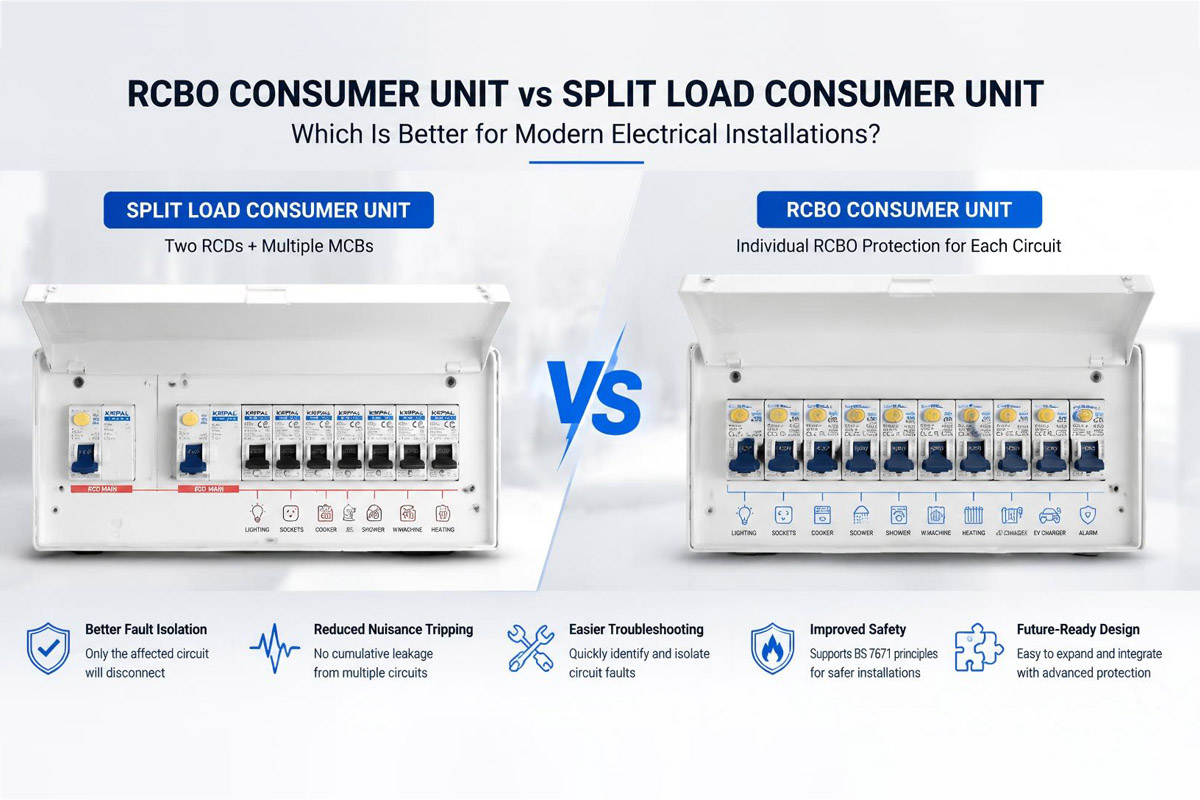
A split-load consumer unit divides final circuits into several groups. Each group is protected by a common RCD, while individual circuits are protected against overload and short circuits by separate MCBs.
For example, a typical split-load board may have:
- One RCD protecting several socket circuits
- Another RCD protecting lighting circuits
- Individual MCBs providing overcurrent protection for each circuit
Historically, this configuration became popular because RCD devices were relatively expensive and larger in size. Using two RCDs to protect multiple circuits provided a practical balance between safety and installation cost.
However, one limitation of this architecture is that several circuits share the same residual current protection device. If leakage current from multiple circuits accumulates, a single unwanted trip can disconnect power from several unrelated areas of the installation.
The All-RCBO Consumer Unit
An all-RCBO consumer unit removes the grouping approach by installing an individual RCBO on each final circuit.
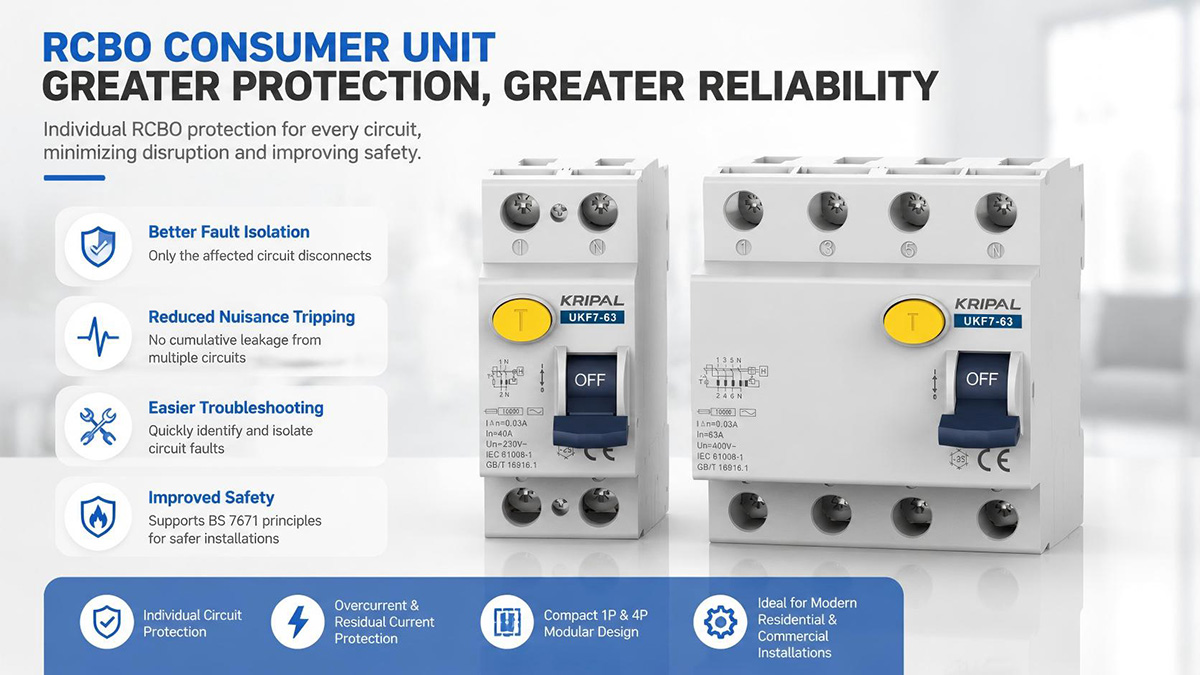
An RCBO combines two protective functions in one device:
- Overcurrent protection similar to an MCB
- Residual current protection similar to an RCD
This means every circuit has its own dedicated protection.
For example, if a kitchen socket develops an earth leakage fault, only the RCBO protecting that circuit will disconnect. Other circuits, such as lighting, heating controls, alarms, or refrigeration equipment, can continue operating normally.
This individual protection arrangement improves system availability and significantly reduces the impact of a single circuit fault.
RCBO Consumer Unit vs Split Load Consumer Unit Comparison
While split-load boards remain a valid solution in many applications, RCBO consumer units provide advantages where reliability, convenience, and circuit independence are priorities.
| Feature | Split Load Consumer Unit | All RCBO Consumer Unit |
|---|---|---|
| Fault isolation | Multiple circuits may disconnect together | Only the affected circuit disconnects |
| Installation cost | Lower initial cost | Higher initial investment |
| Troubleshooting | More difficult due to shared protection | Faster fault identification |
| Nuisance tripping risk | Higher due to cumulative leakage | Lower because each circuit is independent |
| Future expansion | More limited | Easier to modify and expand |
| Space efficiency | Requires separate RCD and MCB arrangement | Modern RCBOs can provide compact protection |
Understanding Standing Leakage Current and Nuisance Tripping
One of the main technical reasons behind the increased adoption of RCBO consumer units is the problem of cumulative leakage current.
Modern electronic devices commonly use switched-mode power supplies (SMPS).
These are found in:
- LED lighting drivers
- Computers and chargers
- Televisions
- Network equipment
- Smart home devices
These devices often include electromagnetic interference filters containing capacitors connected between line, neutral, and earth. As a result, a small amount of normal leakage current may flow to earth during operation.
In a split-load consumer unit, several circuits share the same RCD. The leakage current from multiple devices can add together.
For example:
- Lighting circuit leakage: 3mA
- Office equipment leakage: 5mA
- Kitchen appliances leakage: several mA
The total leakage seen by one shared RCD may gradually increase. If an additional temporary leakage event occurs, the RCD may operate even though no dangerous fault exists. This is commonly known as nuisance tripping.
In an all-RCBO consumer unit, each RCBO monitors only one individual circuit. Leakage current from different circuits does not accumulate through a single protective device, significantly reducing the possibility of unwanted disconnection.
BS 7671 Requirements and Modern Installation Practice
BS 7671, the UK Requirements for Electrical Installations, focuses on providing effective protection against electric shock, fire risks, and dangerous fault conditions. The regulations do not require every installation to use an all-RCBO consumer unit. However, modern wiring practices increasingly consider circuit discrimination and reducing inconvenience during faults.
A key principle of BS 7671 is that electrical installations should be designed so that faults do not create unnecessary danger or excessive disruption. For example, if a lighting circuit fault causes an entire section of a property to lose lighting, this may create inconvenience and potential safety concerns, especially on stairways or emergency routes.
Using individual RCBO protection for lighting and socket circuits can help limit the impact of faults and improve overall installation resilience.
The Role of AFDDs in Modern Consumer Unit Design
Arc Fault Detection Devices (AFDDs) are designed to detect abnormal electrical arcing conditions that may increase fire risk. They are particularly considered for certain higher-risk installations where additional fire protection may be beneficial.
Because AFDDs are designed to work alongside circuit protection devices, including RCBOs, they are easier to integrate into consumer units where each circuit already has individual protection. This is another reason why RCBO-based architectures provide greater flexibility for advanced protection solutions.
When Should You Choose an RCBO Consumer Unit?
An RCBO consumer unit is especially suitable for:
New residential developments
New homes often contain more electrical equipment than older properties. Individual RCBO protection provides better reliability for modern lifestyles.
Property upgrades and renovations
When replacing an older consumer unit, upgrading to RCBO protection can improve safety and reduce nuisance tripping problems.
Commercial and specialist applications
Offices, retail spaces, rental properties, and buildings with critical equipment benefit from improved fault isolation.
Installations with high electronic loads
Properties containing EV chargers, solar systems, heat pumps, or extensive IT equipment may experience higher levels of leakage current, making individual circuit protection increasingly valuable.
Frequently Asked Questions (FAQs)
What is the main difference between an RCBO consumer unit and a split-load consumer unit?
A split-load consumer unit uses shared RCD protection for multiple circuits, while an RCBO consumer unit provides individual protection for each circuit.
Does BS 7671 require an all-RCBO consumer unit?
No. BS 7671 does not require every installation to use RCBOs, but RCBO consumer units are widely adopted because they provide improved fault isolation and reduce inconvenience.
Can RCBOs reduce nuisance tripping?
Yes. Because each RCBO protects only one circuit, leakage currents from different circuits do not combine and trigger unnecessary disconnections.
Can I replace a split-load consumer unit with an all-RCBO board directly?
Yes, during a consumer unit upgrade, an electrician can replace shared RCD/MCB setups with individual RCBOs, provided the wiring polarity and neutral connections are correctly separated per circuit.
Conclusion
Split-load consumer units have played an important role in electrical installations for many years due to their cost effectiveness and practical design. However, as modern buildings contain more electronic equipment and more complex electrical loads, the limitations of shared RCD protection have become increasingly noticeable.
All-RCBO consumer units provide a more flexible and reliable approach by allowing each circuit to operate independently. They improve fault isolation, simplify troubleshooting, and reduce the inconvenience caused by unwanted tripping.
For modern residential, commercial, and renovation projects, RCBO-based protection is becoming an increasingly preferred solution.
Compact RCBO products such as the KRIPAL UKF7 single-module RCBO allow installers to achieve comprehensive circuit protection while maintaining efficient use of consumer unit space. Combining modern protection technology with compact design, RCBO solutions provide a practical way to meet the demands of today’s electrical installations. Contact our team for product support.
Related Resources
Explore Knowledge Center >

Need a matching KRIPAL product?
Share voltage, quantity and destination. An engineer will reply with options and lead time.