Search
Knowledge Center
Door Interlocked Isolator Switch: Safety and Compliance Guide
How door interlocked isolator switches prevent live panel access. EN 60204-1 compliance, interlock mechanism, applications, and installation tips.
 June 27, 2026
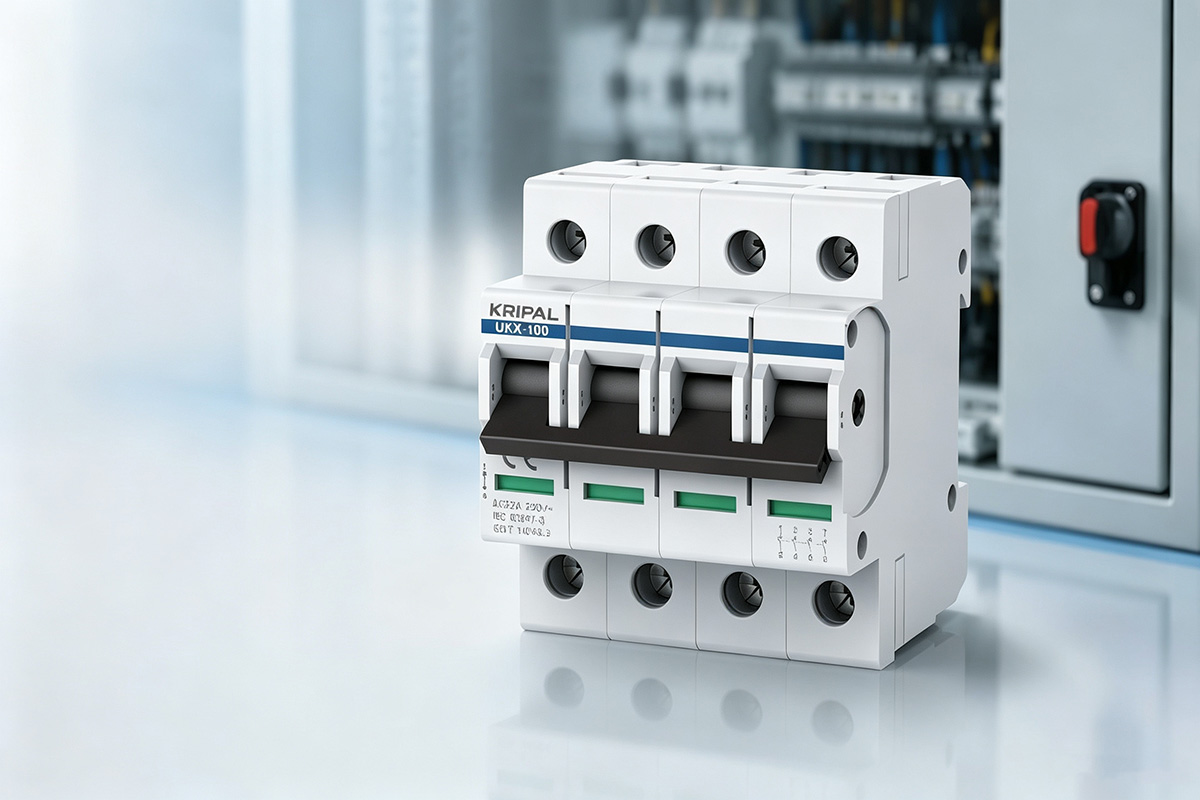
Industrial control panels and machinery enclosures present a specific safety challenge. How do you prevent an operator from opening a live panel door? The answer is a door interlocked isolator switch, a device that mechanically blocks door opening while the circuit is energized and prevents re-energization while the door is open. KRIPAL manufactures door interlocked versions of its UKF and UKX isolator series, designed to meet the requirements of EN 60204-1 and EN 60947-3. This guide explains how the interlock mechanism works, where these devices are used, and what to look for when selecting a door interlocked isolator.
Door Interlocked Isolator Basics
Interlock Mechanism
A door interlocked isolator switch combines a rotary disconnector with a mechanical linkage that extends to the enclosure door. When the isolator handle is turned to the ON position, a mechanical tongue or cam engages with a catch bracket mounted on the door, physically preventing the door from being opened. To open the door, the operator must first rotate the handle to the OFF position that retracts the locking tongue and allows the door to swing open. This sequence enforces a mandatory de-energization before access is possible.
The KRIPAL UKX interlocked series uses a robust metal linkage between the switch mechanism and the door catch. The handle can be padlocked in the OFF position, providing an additional layer of lockout-tagout (LOTO) security for maintenance operations.
Live Door Prevention
The primary safety function of the interlock is to significantly reduce the risk of accidental contact with live electrical components. Without an interlock, a panel door can be opened while the internal busbars and terminals remain energized. The interlock prevents access to the enclosure while the isolator is in the ON position, reducing the risk of exposure to energized components. Some advanced interlock systems also include a defeat mechanism, operated with a tool, that allows authorized personnel to open the door with power on for diagnostic purposes. This defeat feature must require deliberate action, such as inserting a screwdriver or special key, to prevent accidental use.
Safety Standards
EN 60204-1 Standard
EN 60204-1 is the European standard for electrical equipment of machines. Section 5.3 of the standard addresses supply disconnecting devices and states that each machine must have a disconnecting device that isolates the entire electrical installation. For many machine applications, the disconnecting device is mechanically interlocked with the enclosure door to prevent access to hazardous live parts while energized. Clause 6.2.2 also addresses protection against electric shock and requires that live parts above 50 V AC or 120 V DC be protected against direct contact when the door is opened for normal operation.
IEC 60947-3 Interlock Rules
IEC 60947-3 covers switch-disconnectors and includes requirements for interlocking mechanisms. The standard defines mechanical endurance testing for interlocking systems, defined mechanical endurance tests according to the product category and rating. KRIPAL interlocked isolators undergo cycle testing to verify that the mechanical interlock maintains its integrity under repeated use. The handle mechanism and door catch must continue to operate smoothly after the rated number of cycles, and the electrical contacts must continue to meet resistance and temperature-rise limits.
Application Examples
Control Panel Use
The most common application for door interlocked isolators is industrial control panels that house motor starters, PLCs, variable frequency drives, and power distribution components. These panels are found in factories, water treatment plants, HVAC systems, and material handling equipment. The isolator is typically mounted on the panel flange or door, with the switch body inside the enclosure and the external handle accessible to the operator. KRIPAL UKX interlocked models are widely used in control panel builds across Asia, Europe, and the Middle East.
Machinery Use
Standalone machinery such as packaging machines, CNC machining centers, conveyor systems, and injection molding machines all require a local isolation point. The isolator is usually mounted directly on the machine’s electrical enclosure. In these applications, the door interlock serves double duty: it provides the required disconnect means for the machine and prevents unauthorized access to control components that could be damaged or misadjusted.
Installation Guidelines
When installing a door interlocked isolator switch, alignment between the switch mechanism and the door catch is the single most important factor. Misalignment of even a few millimeters can cause the interlock to bind, making operation difficult or causing premature wear. The manufacturer’s drilling template must be followed exactly. After installation, test the interlock through at least 20 full open-close cycles with the door to confirm smooth operation.
Check that the switch handle clearly indicates the ON and OFF positions and that the OFF position allows the padlock hasp to engage. The door should open freely when the handle is in the OFF position. If the door must be opened with power on for troubleshooting, verify that the defeat mechanism works as intended and that it requires a deliberate tool action, not a simple finger push.
For panel builders purchasing KRIPAL products in volume, visit our product catalog for datasheets and dimensional drawings. We also supply circuit breakers and surge protection devices for complete control panel builds.
KRIPAL door interlocked isolators are available in the UKF series and UKX series. For outdoor panel applications, consider the UKF5 weatherproof isolating switch.
Frequently Asked Questions
Q: What is the difference between a door interlocked isolator and a standard isolator?
A standard isolator has no mechanical linkage to the enclosure door. The door can be opened regardless of whether the switch is on or off. A door interlocked isolator has a mechanical linkage that prevents the door from opening while the switch is in the ON position, providing an additional safety barrier against accidental contact with live parts.
Q: Can a door interlocked isolator be defeated in an emergency?
Yes, most interlocked isolators include a defeat mechanism that allows the door to be opened with power on for diagnostic or emergency access. This mechanism normally requires a tool, such as a screwdriver, to operate, ensuring that the defeat action is deliberate and not accidental. KRIPAL interlocked models provide this feature as standard.
Q: Is door interlocking required by law?
Regulations vary by jurisdiction, but EN 60204-1 that is harmonized under the EU Machinery Directive, requires a disconnecting device interlocked with the door for machine electrical equipment. Similar requirements exist in IEC 60204-1 that is adopted in many countries worldwide. Local electrical codes should be consulted for specific requirements in your region.
Q: What happens if the interlock mechanism wears out?
Mechanical interlock components are subject to wear, particularly in high-cycle applications. A worn interlock may fail to engage properly, allowing the door to be opened while the circuit is live, or it may jam, preventing the door from opening at all. Regular inspection of the interlock mechanism should be part of the panel maintenance schedule. If excessive play or binding is observed, the interlock components should be replaced.
Q: Can I retrofit a door interlock to an existing isolator?
Generally, no. The interlock mechanism, handle, and door catch are designed as an integrated system with the switch body. Retrofitting typically requires replacing the entire isolator assembly. However, KRIPAL offers complete interlocked isolator kits that include the switch, handle, shaft extension, and door catch bracket for new installations and panel upgrades.
Q: What IP rating does the interlocked isolator provide?
The interlocked isolator handle assembly typically provides IP65 protection on the door face when correctly installed with the supplied gasket. The switch body itself has an IP20 rating and is intended for installation inside an enclosure. The overall protection rating of the panel depends on the enclosure design and sealing.
Secure Your Control Panels with Confidence
A door interlocked isolator switch is more than just a regulatory requirement for industrial machinery; it is a critical safeguard that protects operators from accidental contact with live electrical components. By enforcing a mandatory power disconnection before physical access is granted, these devices eliminate human error from the panel entry process and ensure compliance with strict safety standards like EN 60204-1.
Whether you are designing a compact motor starter enclosure or a heavy-duty industrial control center, KRIPAL’s UKF and UKX series interlocked isolators provide the mechanical reliability and electrical performance your projects demand.
Related Resources
Explore Knowledge Center >
Need a matching KRIPAL product?
Share voltage, quantity and destination. An engineer will reply with options and lead time.