Search
Knowledge Center
Cable vs Wire: Key Differences, Types, Applications and Selection Guide
Learn the key differences between cable and wire. Explore types, applications, and a selection guide to choose the right conductor for safety and performance.
 June 02, 2026

In the world of electrical engineering, the terms “wire” and “cable” are frequently used interchangeably. However, in professional industrial and residential applications, confusing these two can lead to improper component selection, potential safety hazards, or system failure. Understanding the fundamental structural and functional differences is the first step toward building a reliable electrical network.
Core Highlights
- A wire is typically a single conductor, while a cable is a group of insulated conductors bundled together
- Cables offer better protection and flexibility in complex installations
- Wires are commonly used in simple, low-complexity electrical connections
- The structure, insulation, and application define their real differences more than their appearance
- Choosing the right one directly affects safety, efficiency, and durability of electrical systems
Understanding What a Wire Is
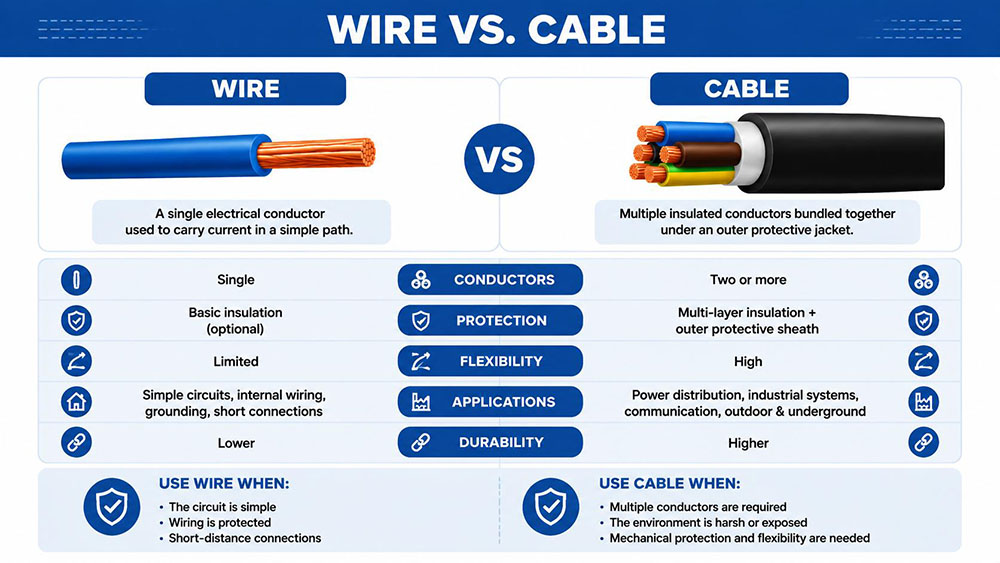
A wire is a single electrical conductor made from copper or aluminum that allows electric current to flow from one point to another.
It may be solid or stranded and can be bare or insulated depending on the application.
Key characteristics of wire:
- Single conductor
- Simple insulation (optional)
- Designed for direct electrical paths
Understanding What a Cable Is
A cable is a structured assembly of two or more insulated wires bundled together under an outer protective jacket.
This structure provides higher mechanical strength and better protection against environmental stress.
Key characteristics of cable:
- Multiple insulated conductors
- Outer protective sheath
- Higher mechanical durability
- Designed for complex electrical systems
Key Differences Between Wire and Cable
The distinction between wire and cable becomes clearer when comparing their structure and use cases.
| Aspect | Wire | Cable |
| Structure | A single conductor | Multiple insulated conductors bundled together |
| Insulation and Protection | May be bare or lightly insulated | Multiple insulation layers with an outer protective sheath |
| Flexibility and Installation | Less flexible and less adaptable in complex routing | More flexible and easier to install in complex or dynamic environments |
| Application | Used in basic electrical circuits, internal wiring, or grounding | Used in power distribution, industrial systems, communication networks, and outdoor installations |
| Durability | Lower durability due to minimal protection | Higher durability with better resistance to environmental factors |
Applications & Selection Guide
When to Use Wire
- Internal wiring inside electrical panels
- Short and fixed connections
- Grounding systems
- Protected indoor environments
When to Use Cable
- Power distribution systems
- Industrial machinery and automation
- Outdoor or underground installations
- Environments with vibration or movement
Practical Rule of Thumb
If the application is simple and protected, wire is sufficient.
If the system is complex, exposed, or mechanically stressed, cable is the safer choice.
Electrical Performance Factors in Real Systems
In practical engineering applications, the selection of wire or cable depends on several performance parameters:
- Current carrying capacity (ampacity) – determines safe operating current
- Voltage rating – ensures insulation can withstand system voltage
- Temperature rating – affects long-term thermal stability
- Insulation class – defines resistance to breakdown and aging
- Mechanical stress resistance – important in vibration or moving equipment
- Environmental exposure – moisture, chemicals, UV, or heat conditions
Improper selection may lead to overheating, insulation breakdown, or premature system failure.
Engineering & Safety Considerations
Proper selection of wire and cable is essential for both performance and safety.
Key Engineering Principles:
- Electrical codes define acceptable installation methods
- Wires are typically installed inside conduit or protective enclosures
- Cables may be rated for direct installation depending on type
- Conductors must be sized according to current load and installation conditions
Wire Sizing Factors:
- Load current
- Cable/wire length
- Insulation temperature rating
Safety Risks of Incorrect Selection:
- Overheating and fire hazards
- Insulation breakdown
- Mechanical damage in exposed environments
- Reduced system reliability
Types of Wires and Cables
Wire Types
- Solid Wire: Used in fixed installations with no movement
- Stranded Wire: Flexible wire for vibration or movement
- Bare Wire: Used in grounding or overhead systems
Cable Types
- Power Cable: Used for power transmission
- Control Cable: Used in automation systems
- Coaxial Cable: Used for high-frequency signals
- Multi-core Cable: Multiple conductors in one jacket
- Armored Cable: Extra protection for harsh environments
Why the Difference Matters in Engineering
Choosing the wrong conductor type can lead to:
- Electrical safety risks
- Mechanical damage
- Increased maintenance costs
- Reduced system reliability
Proper selection ensures long-term performance and safe operation.
Conclusion
Understanding the difference between wires and cables helps make better decisions in electrical design, installation, and maintenance. While a wire is a single conductor suited for simple and direct connections, a cable brings multiple insulated conductors together for greater protection, flexibility, and versatility in more demanding environments.
Choosing between them depends on factors such as application, safety requirements, and working conditions. A clear understanding of both ensures more reliable and efficient electrical systems in practice.
Head over to our site and explore more about wires and cables with me. If you have any questions or need help choosing the right solution, I’m here anytime to help you out.
FAQ
Q1 Can a wire be used instead of a cable?
In simple, low-power applications, a wire may be sufficient. However, in environments requiring protection or multiple conductors, a cable is usually the better choice.
Q2 Why are cables more expensive than wires?
Cables require more materials, including insulation layers and protective sheathing, which increases manufacturing cost.
Q3 Which is safer, wire or cable?
Cables are generally safer in most practical applications because they provide better insulation and mechanical protection.
Q4 Where are wires most commonly used?
Wires are commonly used in internal circuits, grounding systems, and simple electrical connections where environmental stress is minimal.
Q5 What is the main difference between wire and cable?
A wire is a single electrical conductor, while a cable is made up of multiple insulated conductors bundled together with an outer protective sheath.
Q6 Can wires and cables be used interchangeably?
Not always. While both conduct electricity, their structure and protection levels are different, so using the wrong one may affect safety and performance.
Q7 Why is cable more commonly used in industrial applications?
Because cables can handle higher mechanical stress, environmental exposure, and multiple conductors, making them more suitable for industrial environments.
Q8 What materials are commonly used in wires and cables?
Copper and aluminum are the most common materials due to their excellent conductivity and cost-effectiveness.
Q9 How do I choose between wire and cable?
You should consider factors such as voltage level, installation environment, flexibility requirements, and safety standards before choosing.
Q10 Can a cable carry more current than a wire?
Not necessarily. Current capacity depends on conductor size and material, not just whether it is a wire or cable.
Related Resources
Explore Knowledge Center >


Need a matching KRIPAL product?
Share voltage, quantity and destination. An engineer will reply with options and lead time.