Search
Knowledge Center
Why Combination Switched Sockets Are Becoming the Preferred Choice for Outdoor Power Distribution
Discover why combination switched sockets are the preferred choice for outdoor power distribution. Learn about modular systems, safety, and harsh environment applications.
 May 21, 2026
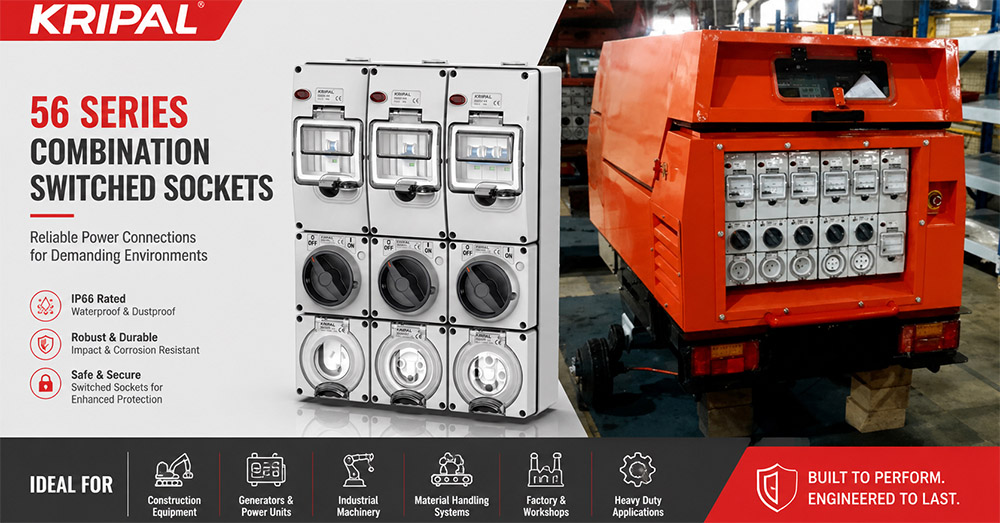
Outdoor electrical systems often require much more than a single power outlet. Construction sites, factories, ports, mining operations, and commercial facilities usually need multiple sockets, local isolation, and circuit protection integrated into one safe and organized solution.
Traditional installations often rely on separately mounted switches, sockets, and protective devices, which increase installation time and require additional wiring space.
Combination switched sockets provide a more efficient approach by bringing these functions together in a modular enclosure.
This article explains how combination switched sockets work, where they are used, and why modular outdoor power distribution systems are becoming increasingly popular.
KRIPAL 56 Series Combination Switched Sockets – Applications in Mechanical Equipment and Industrial Machinery
What Is a Combination Switched Socket?
A combination switched socket is an integrated outdoor power distribution unit that combines industrial sockets with switching and protection functions inside one enclosure.
Depending on project requirements, a system may include:
- Industrial switched sockets
- Local isolation switches
- Miniature circuit breakers (MCB)
- Residual current circuit breakers (RCCB)
- Residual current breakers with overcurrent protection (RCBO)
Instead of installing these components separately, they are assembled into a single modular unit that simplifies both installation and maintenance.
Why Are Modular Systems More Practical?
Electrical projects rarely have identical requirements.
Some installations need one socket and one switch, while others require multiple power outlets with independent protection.
Modular systems allow engineers and contractors to configure equipment according to the application.
Typical configurations may include:
- 1 Gang Combination Unit
- 2 Gang Combination Unit
- 4 Gang Combination Unit
- Multi-Gang Distribution Assemblies
As project requirements change, additional modules can often be integrated without redesigning the entire installation.
Reducing Installation Time
Installing separate waterproof boxes, switches, and protective devices can increase labor costs and wiring complexity.
A pre-configured combination switched socket can help simplify installation by reducing:
- Cable routing
- Wall mounting work
- Internal wiring
- Assembly time
For temporary power systems and industrial expansion projects, faster installation can reduce project downtime.
Improving Electrical Safety
Outdoor electrical equipment is frequently exposed to rain, dust, vibration, and accidental impact.
A combination switched socket helps improve safety by integrating local switching and protective devices close to the power outlet.
Typical safety advantages include:
Local Isolation
Operators can disconnect equipment before maintenance without returning to the main distribution board.
Overload Protection
MCBs help protect connected circuits from excessive current.
Leakage Protection
RCCB and RCBO devices help reduce risks associated with earth leakage faults.
Organized Power Management
Integrating switching and protection into one enclosure helps reduce wiring confusion and simplifies future maintenance.
Suitable for Harsh Outdoor Environments
Outdoor power systems often operate under demanding conditions.
Typical applications include:
Construction Sites
Temporary power distribution requires equipment that can tolerate dust, rain, and rough handling.
Manufacturing Plants
Production equipment often needs local switching and protected power outlets.
Mining and Quarry Operations
Mechanical impact and severe environmental conditions require durable electrical enclosures.
Marine and Port Facilities
Salt spray and outdoor exposure create additional challenges for electrical installations.
Food Processing Areas
Frequent washdowns require electrical equipment that can resist moisture and cleaning chemicals.
Why Enclosure Design Matters
The enclosure is one of the most important parts of an outdoor combination switched socket.
A well-designed housing helps protect internal electrical components from environmental damage.
Important characteristics include:
- Water resistance
- Dust protection
- UV resistance
- Impact resistance
- Chemical corrosion resistance
These features help maintain stable performance in long-term outdoor applications.
Flexible Power Distribution for Different Projects
Different industries require different power distribution layouts.
A modular combination switched socket system can support various installation requirements by combining industrial sockets with protective devices inside a single enclosure.
Typical combinations may include:
| Application | Typical Configuration |
| Workshop Equipment | Socket + Switch |
| Construction Power | Socket + MCB |
| Pump Control | Socket + RCCB |
| Outdoor Machinery | Socket + RCBO |
| Temporary Distribution | Multiple Sockets + Circuit Protection |
This flexibility helps contractors and equipment manufacturers standardize installations while adapting to different project needs.
How KRIPAL Modular Combination Switched Sockets Support Outdoor Installations
KRIPAL specializes in modular outdoor waterproof power distribution solutions.
The combination switched socket range is designed to support configurations from 1 gang to 16 gangs, allowing different combinations of industrial sockets and protective devices.
The system can be integrated with:
- Industrial switched sockets
- 56 Series plug and socket systems
- 56CB1-4N enclosure modules
- Miniature circuit breakers (MCB)
- Residual current circuit breakers (RCCB)
- Residual current breakers with overcurrent protection (RCBO)
The enclosure structure is designed to help protect against:
- Water ingress
- Dust
- UV radiation
- Mechanical impact
- Chemical corrosion
This modular approach provides a practical solution for outdoor electrical distribution where flexibility and long-term reliability are important.
Maintenance Considerations
Regular inspection helps maintain safe operation.
Recommended checks include:
- Inspect enclosure seals
- Verify switch operation
- Check circuit protection devices
- Examine cable entries
- Look for signs of overheating or damage
Preventive maintenance can help reduce unexpected downtime and extend equipment service life.
Conclusion
As outdoor electrical systems become more complex, integrating sockets, switching functions, and circuit protection into one modular enclosure offers practical advantages.
Combination switched sockets simplify installation, improve safety, and provide greater flexibility for industrial and commercial power distribution.
For projects requiring expandable outdoor power systems, modular solutions that combine industrial sockets with MCB, RCCB, and RCBO protection can help create safer and more organized electrical installations.
FAQs
Q What is a combination switched socket?
It is an integrated unit that combines IP66 sockets with switching and electrical protection devices inside one enclosure.
Q Why use a modular outdoor power system?
Modular systems allow different combinations of sockets and protection devices to match project requirements.
Q What protective devices can be integrated?
Depending on the design, MCB, RCCB, and RCBO devices can be included.
Q Where are combination switched sockets commonly used?
They are widely used in construction sites, factories, ports, mining operations, and outdoor industrial facilities.
Q Can modular systems be expanded in the future?
Many modular designs allow additional functions and components to be added as project requirements change.
Related Resources
Explore Knowledge Center >
Need a matching KRIPAL product?
Share voltage, quantity and destination. An engineer will reply with options and lead time.