Search
Knowledge Center
Phase Failure Relay: Complete Motor Protection Guide for Phase Loss, Sequence & Voltage Faults
Learn how phase failure relays protect three-phase motors from phase loss, sequence errors, voltage imbalance, and abnormal voltage. Improve motor reliability.
 July 09, 2026
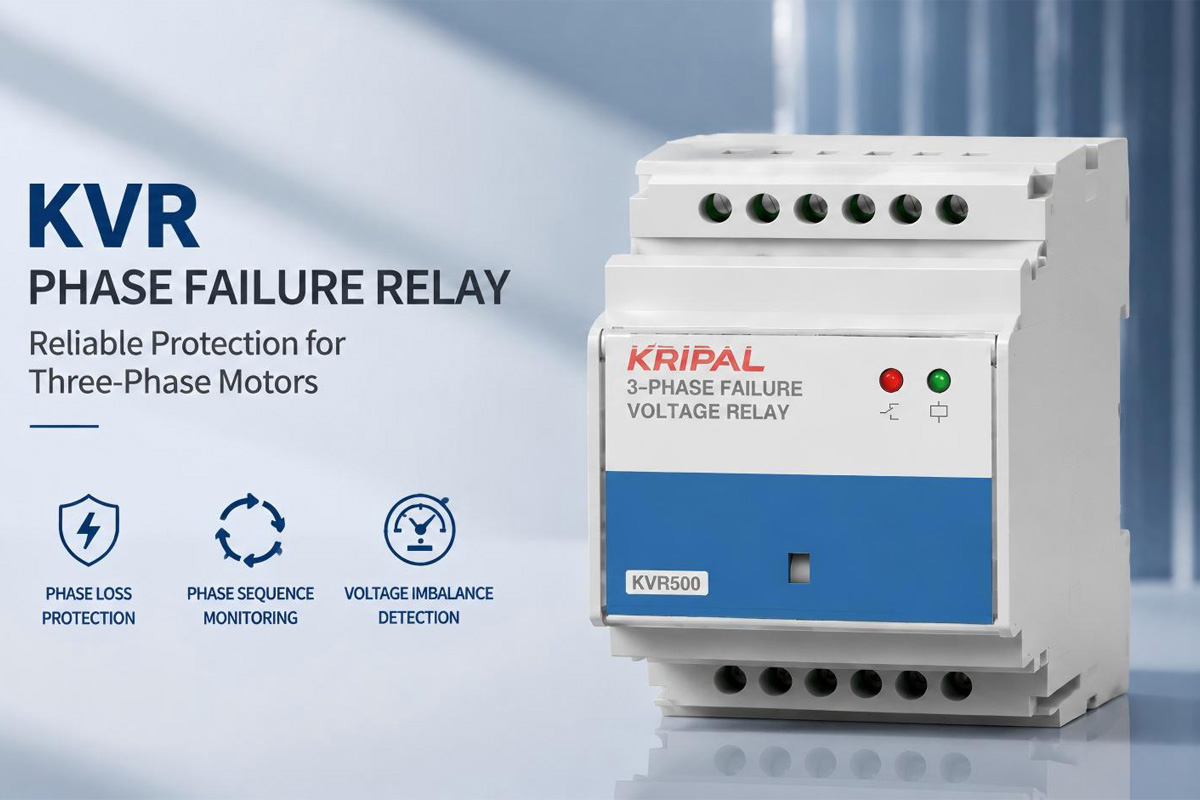
Three-phase motors are widely used in industrial equipment, pumps, compressors, HVAC systems, and automation machinery. However, unstable power conditions such as phase loss, incorrect phase sequence, and voltage imbalance can cause serious motor damage.
A thermal overload relay protects motors from excessive current but cannot directly monitor three-phase power quality. A phase failure relay, also known as a phase monitoring relay or phase sequence relay, provides additional protection by continuously monitoring the incoming power supply and disconnecting the motor control circuit when abnormal conditions occur.
This guide explains how phase failure relays work, their protection functions, wiring principles, and how to select the right solution for three-phase motor protection.
Why Standard Overload Relay Cannot Fully Protect Motors from Phase Failure
Thermal overload relays are essential components in motor protection systems. They are designed to protect motors against excessive current caused by mechanical overload, stalled operation, or prolonged overcurrent conditions. However, phase failure is a special electrical fault that requires additional protection.
When one phase of a three-phase supply is lost, the motor may continue operating on the remaining two phases. Depending on motor design and mechanical load, the current in the remaining windings can increase significantly, sometimes reaching approximately 1.7 to 2.5 times the normal operating current under heavily loaded conditions. A thermal overload relay may eventually trip, but its response depends on factors such as motor loading, relay characteristics, and thermal conditions. During this period, excessive heating can occur inside the motor windings, accelerating insulation aging and reducing motor service life.
A phase failure relay provides faster protection by monitoring voltage conditions directly. Instead of waiting for excessive current and heat buildup, it detects abnormal supply conditions and changes its output contact status. The output is normally connected to the motor contactor control circuit, allowing the contactor to disconnect the motor before prolonged thermal damage occurs. For critical industrial equipment, combining a thermal overload relay with a phase monitoring relay provides a more complete motor protection solution.
For critical industrial equipment, combine a thermal overload relay with a phase monitoring relay to cover both overcurrent and three-phase supply faults before prolonged winding damage occurs.
Four Protection Functions of a Phase Failure Relay
Modern phase failure relays provide multiple monitoring functions to protect three-phase motors from electrical supply problems.
Phase Loss Protection
Phase loss, also called single-phasing, is one of the most common causes of three-phase motor failure. A phase can disappear due to problems such as damaged cables, loose terminals, blown fuses, contactor failures, or upstream power supply faults. When one phase is missing, the motor no longer receives a balanced three-phase voltage supply. The remaining phases experience increased electrical stress, which can cause rapid temperature rise inside the windings.
A phase failure relay continuously monitors the three incoming phases. When it detects the loss of a phase, it immediately changes its output state and interrupts the motor contactor circuit. This protection is especially important for applications where unexpected motor failure can cause significant downtime, including pumps, compressors, conveyors, and industrial machinery.
Phase Sequence Protection
Three-phase motors rotate according to the sequence of the incoming supply phases. For example, an L1-L2-L3 sequence produces one direction of rotation. If two phases are accidentally exchanged, the motor will rotate in the opposite direction.
Incorrect phase sequence may occur after electrical maintenance, generator connection changes, or cable replacement. For equipment such as pumps, compressors, elevators, and directional conveyors, reverse rotation can lead to reduced performance or mechanical damage.
A phase sequence relay monitors the order of the three phases and prevents motor startup when the rotation direction is incorrect.
Voltage Protection and Phase Imbalance Monitoring
Many advanced phase monitoring relays provide protection against abnormal voltage conditions, including under-voltage, over-voltage, and phase voltage imbalance. Under-voltage conditions force motors to draw higher current to maintain mechanical output, increasing heat generation and reducing efficiency. Over-voltage conditions can increase magnetic losses and create additional stress on motor insulation.
Voltage imbalance is another serious problem. Even a small difference between phase voltages can create a much larger current imbalance inside the motor. This produces negative sequence currents, which generate additional heating and reduce motor reliability. A phase failure relay with voltage monitoring functions detects these abnormal conditions and disconnects the motor before long-term damage occurs.
Phase Failure Relay vs Thermal Overload Relay
A phase failure relay and a thermal overload relay protect motors from different types of faults.
A thermal overload relay remains necessary because it protects against overload current conditions.
However, it cannot replace a phase failure relay because it does not directly monitor:
- Missing phase voltage
- Phase rotation sequence
- Voltage imbalance
- Supply voltage abnormality
For complete three-phase motor protection, these devices are normally installed together:
Power Supply → Circuit Breaker → Contactor → Thermal Overload Relay → Motor
The phase failure relay is connected to the control circuit to monitor supply conditions and control contactor operation.
| Protection Device | Main Function | Detection Method |
|---|---|---|
| Thermal Overload Relay | Protects against excessive motor current caused by overload conditions | Current and thermal monitoring |
| Phase Failure Relay | Protects against phase loss, incorrect sequence, voltage faults, and imbalance | Three-phase voltage monitoring |
Installation and Wiring of a Phase Failure Relay
A phase failure relay is usually installed inside a motor control panel and connected to the incoming three-phase supply and contactor control circuit. The relay sensing terminals, commonly marked L1, L2, and L3, are connected to the three-phase power supply. The relay monitors voltage conditions continuously but does not carry the motor operating current.
The relay output contacts are connected in series with the motor contactor coil circuit.
During Normal Operation
- Three-phase supply is healthy → Relay energized → Output contact closed → Contactor operates → Motor runs
During a Fault Condition
- Phase loss or abnormal voltage detected → Relay output changes state → Contactor disconnects → Motor stops
This wiring method allows the relay to provide protection without interrupting the main motor power circuit.
How to Select the Right Phase Failure Relay
When selecting a phase failure relay, engineers should consider four main factors: rated voltage, protection functions, contact configuration, and installation requirements. The relay voltage rating must match the monitored electrical system, such as 220V, 380V, 400V, or 480V AC.
Different applications require different protection levels. Basic models may provide phase loss and phase sequence protection, while advanced models may include voltage imbalance, over-voltage, under-voltage, and adjustable delay functions.
The output contact configuration must match the motor control circuit requirements. Common options include normally open (NO), normally closed (NC), and changeover contacts.
For industrial applications, DIN rail mounted phase failure relays are commonly preferred because they provide simple installation inside control cabinets and automation panels.
Selection Checklist
- Match rated voltage to the monitored system (220V, 380V, 400V, or 480V AC)
- Choose required protection functions (phase loss, sequence, imbalance, over/under-voltage, delay)
- Confirm output contact configuration (NO, NC, or changeover)
- Prefer DIN rail mounting for industrial control cabinets and automation panels
Applications and Benefits of Phase Monitoring Relays
Phase monitoring relays are widely used in industrial and commercial systems where reliable motor operation is essential.
They are commonly applied in pumps, HVAC compressors, elevators, conveyors, production equipment, and automation systems.
By detecting electrical supply problems before they cause serious motor damage, phase failure relays help reduce unexpected downtime, lower maintenance costs, and extend equipment service life.
Frequently Asked Questions
What is the purpose of a phase failure relay?
A phase failure relay monitors three-phase power supplies and detects conditions such as phase loss, incorrect phase sequence, voltage imbalance, and abnormal voltage levels. When a fault occurs, it disconnects the motor control circuit to protect the equipment.
Can a thermal overload relay replace a phase failure relay?
No. A thermal overload relay protects against excessive current, while a phase failure relay monitors the quality of the incoming power supply. Both devices provide different types of protection and are often used together.
What happens when a three-phase motor loses one phase?
When one phase is lost, the motor may continue running on the remaining two phases. However, increased current and electrical stress can cause rapid heating and possible insulation damage if the fault is not cleared.
Where should a phase failure relay be installed?
A phase failure relay is normally installed inside the motor control panel. Its sensing terminals connect to the three-phase supply, while its output contacts control the motor contactor circuit.
How do I choose the right phase failure relay?
The correct relay depends on system voltage, required protection functions, contact configuration, and installation method. For industrial applications, models with phase loss, phase sequence, and voltage monitoring functions provide more complete motor protection.
Conclusion
Three-phase motors depend on stable and balanced electrical power to operate safely. While thermal overload relays provide important overcurrent protection, they cannot fully protect motors from electrical supply problems such as phase loss, incorrect phase sequence, and voltage imbalance.
A phase failure relay, also known as a phase monitoring relay or phase sequence relay, provides an effective additional protection layer by continuously monitoring the incoming three-phase supply and disconnecting motors when abnormal conditions occur.
For critical applications such as pumps, compressors, elevators, and industrial machinery, installing a dedicated phase protection device is a cost-effective way to improve reliability and prevent expensive motor failures. Contact our team for product selection support.
Related Resources
Explore Knowledge Center >
Need a matching KRIPAL product?
Share voltage, quantity and destination. An engineer will reply with options and lead time.