Search
Knowledge Center
EV Charging Connector Types Explained: Type 2 vs CCS vs GB/T vs CHAdeMO vs NACS
Compare Type 1, Type 2, CCS, GB/T, CHAdeMO, and NACS charging connectors by region, power, application, and communication protocol.
 July 22, 2026
The EV charging connector is one of the most important factors affecting compatibility between charging equipment and electric vehicles, especially when selecting products for international markets. Different regions use different charging standards, meaning a connector suitable for one market may not work with vehicles or charging systems in another. For example, a Type 2 connector commonly used in Europe is not compatible with GB/T vehicle inlets used in China, while CCS and CHAdeMO serve different vehicle and regional requirements.
Although EV charging standards vary worldwide, the main connector systems are well established and clearly defined. Understanding the differences between Type 1, Type 2, CCS, CHAdeMO, GB/T, and NACS helps charger manufacturers, distributors, and project buyers select the correct solution for their target market. This guide explains how each connector works, where it is used, and what factors should be considered before ordering EV charging equipment.
The Main EV Charging Connectors Used Worldwide
The global EV market runs on four charging connector families: Type 1 and Type 2 for AC charging, and CCS, CHAdeMO, and GB/T for DC fast charging. China uses GB/T for both AC and DC. Tesla uses its own NACS connector in North America, which complicates the picture further, but the four families above cover the rest of the world.
The distinction between AC and DC charging matters more than the connector brand. An AC charger supplies power to the car’s onboard charger, which converts it to DC for the battery, and AC charging is limited by the onboard charger size, typically 7 to 22 kW. A DC fast charger feeds DC directly to the battery, bypassing the onboard charger, which is why DC charging can reach 50 to 350 kW. The connector must match the vehicle inlet regardless of the power level.
AC Connectors: Type 1 vs Type 2
Type 1 (SAE J1772) is a single-phase AC charging connector mainly used in North America and Japan. It is commonly applied in residential and light commercial charging applications, with typical ratings up to 32A or higher depending on the specific implementation. Some Type 1 systems can support higher current ratings, but charging power is ultimately limited by the vehicle, electrical supply, and onboard charger capability.
Type 2 (IEC 62196-2, also known as the Mennekes connector) is the main AC charging standard used in Europe and many other markets. Unlike Type 1, Type 2 supports both single-phase and three-phase AC charging, allowing higher charging power where three-phase electrical supplies are available. In typical European installations, three-phase Type 2 charging can provide up to 22 kW, while single-phase applications are commonly used for residential charging.
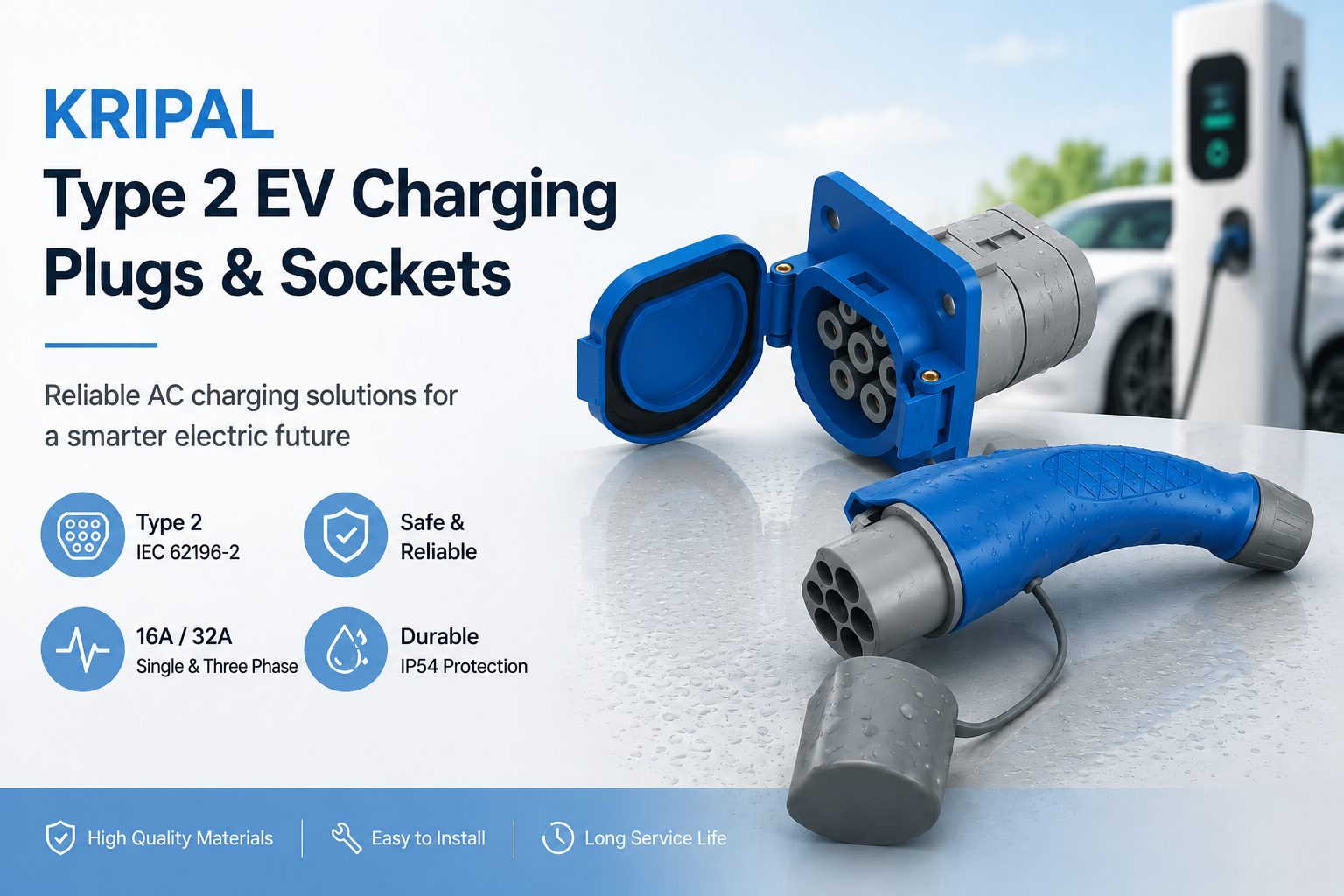
Type 2 is the AC charging connector supplied by KRIPAL for EV charging applications. Its 7-pin design includes three-phase conductors, neutral, protective earth, and two communication pins (Control Pilot and Proximity Pilot). The connector can be used in both tethered charging cables and socket-based charging stations, making it suitable for residential wallboxes, commercial chargers, and other AC charging installations.
DC Connectors: CCS vs CHAdeMO vs GB/T
CCS (Combined Charging System) is a charging system that supports both AC and DC charging. In Europe, CCS Combo 2 combines the Type 2 AC interface with two additional DC power contacts, allowing the same vehicle inlet to support both normal AC charging and DC fast charging. CCS is widely used in Europe and North America, with current fast-charging deployments commonly ranging from 50 kW to 350 kW. The actual charging speed depends on the vehicle battery system, charger output, and thermal management, rather than the connector alone.
CHAdeMO is a Japanese DC fast-charging standard originally developed by the Tokyo Electric Power Company and other industry partners. Unlike CCS, CHAdeMO uses a dedicated connector for DC charging and has been widely adopted in Japan, particularly for earlier generations of electric vehicles. The latest CHAdeMO 2.1 specification increases the technical capability of the standard, supporting charging power up to 800 kW under specified conditions. However, most existing CHAdeMO charging infrastructure operates at significantly lower power levels. CHAdeMO remains important in Japan and in existing vehicle fleets, although CCS adoption continues to expand in Europe and North America.
GB/T is the Chinese national charging standard defined under the GB/T 20234 series and is used for both AC and DC charging in China. The GB/T system is mandatory for EV charging projects targeting the Chinese market, and manufacturers such as BYD, NIO, and XPeng use this standard across many vehicle models. The latest GB/T DC charging specifications significantly increase the capability of the interface, with theoretical power capability reaching up to 1200 kW under maximum voltage and current limits. In practical applications, charging speed is still determined by the vehicle battery system, charger capacity, and operating conditions.
Where Each Connector Is Used
| Connector | AC/DC | Main Markets | Typical Application | Charging Capability | Communication |
|---|---|---|---|---|---|
| Type 1 | AC | North America, Japan | Home / AC charging | Up to 19.2 kW in common applications | Control Pilot |
| Type 2 | AC | Europe | Home / commercial AC | Up to 22 kW commonly | IEC 61851 |
| CCS1 | AC + DC | North America | AC + DC fast charging | Up to 350 kW+ | ISO 15118 / DIN 70121 |
| CCS2 | AC + DC | Europe | AC + DC fast charging | Up to 350 kW+ | ISO 15118 / DIN 70121 |
| CHAdeMO | DC | Japan | DC fast charging | Up to 800 kW in latest specification | CHAdeMO protocol |
| GB/T | AC + DC | China | AC + DC charging | Up to 1200 kW theoretical capability in latest DC specification | GB/T protocol |
| NACS / J3400 | AC + DC | North America | AC + DC charging | Application dependent | SAE J3400 |
The table is the short answer to “which connector do I need”: match the connector to the region where the charger will be installed, and match the vehicle inlet to the connector. A charging station project in Germany uses Type 2 for AC and CCS for DC. A project in Shenzhen uses GB/T for both. A Japanese fleet uses CHAdeMO for DC and Type 1 for AC.
NACS vs CCS: What Is Changing in North America?
NACS (North American Charging Standard) was Tesla’s proprietary connector, and it became an open standard in 2023 when Tesla published the specification. The connector is smaller than CCS, handles AC and DC on the same inlet, and most North American automakers have announced NACS adoption for future models. For a project that will operate for the next decade, the NACS transition is a planning consideration, but the existing installed base of CCS stations means CCS is not going away quickly.
Matching the Connector to the Market
The selection rule is simple: match the connector to the region where the station will operate. A European wallbox project uses Type 2 AC. A US DC fast-charging site uses CCS. A Chinese fleet uses GB/T. A Japanese depot uses CHAdeMO for DC and Type 1 for AC. The connector is not a preference; it is a market requirement, and the station’s entire revenue depends on it matching the vehicles that arrive.
What Buyers Get Wrong
One of the most common mistakes when selecting an EV charging connector is assuming that one connector can support every vehicle on the market. EV charging standards are designed for specific regions and vehicle platforms, so the connector must match the vehicle inlet and charging system. For example, a Type 2 AC socket cannot directly charge a vehicle equipped with a CHAdeMO DC inlet, and CCS and GB/T vehicles use different physical interfaces and communication systems. While adapters may exist for some applications, they do not always provide full charging compatibility and can introduce additional complexity.
Another common mistake is choosing a charger based only on the connector type while ignoring the required charging power. The correct power level depends on the vehicle fleet, charging schedule, available electrical supply, and expected charging time. A lower-power AC charger may be suitable for overnight charging, while commercial fleets or public charging stations may require higher-power DC charging. The connector is only one part of the overall charging system specification.
A third mistake is overlooking communication protocols. The connector provides the physical connection between the charger and the vehicle, but successful charging also requires compatible communication standards. CCS commonly uses ISO 15118 and DIN 70121, GB/T charging systems use GB/T communication protocols such as GB/T 27930, and CHAdeMO uses its own communication protocol. A physical adapter alone cannot solve a protocol mismatch, which is why cross-standard charging remains limited.
How to Choose the Right EV Charging Connector Before Ordering
When you specify a charging connector or a complete charger, run this checklist.
- Confirm the connector type against the market: Type 2 for Europe, CCS for EU/US DC, GB/T for China, and CHAdeMO for Japan.
- Confirm the vehicle inlet: a station can have multiple connector types, but each stall serves vehicles with a matching inlet.
- Confirm the power level: the connector rating must exceed the charger output, not just match it.
- Confirm the protocol: ISO 15118, GB/T 27930, or CHAdeMO, depending on the connector family.
For our KRIPAL EV charging plugs and sockets, the Type 2 range covers 16A and 32A single- and three-phase AC charging, which fits home wallboxes and small commercial stations. We can also supply the matching socket and inlet configurations for the station side.
FAQ
Is Type 2 the same as CCS?
No. Type 2 is the AC connector. CCS is a DC fast-charging system that uses a Type 2 connector with two additional DC pins. A CCS vehicle can use both AC and DC on the same inlet; a Type 2-only vehicle cannot DC charge.
Can I use a Type 2 charger in China?
No. China uses GB/T for both AC and DC charging. A Type 2 connector will not fit a GB/T vehicle inlet, and the communication protocol is also different.
Which connector is fastest?
GB/T DC in the latest specification supports up to 1200 kW, and CCS supports up to 350 kW in current deployments. Real-world speed is limited by the vehicle’s acceptance rate, not just the connector rating.
Does CHAdeMO still matter?
In Japan, yes, it is the dominant DC standard. In Europe and North America, the installed base is being replaced by CCS, but existing CHAdeMO vehicles still need compatible stations.
What is the difference between tethered and untethered chargers?
A tethered charger has the cable permanently attached, with the connector at the end. An untethered charger has a socket on the unit and the user supplies the cable. Type 2 is commonly used in both arrangements, while CCS and CHAdeMO are almost always tethered.
What is the maximum charging speed with a 32A Type 2 plug?
At 230V single-phase, 32A gives about 7.4 kW. At 400V three-phase, 32A gives about 22 kW. The actual speed also depends on the vehicle’s onboard charger.
Bottom Line
The charging connector is a regional decision, not a technical preference. Type 2 for European AC, CCS for EU and US DC, GB/T for China, CHAdeMO for Japan, and NACS for the North American transition. Match the connector to the market, the power level to the fleet, and the protocol to the vehicle, and the station will work. We supply Type 2 EV charging plugs and sockets in 16A and 32A ratings for AC wallboxes and small commercial installations. Contact our engineering team with your market and power requirements, and we will confirm the connector configuration.
Related Resources
Explore Knowledge Center >

Need a matching KRIPAL product?
Share voltage, quantity and destination. An engineer will reply with options and lead time.