A solar PV system can use several types of DC switching and overcurrent protection devices, but they do not perform the same job. A DC isolator provides a means of isolation for safe maintenance. A DC circuit breaker can provide resettable overcurrent protection and, where specified, switching or isolation. A PV fuse provides overcurrent protection, particularly at the string or array level where protection against excessive fault or reverse current may be required.
Understanding the difference is essential when designing a safe and reliable solar installation. Choosing a device based only on voltage or current can leave gaps in protection or result in an unsuitable device being installed in a DC circuit.
At KRIPAL, we manufacture DC isolator switches, DC MCBs, and PV fuse holders for different parts of solar PV systems, including the UKGD, UKPD, UKB7Z, and UKRT18PV ranges. This guide explains what each device does, where it may be used, and what to consider when selecting DC protection for a PV system.
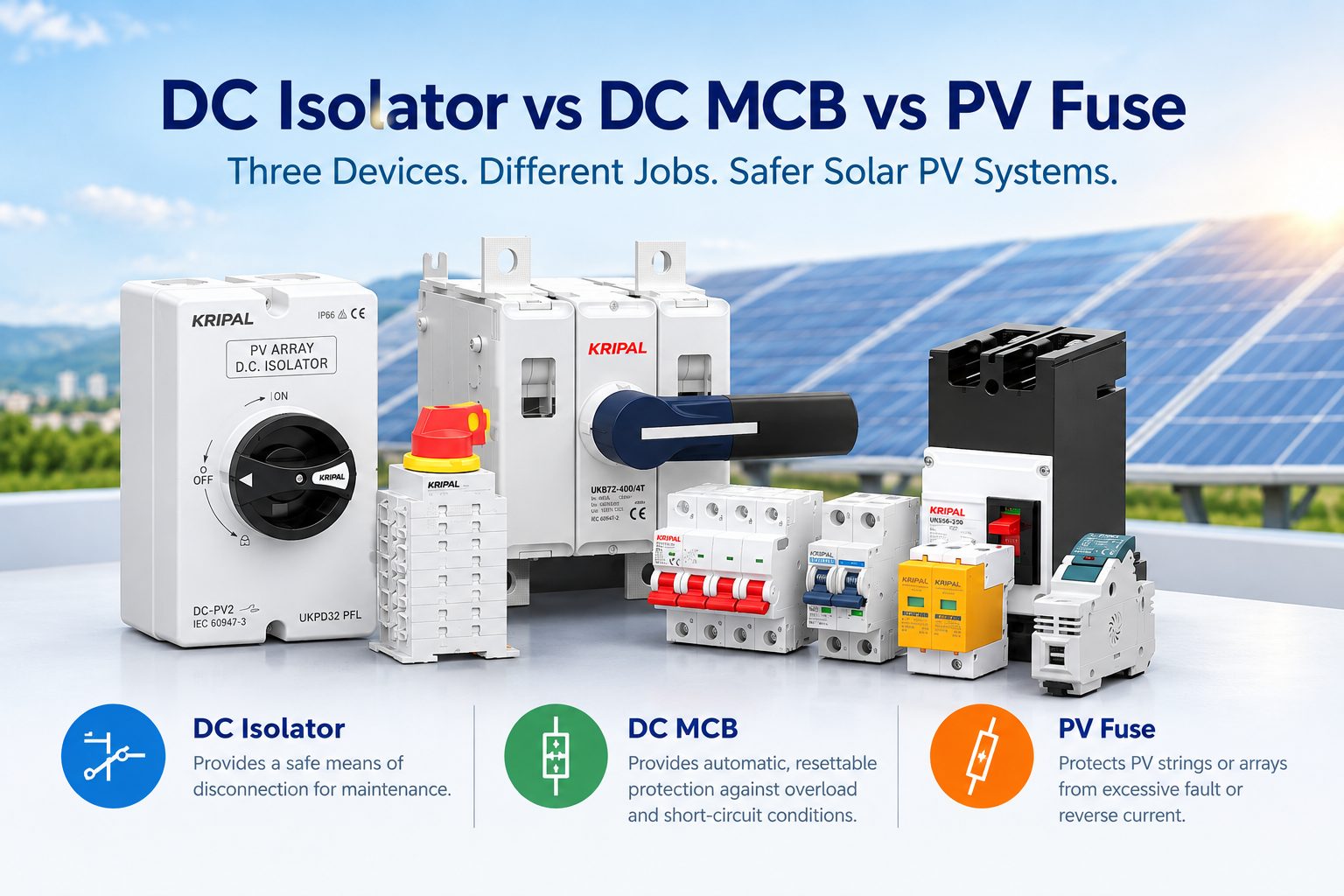
DC Isolator vs DC MCB vs DC Fuse: Different Jobs in PV Systems
The three devices should not be treated as interchangeable.
| Device |
Main function |
Automatic operation |
Typical application |
| DC isolator |
Provides electrical isolation for maintenance |
No |
PV array or inverter DC isolation |
| DC MCB |
Overload and short-circuit protection, with resettable operation |
Yes |
DC circuits where circuit-breaker protection is required |
| PV fuse |
Overcurrent protection for PV strings or arrays |
Yes |
String or array protection where required |
The exact arrangement depends on the PV system architecture, the number of parallel strings, conductor ratings, inverter requirements, available fault current, applicable standards, and local installation rules.
IEC 62548-1:2023+A1:2025 sets out design requirements for PV arrays, including DC array wiring, electrical protection devices, switching, and earthing provisions. The standard therefore provides a broader design framework rather than prescribing one identical protection arrangement for every PV installation.
The DC Isolator: The Maintenance Disconnect
A DC isolator, also known as a DC switch-disconnector when it provides the corresponding switching and isolation functions, is primarily used to disconnect a section of a PV circuit so that maintenance can be carried out safely.
Unlike a circuit breaker or fuse, a conventional isolator does not automatically trip when an overload or short circuit occurs. Its purpose is controlled disconnection rather than automatic overcurrent protection.
DC switching requires equipment specifically rated for the applicable DC voltage and current. This is particularly important in PV systems because a DC arc can continue to be sustained after the contacts separate. The selected device must therefore have an appropriate DC rating and switching capability for the application.
For a PV system, the isolator may be located at the array boundary, near the inverter, or at another position required by the system design and applicable installation requirements. The location should provide a practical means of isolating the relevant circuit before maintenance.
KRIPAL UKGD and UKPD isolator switch ranges are designed for high-voltage DC applications, with versions available for solar PV systems up to 1500 V DC.
The DC MCB: Resettable Overcurrent Protection
A DC MCB provides automatic protection against excessive current, including overload and short-circuit conditions, and can be reset after the fault has been cleared.
Unlike an isolator, an MCB is designed to respond automatically to abnormal current conditions. However, not every DC MCB is suitable for every PV application. The device must be selected according to its DC voltage rating, current rating, pole configuration, tripping characteristics, and breaking capacity.
In a PV system, a circuit breaker may be used on a DC circuit between the PV array or combiner equipment and the inverter when the system design requires circuit-breaker overcurrent protection. The exact location and rating depend on the circuit being protected and the applicable installation requirements.
A DC MCB should therefore be selected based on the circuit it protects rather than simply on the total PV system capacity.
The KRIPAL UKB7Z series provides a DC circuit-breaker solution for applications requiring resettable overcurrent protection and, depending on the specific product configuration, switching or isolation functions. Related options include DC MCCB products and broader circuit breakers for other distribution needs.
DC MCB vs DC Fuse: Which Is Better?
Neither device is universally better. They solve different engineering and operational requirements.
A circuit breaker can be advantageous when resettable protection, convenient switching, or repeated operation is important. A fuse can provide fast fault interruption and a compact solution for applications such as PV string protection.
The correct choice depends on the fault characteristics, system architecture, equipment ratings, coordination requirements, and applicable standards.
The PV Fuse: String and Array Overcurrent Protection
PV fuses are designed specifically for photovoltaic circuits and can provide overcurrent protection for PV strings and arrays.
In a parallel PV configuration, a fault in one string can allow current from other parallel strings to flow toward the faulted circuit. If that possible reverse or fault current exceeds the allowable limits of the module, conductors, or other components, suitable overcurrent protection may be required.
Where string protection is required, PV fuse-links are commonly installed in the combiner box or other suitable location at the string level.
However, it is important not to assume that every PV string always requires a fuse. The need for string overcurrent protection depends on factors such as the number of parallel strings, module maximum series-fuse or overcurrent protection rating, conductor ampacity, short-circuit current, and the applicable installation requirements.
IEC 60269-6 specifies supplementary requirements for fuse-links used to protect PV strings and PV arrays, including circuits with nominal voltages up to 1500 V DC.
KRIPAL UKRT18PV PV fuse holders are designed for solar PV applications and support common PV fuse sizes for DC string protection. They form part of a broader circuit protection offering for PV installations.
Where Do DC Isolators, MCBs, and Fuses Go?
The location of each device should follow the electrical architecture of the PV installation rather than a fixed rule.
PV String Level
Where string overcurrent protection is required, PV fuse-links are commonly installed at the string level, typically inside a combiner box.
Their purpose is to limit excessive current that may flow into a faulted string from parallel circuits. The fuse rating must be coordinated with the PV module, string conductors, operating current, maximum series-fuse rating, and the applicable design requirements.
A fuse that is oversized may fail to provide adequate protection, while an undersized fuse can result in unwanted operation during normal PV conditions.
Combiner or Main DC Circuit
Where the system design requires overcurrent protection on the combined DC circuit, a suitably rated DC circuit breaker may be installed between the PV array or combiner equipment and the inverter.
The breaker must be selected for the actual circuit current and available fault current at its installation point. Its breaking capacity must be sufficient for the prospective fault current under the relevant operating conditions.
The circuit breaker should not be selected simply by adding together the nominal current ratings of individual strings. The actual system configuration and protection requirements must be evaluated.
Inverter DC Input
An isolator or switch-disconnector may be provided at or near the inverter to provide a defined means of disconnecting the DC supply for maintenance.
The exact arrangement depends on the inverter manufacturer’s instructions and the applicable installation requirements. Some equipment may integrate switching, isolation, and overcurrent protection functions into a single device or assembly.
Array Boundary or Building Entry
For some installations, a DC isolating device may also be required at an accessible location near the PV array boundary or building entry point.
This can support emergency isolation, maintenance, or fire-safety requirements where required by local regulations or the project’s safety strategy.
The final location should therefore be determined from the applicable national electrical code, project requirements, inverter documentation, and PV system design.
How to Select the Right DC Protection Device
Selecting a DC isolator, MCB, or PV fuse requires more than matching the nominal system voltage.
1
Check the Maximum DC Voltage
The device must have a DC voltage rating suitable for the maximum voltage that can occur in the circuit.
For PV arrays, the maximum open-circuit voltage should be evaluated under the relevant temperature conditions rather than relying only on the module’s STC voltage.
For example, a PV system described as a 1500 V system requires equipment with an appropriate 1500 V DC rating where that voltage can occur.
2
Check the Operating Current
The current rating must correspond to the circuit in which the device is installed.
For a string fuse, the selection should consider the string short-circuit current, module maximum series-fuse rating, conductor ampacity, operating conditions, and applicable PV protection requirements.
For a DC MCB, the rating should protect the relevant conductor and circuit under normal operating and fault conditions.
For an isolator, the device must be capable of switching and carrying the applicable DC load current at its rated voltage and utilization category.
There is no single multiplier that can safely determine every PV fuse or breaker rating. The manufacturer’s datasheet and applicable PV design standard should always be used for final selection.
3
Check the Breaking Capacity
For an MCB or fuse, the interrupting or breaking capability must be suitable for the available fault current at the installation point.
The fault-current calculation should consider the PV array configuration, parallel strings, inverter characteristics, conductor arrangement, and other relevant sources of fault current.
A device with an adequate current rating but insufficient breaking capacity is not an acceptable substitute for a properly rated protective device.
4
Check Coordination
Protection devices should be coordinated so that the appropriate device operates for the fault being protected.
For example, a string-level fault may require string-level overcurrent protection, while a fault on a downstream main DC cable may require the upstream circuit protection to operate.
Coordination should be verified using the manufacturer’s product data and, where applicable, time-current curves and coordination tables.
Common PV DC Protection Mistakes
Using an AC-Only Device on a DC Circuit
An AC-rated device is not automatically suitable for DC operation.
DC switching and interruption require equipment specifically rated for the applicable DC voltage, current, and operating conditions. Using an AC-only breaker or switch in a DC circuit can result in inadequate arc interruption and serious equipment or safety risks.
Assuming Every PV String Requires a Fuse
String fuses are an important part of many PV combiner-box designs, but the requirement should be determined from the PV system configuration and applicable protection rules.
The number of parallel strings, module protection ratings, conductor ratings, and possible reverse-current conditions all need to be considered.
Oversizing a PV Fuse
A fuse should not be oversized simply to avoid nuisance operation.
The selected fuse must provide effective protection while remaining compatible with the module, cable, connector, and other components in the circuit.
Treating an Isolator as Overcurrent Protection
An isolator does not replace a fuse or circuit breaker unless the particular device is specifically designed and rated to provide the required protective function.
Isolation and overcurrent protection are different functions and should not be confused during system design.
Relevant Standards for Solar PV DC Protection
Several IEC standards may be relevant when selecting DC switching and protection equipment for PV applications.
- IEC 62548-1:2023+A1:2025 — Photovoltaic (PV) arrays – Part 1: Design requirements. It covers PV array DC wiring, electrical protection devices, switching, earthing, and related design safety requirements.
- IEC 60269-6:2010+A1:2021 — Low-voltage fuses – Part 6: Supplementary requirements for fuse-links for the protection of solar photovoltaic energy systems. It applies to PV fuse-links used for PV strings and arrays, including circuits up to 1500 V DC.
For DC circuit breakers and switch-disconnectors, the applicable requirements should also be checked against the relevant IEC 60947 series standard and the national installation requirements for the project.
Standards and national regulations should always be checked against the latest applicable edition for the target market.
FAQ
Can I use a DC MCB as an isolator?
A DC MCB can provide an isolation function only when the specific device is designed, marked, and rated for isolation according to the applicable requirements. Check the manufacturer’s datasheet and markings rather than assuming every MCB can be used as an isolator.
Do I need a fuse on every PV string?
Not necessarily. String overcurrent protection depends on the number of parallel strings, the module’s maximum series-fuse or overcurrent protection rating, conductor ampacity, fault-current conditions, and the applicable installation requirements. Where string protection is required, each string is commonly protected with a suitably rated PV fuse or circuit breaker.
What is the difference between a PV fuse and a DC MCB?
Both can provide overcurrent protection, but they operate differently. A PV fuse is a sacrificial device that must be replaced after operation, while a DC MCB is resettable after the fault has been cleared. The appropriate choice depends on the system architecture, protection requirements, fault characteristics, and operating requirements.
What voltage rating do I need for a 1500 V solar system?
The selected equipment must have an appropriate DC voltage rating for the maximum voltage that can occur at its installation point. For a 1500 V PV system, equipment used on circuits that can reach 1500 V must be appropriately rated for that DC voltage and the relevant application conditions.
Why does my DC MCB keep tripping?
Possible causes include overload, short circuit, incorrect breaker selection, wiring problems, or operating conditions outside the expected design range. Check the circuit current, conductor size, breaker rating and tripping characteristics, and investigate the circuit for faults before simply replacing the breaker with a higher-rated device.
Do I need a DC isolator at the inverter?
An appropriate means of DC isolation may be required at or near the inverter depending on the inverter manufacturer’s instructions and the applicable installation requirements. The purpose is to provide a defined means of disconnecting the DC supply before maintenance.
Three Devices, Three Different Functions
A DC isolator, DC MCB, and PV fuse should not be treated as interchangeable components. The DC isolator provides a controlled means of isolation for maintenance. The DC MCB can provide resettable overcurrent protection and, where appropriately rated, switching or isolation. The PV fuse provides overcurrent protection for PV strings or arrays where required by the system design.
The correct protection arrangement depends on the PV architecture, system voltage, operating current, available fault current, conductor ratings, module requirements, inverter specifications, and applicable standards.
KRIPAL provides DC isolator switches, DC MCBs, and PV fuse holders for solar PV applications, including the UKGD and UKPD DC isolator ranges, UKB7Z DC MCBs, and UKRT18PV PV fuse holders.
Need help selecting DC protection for a PV project? Send us your system voltage, string Isc, number of parallel strings, module maximum series-fuse rating, conductor information, and inverter configuration. Our engineering team can help review the appropriate DC isolator, circuit breaker, and PV fuse arrangement for your application. Browse the DC isolator range, related circuit protection devices, or contact us for application support.
Request a Quote



 Search
 August 02, 2026