Push Button Control Stations Explained: Types, Functions, and Applications
A push button control station provides a simple and reliable way to operate electrical equipment from a local control point. Instead of installing individual push buttons directly into a control panel, a control station combines the buttons, contacts, and enclosure into a compact unit that can be installed close to the machine or operator.
Depending on the configuration, a push button control station can provide start, stop, emergency-stop, or combined start/stop functions. The most common industrial arrangements use normally open (NO) contacts for start commands and normally closed (NC) contacts for stop functions.
For machinery such as pumps, compressors, conveyors, lathes, and processing equipment, choosing the right control station requires more than simply selecting a button color. Contact configuration, electrical rating, enclosure protection, button arrangement, and the intended control function all need to match the application.
What Is a Push Button Control Station?
A push button control station is an enclosed operator-control device containing one or more push buttons and their associated electrical contacts. It allows an operator to send a control signal to equipment without opening the main electrical enclosure.
A typical station may contain:
- A push button or emergency-stop actuator
- Normally open (NO) or normally closed (NC) contacts
- An enclosure
- Cable entry and sealing components
- Terminals for connection to the control circuit
The main advantage is that the control point can be positioned where the operator needs it. For example, a pump may have its main electrical equipment located inside a control cabinet while a start/stop station is installed nearby for local operation.
A single-button station can provide one control function, while a two-button station can combine start and stop functions. Other configurations can combine normal machine control with an emergency-stop function.
How Does a Push Button Control Station Work?
Most industrial push button control stations operate by changing the state of an electrical contact when the button is pressed.
A momentary push button returns to its normal position when released. A normally open contact is open when the button is at rest and closes when pressed. A normally closed contact is closed at rest and opens when pressed.
This makes different contact types suitable for different control functions.
For example, a typical start command uses an NO contact. Pressing the button temporarily closes the control circuit and sends a start signal to a relay, contactor, PLC, or other control device.
A stop command commonly uses an NC contact. The control circuit remains closed during normal operation, and pressing the stop button opens the circuit.
The push button therefore does not normally switch the motor power directly. Instead, it provides an input to the control circuit that determines how the equipment operates.
Common Types of Push Button Control Stations
Different machines require different button combinations. Selecting the correct station starts with understanding the control function.
Single Start Push Button Station
A single start station uses a push button to provide a start command to the control circuit. It is commonly used when the stop function is provided elsewhere or when the machine has another control arrangement. A normally open contact is typically used for the start command because the circuit remains open until the operator presses the button.
Single Stop Push Button Station
A stop station is designed to interrupt the control circuit when pressed. A normally closed contact is commonly used so that the control circuit remains closed during normal operation. This arrangement can also help detect certain wiring faults because an open circuit can result in the equipment being stopped rather than leaving the stop function unavailable.
Start/Stop Push Button Station
A start/stop station combines two push buttons in one enclosure. The start button is normally NO, while the stop button is normally NC. This is one of the most common arrangements for local machine control. In a conventional contactor control circuit, pressing Start energizes the contactor coil. An auxiliary contact can then provide a holding or seal-in path, allowing the contactor to remain energized after the Start button is released. Pressing Stop opens the control circuit and releases the contactor. This type of control is commonly used with motors, pumps, compressors, conveyors, and other machinery.
Emergency Stop Control Station
An emergency-stop station serves a different purpose from a standard start or stop station.
An emergency-stop device is typically designed with a mechanically latching actuator so that the emergency-stop condition remains active after the operator releases the actuator. Resetting normally requires a deliberate manual action, such as twisting or pulling the actuator, depending on the design.
Emergency-stop devices commonly use normally closed safety contacts. However, an NC contact by itself does not make a complete circuit safety-rated. The complete emergency-stop function must be designed according to the applicable machinery and electrical safety requirements.
This distinction is important when selecting a push button control station: a standard momentary push button should not automatically be treated as an emergency-stop device.
NO vs NC: Which Push Button Contact Do You Need?
The contact arrangement should be selected according to the required control function.
An NO contact is open when the button is at rest and closes when pressed. An NC contact is closed when the button is at rest and opens when pressed.
For a conventional start/stop circuit, this arrangement provides a straightforward control philosophy: Start sends a command when pressed, while Stop interrupts the control circuit when pressed.
The actual contact configuration should always be confirmed against the machine control schematic and the requirements of the equipment being controlled.
| Control Function |
Typical Contact |
| Start |
Normally Open (NO) |
| Jog/Inching |
Normally Open (NO) |
| Reset |
Normally Open (NO) |
| Stop |
Normally Closed (NC) |
| Emergency Stop |
Typically NC safety contacts |
| Other control signals |
Depends on circuit design |
Push Button Control Station Wiring for Start and Stop
A typical start/stop control circuit uses the stop contact and start contact as part of the contactor control circuit.
The Stop button is normally wired in series with the contactor coil. The Start button is connected so that pressing it energizes the coil. Once the contactor operates, an auxiliary contact can provide the holding path.
Press Start → Contactor energizes → Auxiliary contact maintains the circuit → Release Start → Equipment continues running
Press Stop → Control circuit opens → Contactor de-energizes → Equipment stops
Actual wiring depends on the control voltage, contactor arrangement, machine design, and applicable standards. A qualified person should verify the complete circuit before installation or modification.
Jog and Inching Applications
A push button control station can also be used for jog or inching operations.
Unlike a maintained run command, a jog function normally operates equipment only while the control command is being applied. Releasing the button removes the command.
Jogging can be useful when an operator needs to position equipment during setup, move a conveyor a short distance, or adjust machinery before normal operation.
The exact jog circuit should be designed for the machine because some equipment requires additional interlocking or control logic to prevent unintended operation.
Choosing the Right IP Rating
The enclosure’s IP rating is an important consideration when installing a push button control station.
The appropriate rating depends on the installation environment, including exposure to dust, water, moisture, and cleaning processes. A station intended for a protected indoor installation may have different requirements from one installed outdoors or in an area exposed to water.
The enclosure rating is also dependent on proper installation. Cable glands, cable entries, unused openings, gaskets, and button seals need to be correctly installed to maintain the intended level of ingress protection.
For example, an enclosure designed to provide high ingress protection cannot deliver that protection if an improperly sealed cable entry creates a path for water or dust. For related field equipment, see KRIPAL’s outdoor waterproof switch range.
How to Choose a Push Button Control Station
Before selecting a control station, consider the actual control requirements rather than choosing a product based only on button appearance.
1. Determine the Control Function
First identify whether the station is required for:
- Start
- Stop
- Start/Stop
- Jog
- Emergency Stop
- Combined control functions
This determines the appropriate button and contact arrangement.
2. Check the Contact Configuration
Confirm whether the application requires NO, NC, or a combination of contacts.
Start and jog functions commonly use NO contacts, while stop functions commonly use NC contacts.
3. Check the Electrical Rating
The electrical rating of the contacts must be suitable for the control circuit. Do not assume that the enclosure’s rating alone determines whether the button can be connected directly to a particular load.
The KRIPAL 56 Series product information supplied for this article specifies a rated current of 10 A at 250 V, with utilization-category ratings shown for AC-15 at 240 V and DC-13 at 24 V. The actual circuit should be checked against the applicable utilization category and load characteristics before selection.
4. Select the Required Button Combination
A single-button station may be sufficient for one control function, while a two-button station can provide convenient start/stop control from one location.
For applications requiring emergency-stop functionality together with normal machine control, a combined station can provide both functions in a single enclosure, provided the selected configuration is appropriate for the required safety function.
5. Consider the Installation Environment
The enclosure and sealing arrangement should match the environment where the station will be installed. Consider moisture, dust, outdoor exposure, cleaning, mechanical conditions, and cable-entry requirements.
KRIPAL 56 Series Push Button Control Stations
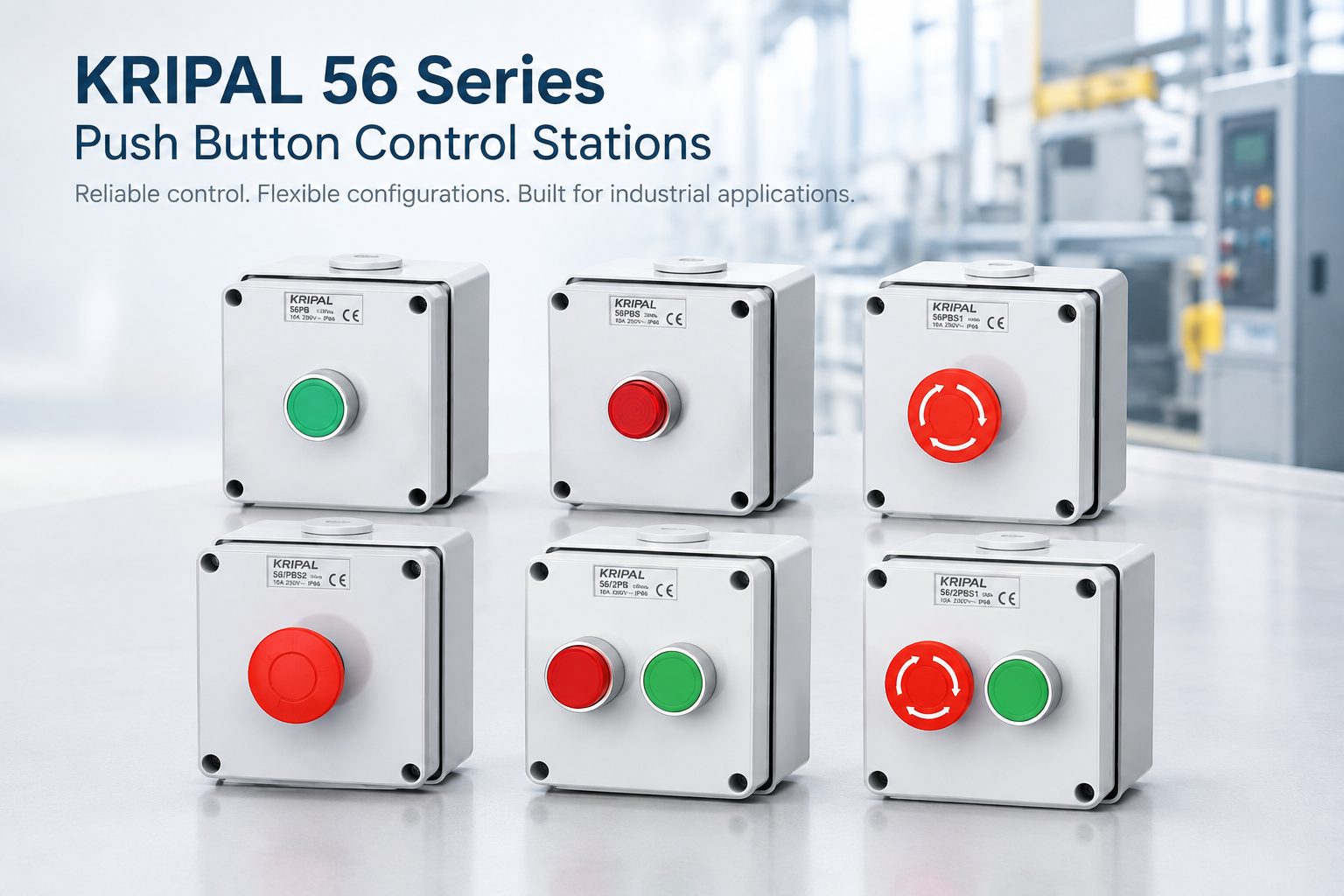
KRIPAL’s 56 Series provides several push button control station configurations for local machine control.
The supplied product information shows six configurations:
- 56PB – Start control station
- 56PBS – Stop control station
- 56PBS1 – Emergency stop station
- 56PBS2 – Stop station with emergency-stop configuration
- 56/2PB – Combination start/stop control station
- 56/2PBS1 – Combination start/stop control station with an emergency-stop button
This range allows the control station to be selected according to the required machine-control function rather than using the same enclosure for every application.
The supplied specifications show a 10 A rated current and 250 V rated voltage, with IP66 protection, and conductor sizes of 1 to 4 mm² for the listed configurations. The dimensions vary according to the station configuration. These values should be checked against the current product datasheet before final selection.
Maintaining a Push Button Control Station
Regular inspection helps maintain reliable operation.
Check that the enclosure cover is properly secured and that the gasket remains in good condition. Cable glands should be tight and appropriately sealed, while unused cable entries should not compromise the enclosure’s protection.
The push buttons should also operate smoothly without sticking or excessive mechanical resistance. For emergency-stop devices, the actuator and reset mechanism should be checked as part of the machine’s required safety inspection and maintenance procedure.
Any damaged enclosure, seal, actuator, or electrical connection should be addressed before the station is returned to service.
FAQ
What is a push button control station?
A push button control station is an enclosed operator-control device containing one or more push buttons and electrical contacts. It provides a local interface for functions such as starting, stopping, jogging, resetting, or emergency stopping equipment.
What is the difference between a push button and a push button control station?
A push button is the operator interface itself, while a push button control station combines one or more buttons and their electrical contacts inside a dedicated enclosure for installation and operation in a particular location.
Should a start button be NO or NC?
A conventional start button is normally open (NO). Pressing the button closes the contact and sends a start command to the control circuit.
Should a stop button be NO or NC?
A conventional stop button is normally closed (NC). Pressing it opens the control circuit and removes the run command. This arrangement can also provide a fail-safe response to certain open-circuit faults.
What IP rating should a push button control station have?
The required IP rating depends on the installation environment and exposure to dust and water. The enclosure rating should be considered together with cable glands, cable entries, seals, and installation practices.
Is an emergency stop the same as a momentary push button?
No. Although emergency-stop devices commonly use NC contacts, a proper emergency-stop device typically incorporates a mechanical latching mechanism so that the emergency-stop condition remains active until deliberate manual reset. A standard momentary push button should not automatically be used as an emergency-stop device.
Conclusion
A push button control station is more than a collection of buttons inside an enclosure. The button configuration, NO or NC contacts, electrical rating, enclosure protection, and intended control function all determine whether the station is appropriate for a particular machine.
For conventional applications, start and jog commands commonly use NO contacts, while stop functions commonly use NC contacts. Emergency-stop applications require purpose-designed emergency-stop devices and an appropriately designed safety function.
KRIPAL’s 56 Series provides different single-button, start/stop, and emergency-stop configurations for local machine control. Selecting the appropriate configuration according to the control circuit and installation environment can provide a practical and reliable operator interface for industrial equipment. Contact KRIPAL for application guidance.
Request a Quote



 Search
 July 26, 2026