Search
Knowledge Center
How to Choose a Reliable Circuit Breaker Supplier
Learn how to verify circuit breaker suppliers through certificates, factory audits, sample testing, traceability, and total cost analysis.
 July 19, 2026
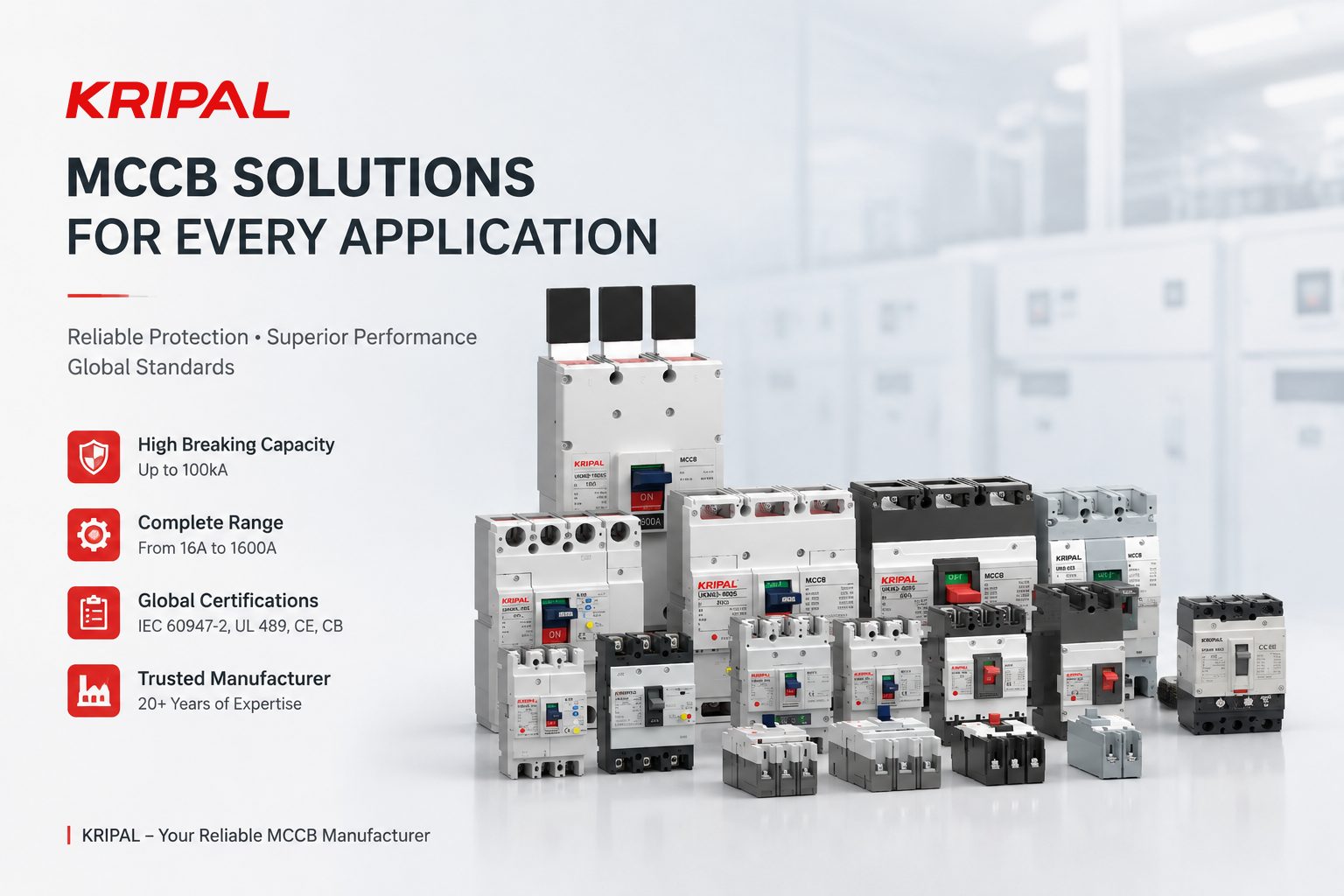
A circuit breaker is the last device between your equipment and a short circuit. When it fails to trip, the result is fire, damaged machinery, or worse. Yet most buyers choose a breaker supplier on price per unit and hope for the best. As a manufacturer specializing in MCCBs and low-voltage circuit protection products, KRIPAL has supported global customers for more than 20 years in selecting reliable protection solutions.
This guide covers what to verify before you commit: certificates, factory audits, real sample testing, and the cost calculations that separate a genuine manufacturer from a trader with a logo.
Start with the Application
Before you compare suppliers, write down what the breaker must actually do in your installation. Voltage, current, breaking capacity, trip curve, number of poles, mounting style, and the standard the application must meet. A breaker that is perfect for a US industrial panel may be useless for a European residential board. The testing requirements differ between the two markets, and so do the trip characteristics that inspectors will check.
Standards Define the Application
The application also defines the minimum standard. This is where buyers without an electrical background get into trouble. Miniature circuit breakers for residential applications commonly follow IEC 60898-1, while UL 489 applies to branch circuit breakers in North America. UL 1077 devices are generally used as supplementary protection. For industrial low-voltage circuit breakers such as MCCBs, IEC 60947-2 is one of the main applicable standards. These are not interchangeable. A supplier who cannot tell you which standard applies to which product is a supplier to walk away from.
The standards question is not academic. It determines the breaking capacity the breaker must prove, the trip curve tolerances it must hold, and the documentation customs and inspectors will ask to see. A breaker that meets IEC 60898 but is sold into an industrial application where IEC 60947-2 is required is noncompliant regardless of how well it performs, because it was never tested for the duty.
The Three Documents That Matter
Ask for three documents: the certificate, the test report, and the Declaration of Conformity. Then verify each one rather than filing it away.
The Certificate
The certificate lists the manufacturer, the facility, the product range, and the expiration date. Check that the manufacturer name matches the factory you are buying from, not a parent company three levels up. Check that your specific model series is listed. A certificate covering circuit breakers does not cover every breaker the supplier sells.
The Test Report
The test report shows the tested values: breaking capacity, trip times, temperature rise, and dielectric strength. This is the document that tells you whether the breaker actually does what the datasheet claims. The datasheet describes the design intent. The test report records the measured result. A certificate alone may not provide sufficient technical evidence. The related test report helps verify the actual tested performance.
The Declaration of Conformity
The Declaration of Conformity is the manufacturer’s legal statement for CE markets. It references the directives and standards, and it names the issuing location and date. For CE self-declared products, this document plus the technical file is the entire compliance package. Its absence is a compliance gap, not a paperwork preference.
For UL-listed products, the file number on the label can be verified in UL’s public database, which shows the active listing and the facility. We hold active listings for our MCCB range and publish the file references on request. A supplier who cannot produce a verifiable file number should be treated as unverified, regardless of how persuasive the sales presentation is.
Note for Non-EU Manufacturers
A valid CE Declaration of Conformity must include details of an EU-authorized representative (EU Rep). Without EU Rep information, the DoC will not be accepted by EU customs or market surveillance authorities.
What the Documents Do Not Tell You
Documents prove the product passed a test. They do not tell you whether the factory still produces to that standard, whether the batch on your dock matches the tested sample, or whether the company will exist in two years to honor the warranty. Those questions are answered by the audit, not by the paperwork. Buyers who stop at the certificate stage are buying a test result, not a quality system.
Audit the Factory, or Send Someone Who Can
A certificate proves that a product passed a test at one moment in time. It does not prove that every unit shipped matches that test. That gap is closed by factory quality systems, which is why the follow-up inspection visits from the certification body matter. Your own audit matters even more, because the certification body visits for its own purposes, not for yours.
The Four Audit Areas
Incoming Material Control
Do they test the copper, plastics, and bimetal strips before production, or do they trust their raw material supplier?
In-Process Testing
Is every unit tested for trip time and dielectric strength, or only a sample?
Calibration
Are the test instruments calibrated and traceable to a recognized standard?
Traceability
Can they trace a shipped batch back to the production date and the material lots?
The biggest single question is whether they test 100 percent of units or a sample. High-quality manufacturers normally implement 100% routine testing for critical functions before shipment as their internal quality control strategy, even though applicable standards do not explicitly mandate 100% testing for every unit. A single failed breaker in a batch is a safety issue, not a quality statistic. A batch failure does not cost you a percentage of the order. It costs you whatever the failed breaker destroys downstream. For example, KRIPAL tests every MCCB for trip function before packaging. You may use this practice as one benchmark when evaluating potential suppliers.
What a Remote Audit Can Still Reveal
If a full factory visit is not possible, a remote audit still gets you most of the way there. Ask for a live video walkthrough of the production line and the test station, with the camera held on the test equipment while it runs. Ask for the calibration certificates of the test instruments and the dates of the last certification body visit. Ask for batch traceability records in real time, not screenshots prepared in advance. A genuine manufacturer should be able to provide this information transparently. Suppliers without direct manufacturing capability may not be able to provide the same level of detail.
Check the Trip Curves on Real Samples
Datasheets show idealized curves. Real breakers have manufacturing tolerances, and the batch you receive will sit somewhere inside a tolerance band. The test report shows the guaranteed band. Your own sample testing confirms that the production actually sits inside it. Neither document is a substitute for the other.
What to Test on Incoming Batches
Order samples drawn from your actual production batch, rather than special preselected “golden samples” kept only for sales demonstration. Test three things: trip time at the rated overload, trip at the magnetic threshold, and temperature rise at rated current. If the samples do not match the datasheet within the stated tolerance, the supplier has a quality problem regardless of the certificates. The certificates describe one point in time. The samples describe what they are shipping now.
For batch consistency, ask about the production lot size and the traceability records. A supplier who cannot tell you which lot your samples came from cannot control what you will receive in bulk. That lack of control surfaces as field failures months later, usually after the payment terms have settled.
Building a Simple Incoming Test Rig
You do not need a laboratory to run a useful incoming test. A variable transformer, a current clamp, and a timer are enough to verify overload trip function on most breakers. Note that simple DIY setups cannot reliably generate the high short-circuit current burst required for magnetic instantaneous trip testing; for magnetic threshold validation, use proper test equipment or third-party lab services. Perform sample verification according to the applicable IEC or UL requirements and the manufacturer’s test specifications. The test takes minutes per unit, and it catches the two most common production faults: mis-set trip calibration and damaged mechanisms from handling.
Compare Total Cost, Not Unit Price
The cheapest breaker per unit is rarely the cheapest breaker installed. The failure cost is invisible until it happens. A breaker that trips late destroys the downstream equipment. A breaker that trips early causes nuisance downtime and lost production. A breaker with poor batch consistency forces you to stock more spares. A failed breaker in the field creates warranty claims, shipping costs, and account damage that no unit-price savings cover.
The price difference between a certified manufacturer and a no-name trader is often 20 to 40 percent. That sounds like a real savings until you model the downside. In many industrial applications, the cost of a field failure can significantly exceed the initial product price difference. The loss shows up in places the accounting never traces back to the purchasing decision.
The True Cost of a Field Failure
Walk through one scenario. A 250A MCCB fails to trip on a short circuit in a factory distribution board. The arc flash damages the panel and the connected equipment, and possibly injures someone. The direct costs are the panel rebuild, the equipment repair, and the downtime. The indirect costs are the safety investigation, the insurance premium increase, and the customer orders that went elsewhere while the line was down. None of these appear on the purchase order that saved you 30 percent.
The Buyer’s Checklist
Run this checklist before placing the order, and keep the answers in the supplier file rather than in your head.
- Application defined: voltage, current, breaking capacity, curve, poles, and standard
- Certificate verified: manufacturer, facility, model range, and expiration
- Test report reviewed: tested values match the datasheet claims
- File number confirmed: verifiable in the issuing body’s database
- Factory audited: incoming control, 100 percent testing, calibration, and traceability
- Samples tested: trip times and temperature rise inside the stated tolerance
- Batch control confirmed: lot size, traceability records, and how deviations are handled
- Total cost calculated: unit price plus failure cost, not just the unit price
Frequently Asked Questions
How do I verify a circuit breaker certificate?
Check the manufacturer name and facility against your supplier. Confirm your model series is listed. Look up the file number in the issuing body’s public database. The certificate alone is not proof; the test report and the active listing are.
What is the difference between IEC 60898 and IEC 60947 breakers?
IEC 60898 covers miniature circuit breakers for household and similar installations. IEC 60947-2 covers low-voltage switchgear for industrial use. The testing, breaking capacity requirements, and trip characteristics differ. Use the standard that matches your application.
Should I test incoming batches of circuit breakers?
Yes. Sample test at least the trip function on incoming batches, especially when the supplier is new or the application is safety-critical. The cost of a sample test is trivial compared with a field failure.
What is a reasonable MOQ for OEM circuit breakers?
It varies by product and supplier. A serious manufacturer can work with small MOQs for standard products and larger MOQs for custom markings and special trip settings. Ask for the lot size structure rather than a single number.
How do I know if a supplier is a manufacturer or a trader?
Ask for the factory address, production line photos, test equipment list, and certificate facility name. A manufacturer can show you the production line and the test station. A trader can show you a catalog and a website, and the certificate, if there is one, will name a different facility.
What trip curve should I use for motor circuits?
Type D or a motor-rated breaker with an appropriate magnetic threshold, because motors draw high inrush current at startup. Type C is common for general loads, and Type B for circuits with minimal inrush. Confirm the curve against the application before ordering. For industrial motor applications, adjustable trip settings and coordination requirements may also need to be considered.
Can a remote factory audit replace an in-person visit?
It covers most of the ground but not all of it. A live video walkthrough, calibration certificates, and real-time traceability records reveal a lot about a factory. What it cannot show you is the atmosphere of the floor, the housekeeping, and the way operators handle rejected parts. For critical suppliers, combine the remote audit with a visit at least once.
Conclusion
Choose a circuit breaker supplier the way you would choose a component that can fail once and cost you a plant. Verify the certificates in the issuing database. Audit the factory for real testing. Test samples from your actual batch. Price the total cost including failure. We publish our test documentation and welcome factory visits at KRIPAL. Start the conversation with your application details and we will confirm the right breaker, or contact our engineering team for the technical file.
Related Resources
Explore Knowledge Center >

Need a matching KRIPAL product?
Share voltage, quantity and destination. An engineer will reply with options and lead time.