Search
Knowledge Center
How to Wire and Install an RCBO Breaker: Complete Wiring Guide for Single & Three Phase Systems
Learn what an RCBO is, how it works, and follow our step-by-step guide to wiring and installing single-phase and three-phase RCBOs safely.
 June 08, 2026
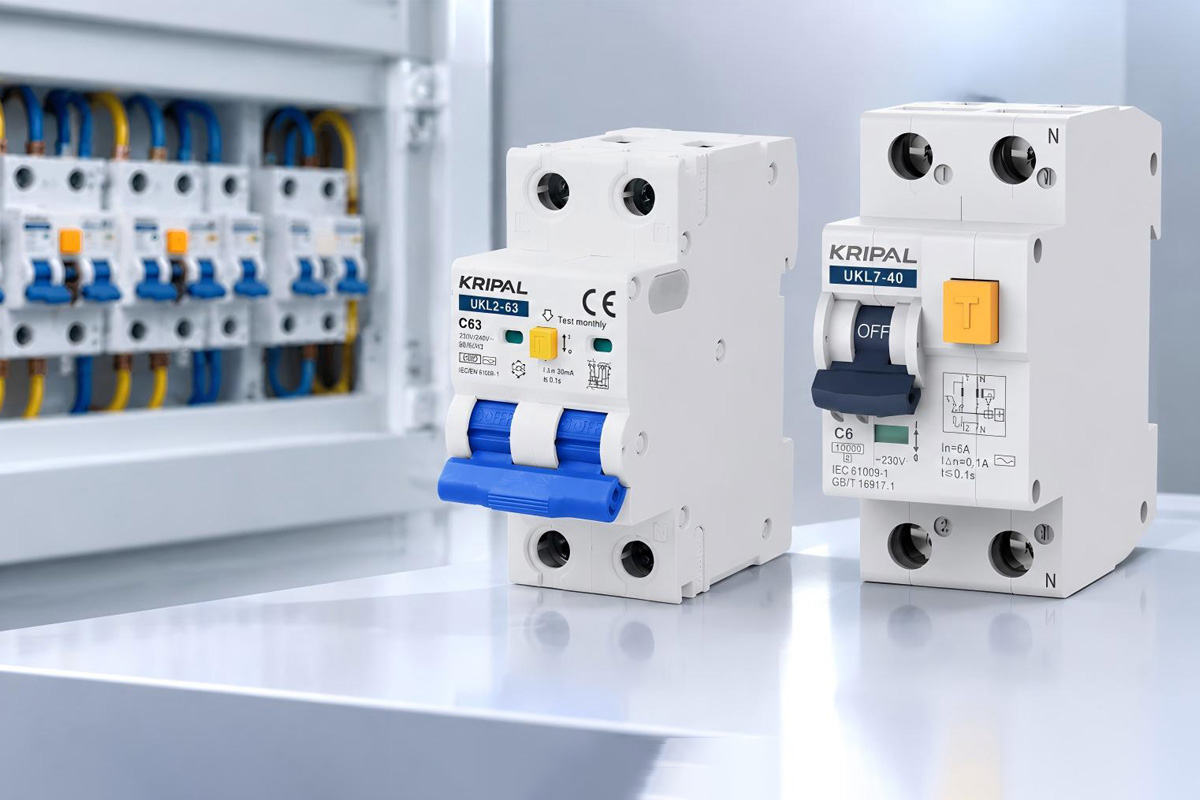
An RCBO (Residual Current Breaker with Overcurrent Protection) is a protective device that combines residual current protection and overcurrent protection in a single compact unit. It integrates the functions of an RCD and an MCB to provide comprehensive protection against electric shock, as well as safeguarding electrical circuits against overloads and short circuits. Unlike traditional RCD + MCB arrangements that may disconnect multiple circuits when a fault occurs, RCBOs provide individual circuit protection, allowing only the affected circuit to be isolated. This guide explains how RCBOs work, how to wire and install them correctly, common installation mistakes, and how to select the suitable RCBO type for different applications.
What Is an RCBO?
An RCBO monitors the current flowing through the circuit and detects residual current imbalance between live and neutral conductors.
- The current exceeds the rated capacity
- A short circuit occurs
- Leakage current is detected between live conductors and earth
Our KRIPAL RCBO series is engineered for reliability, featuring a robust, UV-Resistant PC/ABS Housing that ensures long-term performance in demanding industrial and residential environments.
Where RCBOs Are Commonly Installed
RCBO breakers are commonly installed in residential consumer units, commercial distribution boards, garage circuits, kitchen and bathroom circuits, and industrial power circuits. Many electricians prefer using RCBOs for individual circuit protection because if a fault occurs on one circuit, only the affected circuit is disconnected, ensuring system uptime for the remaining circuits.
Tools and Materials Required
Before installing an RCBO breaker, prepare all necessary tools and equipment to ensure the work can be carried out safely and efficiently. These typically include the RCBO breaker itself, an insulated screwdriver, a wire stripper, a voltage tester or multimeter, the distribution board or consumer unit, suitable electrical cables, and a DIN rail if required for mounting.
Appropriate PPE, including insulated tools and protective equipment required by local regulations, should be used. It is important to select an RCBO with the correct voltage rating, current rating, and protection type suitable for the specific electrical installation.
Safety Precautions Before Installation
Working inside a distribution board involves exposure to live electrical parts. Before wiring an RCBO:
- Switch OFF the main power supply
- Verify isolation using a voltage tester
- Follow local electrical regulations
- Use insulated tools
- Confirm cable sizes and breaker ratings
- Test the RCBO after installation
Electrical installation work should be carried out by qualified personnel where required by local regulations.
Understanding RCBO Terminals
Most single-phase RCBOs are designed with several key terminals and components required for proper operation and protection. These typically include an incoming live terminal, an outgoing live terminal, a neutral terminal, and either a neutral flying lead or a dedicated neutral connection point.
A test button is also provided to allow regular functional testing of the device. In some RCBO designs, a neutral tail wire is included, which connects directly to the neutral bar inside the consumer unit.
Step-by-Step Guide to Wiring an RCBO
Step 1: Turn Off the Main Supply
Switch OFF the main breaker supplying the distribution board. Use a voltage tester to confirm that no voltage is present before touching any conductors.
Step 2: Remove the Distribution Board Cover
Carefully remove the front cover of the consumer unit or distribution board to access the busbar and terminal connections. Keep screws and covers in a safe location during installation.
Step 3: Mount the RCBO
Attach the RCBO securely onto the DIN rail inside the distribution board. Ensure the breaker locks firmly into position.
Step 4: Connect the Incoming Live Supply
Connect the line conductor to the RCBO line terminal according to the manufacturer’s wiring diagram. In many consumer units, the RCBO is supplied from the live busbar. Tighten the terminal screw according to the manufacturer’s torque specification.
Step 5: Connect the Outgoing Load Wire
Connect the outgoing live wire of the protected circuit to the RCBO output terminal. This wire supplies power to the connected load such as sockets, lighting, or appliances.
Step 6: Connect the Neutral Wire
Depending on the RCBO design:
- For standard RCBOs with a flying lead, connect the RCBO neutral flying lead to the main neutral bar, and connect the circuit (load) neutral wire to the outgoing neutral terminal of the RCBO.
- For RCBOs without a neutral flying lead, connect the supply neutral and load neutral to their designated neutral terminals on the RCBO according to the manufacturer’s instructions.
Correct neutral wiring is necessary for proper residual current detection.
Step 7: Connect the Earth Wire
The earth conductor does not connect directly to the RCBO. Instead, connect it to the earth bar within the distribution board.
Step 8: Check All Connections
Before energizing the system:
- Verify terminal tightness
- Confirm correct cable routing
- Ensure live, neutral, and earth conductors are properly connected
- Check that no exposed copper is visible
Step 9: Restore Power
Reinstall the distribution board cover and switch ON the main supply. Then switch ON the RCBO.
Step 10: Test the RCBO
Press the TEST button on the RCBO. The breaker should trip immediately. This confirms the residual current protection is functioning correctly. Reset the breaker after testing.
Single-Phase & Three-Phase RCBO Wiring
Single-Phase RCBO Wiring
Single-phase RCBOs are commonly used in homes with 230V AC supply systems.
Typical connections include:
- Live input from the busbar
- The RCBO’s neutral flying lead (tail) connected to the main neutral bar
- Both outgoing live and neutral wires connected directly to the load circuit via the RCBO terminals
These RCBOs are often labeled as:
- 1P + N
- Single-pole RCBO
Three-Phase RCBO Wiring
Three-phase RCBOs are commonly used in commercial and industrial electrical installations where multiphase equipment requires both residual current protection and overcurrent protection. Available configurations may include 3P, 3P+N, and 4P designs depending on the system requirements. Compared with single-phase RCBOs, three-phase RCBOs provide protection for multiphase circuits, helping improve electrical safety and reliability in high-power applications.
Depending on the configuration, a three-phase RCBO may include L1, L2, L3 phase terminals and a neutral terminal. The protective earth conductor connects directly to the distribution board’s earth bar and remains separate from the RCBO. During installation, all phase conductors and the neutral conductor (where applicable) must be connected correctly according to the manufacturer’s wiring diagram.
Proper phase balancing is also important in three-phase systems because uneven loading can increase neutral current, reduce system efficiency, and affect overall system performance.
Correct neutral wiring is essential for accurate residual current detection. Incorrect neutral connections, shared neutrals between circuits, or loose terminals may cause nuisance tripping or incorrect RCBO operation. Therefore, all connections should be tightened according to the manufacturer’s specifications, tested carefully, and verified before energizing the system.
Common RCBO Installation Mistakes
Incorrect Neutral Connections
Incorrect neutral wiring can cause nuisance tripping or prevent the RCBO from operating properly. Problems may occur if neutrals are shared between circuits or connected to the wrong neutral bar. To ensure correct operation, each circuit neutral should remain connected to its corresponding RCBO and follow the manufacturer’s wiring diagram.
Loose Terminal Connections
Loose terminal connections can cause overheating, unstable electrical contact, and unreliable RCBO operation. Over time, poor connections may also damage wires or terminal components. All terminal screws should be tightened correctly according to the manufacturer’s specifications during installation.
Wrong RCBO Type
Electronic devices and modern appliances often require Type A protection. Choosing the wrong type might lead to inadequate protection.
Overloading the Circuit
Overloading a circuit can cause overheating, nuisance tripping, or damage to electrical equipment. The RCBO rating should always match the cable size and the expected load of the circuit. Using an RCBO with an incorrect current rating may reduce protection performance and affect safe operation.
| RCBO Type | Detects | Typical Applications | Features |
|---|---|---|---|
| Type AC | Alternating sinusoidal AC leakage currents only | Traditional resistive loads, basic lighting circuits, electric heaters | Detects sinusoidal AC residual currents only. Suitable for simple AC circuits without electronic components. However, it cannot detect pulsating DC residual currents produced by modern electronic devices, so Type A or higher protection types are commonly preferred for new installations. |
| Type A | AC leakage currents and pulsating DC leakage currents | Washing machines, dishwashers, LED lighting, computers, kitchen appliances, power supplies | Commonly used in modern residential installations. Suitable for circuits containing electronic devices and inverter-based equipment. |
| Type F | AC, pulsating DC, and high-frequency leakage currents | Air conditioners, heat pumps, inverter-driven motors, variable-speed appliances | Provides improved protection for equipment using frequency converters or variable-speed drives. Offers better resistance to nuisance tripping. |
| Type B | AC, pulsating DC, smooth DC, and high-frequency leakage currents | EV chargers, solar PV systems, industrial drives, medical equipment, three-phase inverters | Used in advanced commercial and industrial applications where smooth DC leakage currents may occur. Supports a wider range of fault detection. |
Advantages of Using an RCBO
RCBO breakers offer several practical benefits:
- Combined overload and leakage protection
- Individual circuit isolation
- Reduced nuisance shutdowns
- Compact installation
- Easier fault identification
Many modern consumer units now use RCBOs instead of shared RCD protection for multiple circuits.
Conclusion
If you need help with RCBO selection, wiring, or installation, feel free to contact our team.
FAQ
Q: Can an RCBO replace both an MCB and an RCD?
Yes. An RCBO combines overcurrent protection and residual current protection in one device, replacing the separate functions of an MCB and RCD for individual circuits.
Q: Why does my RCBO keep tripping?
Frequent tripping may be caused by earth leakage, incorrect neutral connections, overloaded circuits, damaged appliances, or incorrect RCBO selection.
Q: Does an RCBO need an earth connection?
The protective earth conductor normally connects to the distribution board earth bar rather than directly through the RCBO.
Q: What is the difference between Type A and Type B RCBO?
Type A detects AC and pulsating DC residual currents and is common in modern residential circuits. Type B can detect smooth DC residual currents and is typically used for applications such as EV charging, solar PV systems, and industrial drives.
Related Resources
Explore Knowledge Center >


Need a matching KRIPAL product?
Share voltage, quantity and destination. An engineer will reply with options and lead time.