Search
Knowledge Center
RCBO Consumer Unit vs. Split Load: Which Configuration to Choose
Compare RCBO and split load consumer units: fault isolation, BS 7671 requirements, nuisance tripping, cost, and when each configuration fits your project.
 July 14, 2026
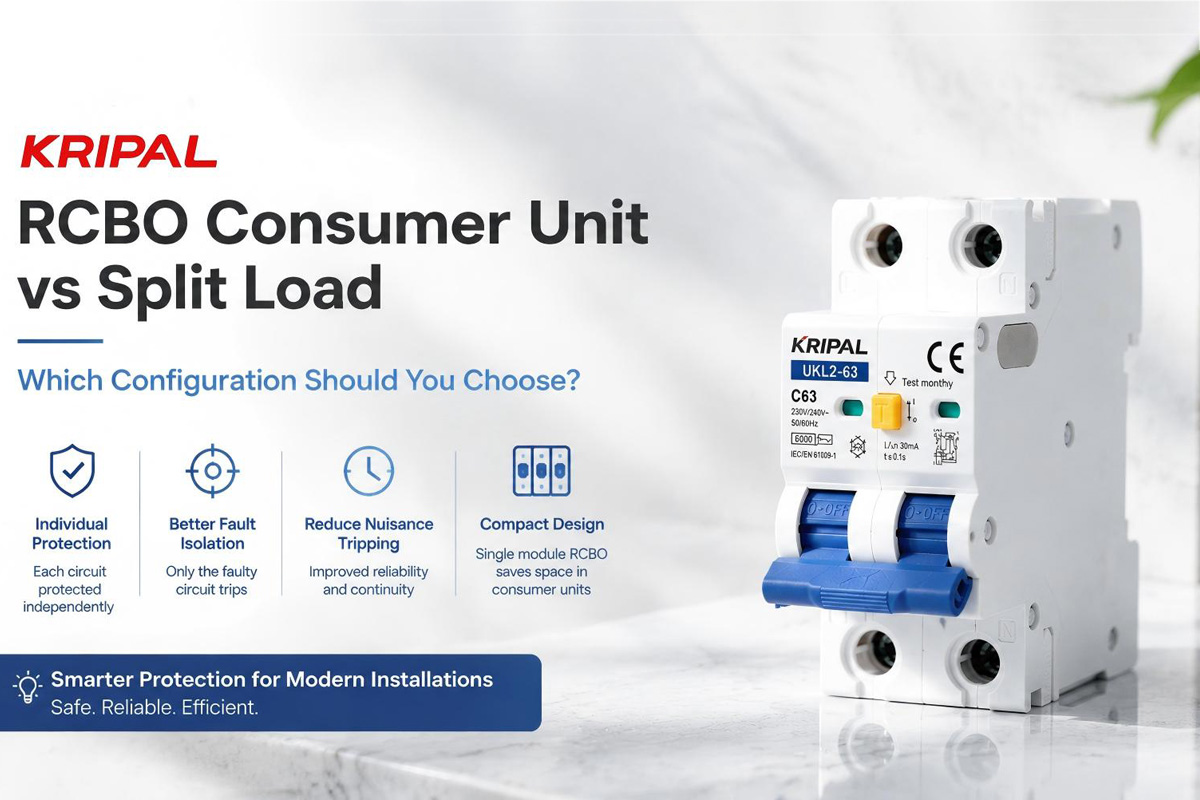
Modern electrical installations require reliable protection, especially as homes and commercial buildings use more electronic equipment and higher electrical loads.
When choosing a distribution system, the main options are a split load consumer unit and an all-RCBO consumer unit. A split load design uses shared RCD protection for groups of circuits, while an all-RCBO consumer unit provides individual protection for each circuit.
This article explains the key differences between RCBO and split load consumer units, including fault isolation, BS 7671 requirements, installation considerations, and how to choose the right solution for your application.
How Each Configuration Works
Split-Load Consumer Unit
A split load consumer unit divides circuits into separate groups, with each group protected by an RCD. Individual MCBs then provide protection against overload and short circuits for each circuit. For example, one RCD may protect several socket circuits, while another RCD protects lighting or other circuits.
The main advantage of this design is its lower initial cost and simple structure. However, because multiple circuits share the same RCD, a fault on one circuit may disconnect other unaffected circuits. For homeowners and businesses, this can result in unnecessary disruption. A single faulty appliance or damaged cable may cause loss of power to several areas of the building.
All-RCBO Consumer Unit
An all-RCBO consumer unit provides dedicated protection for each final circuit.
An RCBO combines:
- Residual current protection
- Overcurrent protection
in a single device.
When a fault occurs, only the affected circuit trips. Other circuits remain powered, improving reliability and making fault identification much easier.
Modern single module RCBOs have made all-RCBO installations more practical because they provide individual circuit protection while maintaining compact consumer unit designs.
Nuisance Tripping and Selectivity
One of the biggest differences between RCBO and split load consumer units is how they manage leakage current. Modern electrical equipment such as LED drivers, computers, power supplies, and smart appliances can create small amounts of normal leakage current.
In a split load consumer unit, leakage from several circuits is combined because they share the same RCD. As the total leakage increases, the RCD may become more likely to trip when an additional fault occurs. The challenge is that the user may not immediately know which circuit caused the problem. The electrician must test multiple circuits to locate the fault.
An all-RCBO consumer unit avoids this issue by monitoring each circuit independently. Background leakage on one circuit does not affect other circuits.
This provides:
- Better fault isolation
- Faster troubleshooting
- Reduced power interruption
For installations where continuity of supply is important, individual RCBO protection provides a clear advantage.
Comparison of the Two Configurations
| Feature | Split Load Consumer Unit | All-RCBO Consumer Unit |
|---|---|---|
| Protection method | Shared RCD + MCBs | Individual RCBOs |
| Fault impact | Multiple circuits may disconnect | Only faulty circuit disconnects |
| Fault identification | Requires investigation | Immediate identification |
| Leakage management | Combined across circuits | Individual monitoring |
| Initial cost | Lower | Higher |
| Long-term reliability | More inconvenience after faults | Better continuity of supply |
| Space efficiency | Requires separate RCD groups | Compact with single module RCBOs |
BS 7671 Requirements and Modern Protection
The IET Wiring Regulations BS 7671 place increasing emphasis on effective RCD protection and reducing inconvenience caused by electrical faults.
Socket Outlet Protection
BS 7671 Regulation 411.3.3 requires 30mA RCD protection for many socket outlets up to 32A. In a split load system, several socket circuits may share one RCD. A fault on one circuit may therefore affect other circuits protected by the same device. With an all-RCBO consumer unit, each socket circuit has independent protection.
Lighting Circuit Protection
For domestic installations, BS 7671 Regulation 411.3.4 requires RCD protection for many lighting circuits. Individual RCBO protection helps prevent a single lighting fault from affecting multiple areas of a building. This is particularly useful in homes, rental properties, and commercial buildings where maintaining lighting availability is important.
AFDD Considerations
BS 7671 Regulation 421.1.7 addresses arc fault detection devices (AFDDs) for certain higher-risk applications. Because AFDDs operate at circuit level, they are often easier to integrate into distribution systems where each circuit already has dedicated protective devices.
When Should You Choose an All-RCBO Consumer Unit?
An all-RCBO consumer unit is particularly suitable for modern installations where reliability and circuit availability are important.
Typical applications include:
- New residential projects requiring improved circuit separation
- Homes with high numbers of electronic devices
- Offices and commercial buildings where power interruption affects productivity
- Properties where users require reliable lighting and essential circuits
Although the initial equipment cost is higher, the long-term benefits often justify the investment through easier maintenance and reduced disruption.
When Is Split Load Still Suitable?
Split load consumer units remain a practical choice for simple installations where budget and circuit requirements are limited.
They may be suitable for:
- Small workshops
- Garages
- Extensions
- Basic electrical installations
However, designers should consider the possible inconvenience caused by shared RCD protection, especially in installations where continuous power is important. For larger or more complex electrical systems, an all-RCBO configuration generally provides better performance.
Frequently Asked Questions
Is an all-RCBO consumer unit more expensive?
Yes. The initial equipment cost is usually higher because every circuit requires an individual RCBO. However, the total cost difference can be reduced when considering easier fault finding, reduced downtime, and improved reliability.
Can an existing split load board be upgraded to RCBO protection?
In some cases, yes. However, compatibility depends on the consumer unit design, available space, busbar arrangement, and selected RCBO model. A complete assessment should be carried out before upgrading.
Are Type A RCBOs better than Type AC RCBOs?
Type A RCBOs can detect residual currents containing pulsating DC components and are commonly used with modern electronic equipment. They are often selected for circuits supplying devices such as EV chargers, heat pumps, and inverter-controlled appliances. The correct RCBO type depends on the application requirements.
Are RCBOs compatible with every consumer unit?
No. Although many RCBOs use DIN rail mounting, compatibility depends on mechanical dimensions, busbar design, and manufacturer specifications. Always confirm compatibility before installation.
Conclusion: Choosing the Right Electrical Protection Solution
The choice between a split load consumer unit and an all-RCBO consumer unit depends on installation requirements, budget, and reliability expectations. Split load systems remain suitable for smaller and simpler applications. However, modern electrical environments increasingly require better circuit separation, easier fault identification, and improved continuity of supply.
An all-RCBO consumer unit provides individual circuit protection, reduces unnecessary power interruptions, and creates a more resilient electrical distribution system. For residential, commercial, and industrial applications, selecting reliable single module RCBO protection can help improve both safety and long-term system performance.
Looking for reliable RCBO solutions for your electrical distribution projects? KRIPAL provides compact single module RCBO products designed for modern residential and commercial applications. Contact our technical team for professional product support.
Related Resources
Explore Knowledge Center >
Need a matching KRIPAL product?
Share voltage, quantity and destination. An engineer will reply with options and lead time.