Search
Knowledge Center
High Voltage vs Low Voltage: Key Differences, Safety Standards & Applications
Compare high voltage and low voltage electrical systems — key differences in safety standards, energy efficiency, applications, and equipment selection. A comprehensive guide covering LV, MV, and HV classifications with practical decision frameworks for engineers and facility managers.
 May 28, 2026
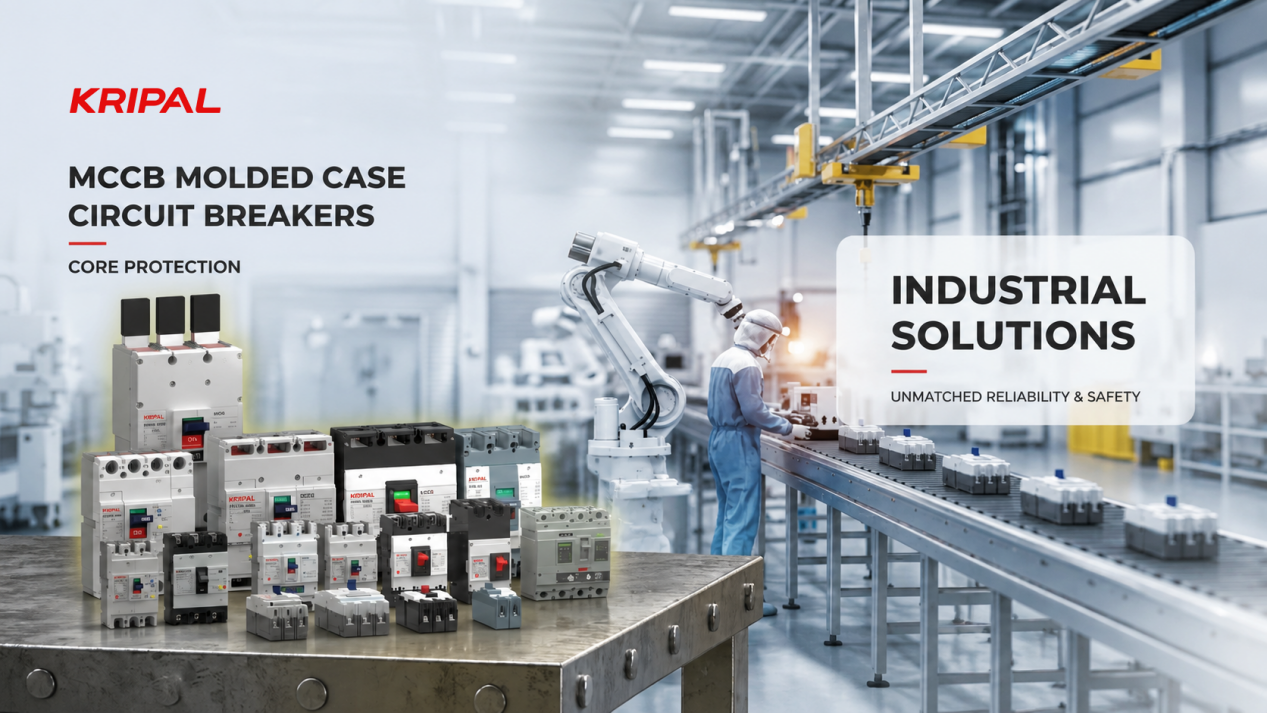
Electricity powers nearly every aspect of modern life — from household appliances and office equipment to industrial machinery and utility networks. Yet not all electrical systems operate at the same voltage level. Depending on the application, electrical power may be transmitted, distributed, or consumed using high voltage, medium voltage, or low voltage systems.
Understanding the differences between high voltage and low voltage helps engineers, facility managers, electricians, and equipment buyers make informed decisions regarding safety, efficiency, and system design. Different voltage levels serve different purposes, and each comes with its own standards, equipment requirements, and operational considerations.
⚡ Key Takeaways
- High voltage systems are primarily used for power transmission and large industrial applications, typically above 35 kV.
- Low voltage systems (up to 1,000 V AC) are found in homes, offices, commercial buildings, and control circuits.
- Higher voltage allows electricity to travel longer distances with significantly lower transmission losses — a core physics principle behind modern grid design.
- Safety requirements become exponentially more stringent as voltage levels increase — specialized certifications and equipment are mandatory.
- Choosing the appropriate voltage depends on distance, power demand, installation costs, and operational requirements — not personal preference.
What Is Voltage?
Voltage is the electrical potential difference between two points in a circuit. It can be thought of as the force that pushes electric current through conductors — analogous to water pressure in a pipe.
The higher the voltage, the greater the potential to move electrical energy across a circuit or network. However, higher voltage also introduces increased insulation requirements, greater safety risks, and more complex equipment designs.
≤ 1,000 V AC
1 kV – 35 kV
> 35 kV
Electrical systems are generally categorized into three groups: Low Voltage (LV), Medium Voltage (MV), and High Voltage (HV). While exact classifications may vary by country and industry standards, these categories provide a practical framework for understanding electrical infrastructure.
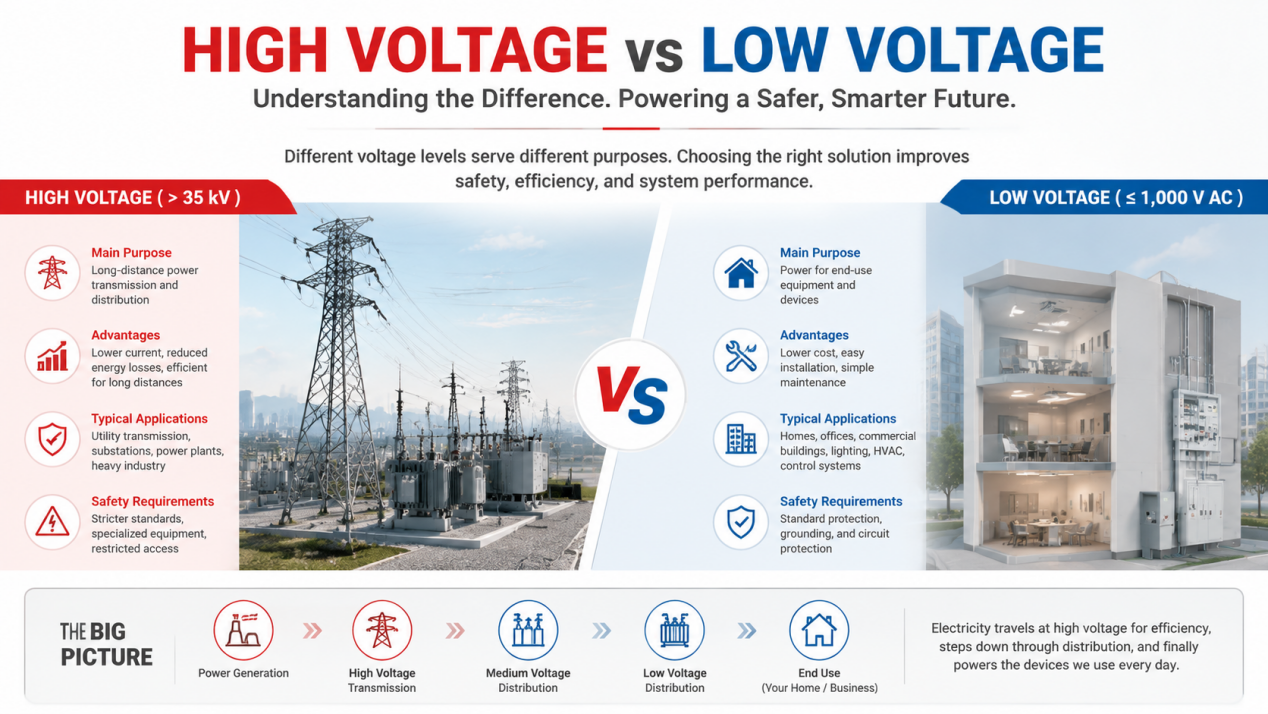
Understanding Low Voltage Systems
Low voltage systems generally operate at voltages up to 1,000 V AC or 1,500 V DC. These systems are commonly encountered in everyday environments and are used to power devices that people interact with regularly. Most household power outlets fall within the low-voltage category, although the actual voltage level varies from region to region.
Advantages of Low Voltage Systems
✅ Improved Accessibility
Low voltage equipment is widely available and easier to install compared to higher-voltage infrastructure. Standard electricians can handle most installations without specialized HV certifications.
✅ Lower Installation Costs
Cable insulation requirements, switchgear complexity, and maintenance procedures are generally less demanding — translating to 30-50% lower upfront capital expenditure versus equivalent MV/HV installations.
✅ Easier Maintenance
Technicians can often troubleshoot and maintain low-voltage systems with less specialized equipment. Routine maintenance can be performed during normal business hours without complex lockout procedures.
✅ Suitable for Short Distances
Low voltage works efficiently when power is consumed relatively close to its source — typically within a few hundred meters for most commercial and residential applications.
Limitations of Low Voltage Systems
The main challenge with low voltage transmission is current. To deliver the same amount of power at a lower voltage, higher current is required — following the fundamental power equation P = V × I. Higher current results in increased conductor size, more heat generation, greater energy losses (I²R), and larger cable costs over long distances. These factors make low voltage less suitable for large-scale power transmission.
Understanding High Voltage Systems
High voltage systems typically operate above 35 kV or 52 kV, depending on regional standards. High voltage is primarily used when large amounts of electricity need to travel long distances efficiently.
High-voltage transmission lines are the backbone of modern electrical grids, carrying power from generating stations to distribution networks — often across hundreds of kilometers with minimal losses.
Advantages of High Voltage Systems
🔋 Minimal Transmission Losses
By stepping up voltage, current drops proportionally for the same power level. Since losses scale with I²R, even modest voltage increases yield substantial efficiency gains over long distances.
🏭 Large-Scale Power Delivery
HV systems can deliver hundreds of megawatts across entire regions — essential for connecting remote generation sites (hydro, solar farms, wind) to urban load centers.
⚙️ Smaller Conductor Cross-Sections
Lower current means thinner (and lighter) conductors for the same power throughput — reducing tower structural loads and material costs for transmission infrastructure.
📊 Better Voltage Regulation
HV transmission lines exhibit lower percentage voltage drop over distance compared to LV distribution, maintaining power quality at the receiving end.
Challenges of High Voltage Systems
⚠️ Specialized Equipment Required
Transformers, switchgear, circuit breakers, and protective relays must be rated for HV operation — significantly more expensive than LV equivalents.
⚠️ Advanced Insulation Systems
HV installations require sophisticated insulation coordination, including SF6 gas-insulated switchgear, oil-filled transformers, and carefully designed creepage/clearance distances.
⚠️ Larger Safety Clearances
Arc flash boundaries, approach distances, and exclusion zones expand dramatically with voltage — requiring more physical space and stricter access controls.
⚠️ Higher Failure Consequences
The consequences of equipment failure are generally more severe than in low-voltage environments — arc flash incidents at HV can release energy equivalent to several kilograms of TNT.
Where Does Medium Voltage Fit In?
Medium voltage serves as the bridge between transmission and end-user distribution. Although classifications vary, medium voltage often ranges from 1 kV to 35 kV. Utility companies frequently use medium voltage distribution networks to deliver electricity from substations to neighborhoods, commercial facilities, and industrial sites.
| Application | Typical Voltage | Key Equipment |
|---|---|---|
| Industrial Manufacturing Plants | 4.16 kV – 13.8 kV | MV switchgear, motor control centers, transformers |
| Hospitals | 13.8 kV primary / 480 V secondary | Dual-source MV switchgear, ATS, emergency generators |
| Airports | 5 kV – 15 kV distribution | Ring main units, MV cables, unit substations |
| University Campuses | 13.8 kV loop distribution | Pad-mounted transformers, MV underground cables |
| Large Commercial Complexes | 13.8 kV service entrance | MV vacuum circuit breakers, protective relays |
| Utility Distribution Feeders | 11 kV – 33 kV | Reclosers, sectionalizers, voltage regulators |
Medium voltage offers a practical balance between transmission efficiency and equipment cost — delivering power at voltages high enough to cover urban and suburban distances economically, yet low enough to use commercially available switchgear and protection devices.
High Voltage vs Low Voltage: Key Differences
| Parameter | Low Voltage (LV) | High Voltage (HV) |
|---|---|---|
| Voltage Range | ≤ 1,000 V AC / 1,500 V DC | > 35 kV (varies by standard) |
| Primary Use | End-user equipment, residential, commercial | Bulk power transmission, heavy industry |
| Transmission Distance | Short (meters to hundreds of meters) | Long (tens to hundreds of kilometers) |
| Current Level (same power) | High → larger conductors, more heat | Low → smaller conductors, less I²R loss |
| Equipment Cost | Lower (commodity components) | Higher (specialized, certified) |
| Safety Requirements | Standard electrical safety (PPE Category 0-2) | Arc flash rated gear (PPE Category 3-4), restricted approach boundaries |
| Installation Complexity | Moderate (standard electrician) | High (HV-certified engineers, strict commissioning) |
| Insulation Requirements | PVC/XLPE standard insulation | Oil, SF6 gas, epoxy resin, extended creepage |
| Typical Standards | IEC 60364, NEC Article 210-240 | IEC 61936, IEEE C2 (NESC), NEC Article 490 |
Energy Efficiency Considerations
One of the most frequently discussed differences between high voltage and low voltage systems is energy efficiency.
Power = Voltage × Current (P = V × I)
For a fixed amount of power, increasing voltage allows current to decrease proportionally. Since electrical losses in conductors are proportional to I²R, even a modest reduction in current produces a substantial reduction in energy losses — this is the fundamental reason why utilities step voltage up for transmission.
📐 The I²R Principle
Doubling the voltage halves the current — and quarters the resistive losses. At utility scale, this difference translates to megawatt-hours saved daily across a national grid.
🔄 Step-Up, Step-Down
This is why utility companies step voltage up to very high levels (110 kV – 765 kV) for transmission and then step it down again as electricity approaches homes and businesses — combining transmission efficiency with practical and safe utilization voltages.
Safety Standards for High and Low Voltage Systems
Safety requirements become increasingly important as voltage levels rise. Personnel working on high-voltage equipment often require specialized certifications and strict adherence to safety procedures.
🌍 IEC Standards
International Electrotechnical Commission — IEC 60364 (LV installations), IEC 61936 (HV installations), IEC 60947 (low-voltage switchgear). Global baseline for electrical safety and performance.
🇺🇸 IEEE Standards
IEEE C2 (National Electrical Safety Code), IEEE 1584 (arc flash hazard calculations), IEEE 141 (industrial power distribution). Dominant in North America and referenced worldwide.
🔥 NFPA Regulations
NFPA 70 (NEC), NFPA 70E (electrical safety in the workplace). Defines PPE categories, approach boundaries, and energized work permits for US installations.
🏗 National Electrical Codes
Country-specific codes (BS 7671 in UK, AS/NZS 3000 in Australia, GB 50054 in China) adapt international standards to local conditions, climate, and construction practices.
Compliance ensures system reliability while protecting personnel and equipment. The gap between LV and HV safety protocols is not incremental — it is qualitative. What is a standard lockout/tagout procedure at 480 V becomes a multi-layer safety system with arc flash analysis, restricted approach boundaries, and incident energy calculations at 115 kV.
Choosing Between High Voltage and Low Voltage
The choice is usually determined by the application rather than personal preference. Many modern electrical systems actually incorporate both — electricity may travel through high-voltage transmission networks, pass through medium-voltage distribution systems, and ultimately reach low-voltage equipment used by end users.
Practical Decision Framework: For distances under 500 meters with loads under 1 MW, LV distribution is typically optimal. For distances over 5 km or loads exceeding 10 MW, MV or HV becomes economically justified. The crossover point depends on local equipment costs, cable pricing, and utility tariff structures — but the physics of I²R losses remains universal.
Conclusion
High voltage and low voltage systems serve different but complementary roles within the electrical infrastructure. Low voltage provides practical and convenient power for everyday applications, while high voltage enables efficient transmission across vast distances and supports large-scale industrial operations.
Understanding how voltage levels affect efficiency, safety, equipment design, and operating costs makes it easier to select the appropriate solution for a given application. For engineers specifying switchgear, facility managers planning electrical infrastructure, or procurement teams sourcing components — voltage class is not just a technical parameter; it is a system-level design decision with profound implications for cost, safety, and reliability.
Looking for LV, MV, or HV Electrical Solutions?
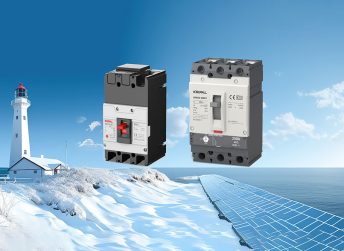
KRIPAL manufactures a comprehensive range of industrial electrical components — from low-voltage contactors and circuit breakers to medium-voltage switchgear and high-voltage protection devices. All products are designed and tested to international standards including IEC, UL, CE, CB, CCC, and RoHS.
- AC Contactors (9A – 800A) — UKC1, UKC2, UKC5 series
- Circuit Breakers — MCB, MCCB, ACB for LV/MV applications
- Isolator Switches — AC, DC, and PV DC isolators
- Industrial Plugs & Sockets — IP44/IP67 rated, 16A – 125A
- Protection Devices — Surge protection, thermal overload relays, earth leakage relays
Factory-direct pricing, global certifications, and engineering support for your project requirements.
Frequently Asked Questions
Related Resources
Explore Knowledge Center >
Need a matching KRIPAL product?
Share voltage, quantity and destination. An engineer will reply with options and lead time.