Search
Knowledge Center
Top-rated DC MCCB Products for Electric Vehicle Charging Stations
Discover DC MCCB for EV charging stations. Compare 1000V/1500V, high breaking capacity, and smart options.
 April 17, 2026
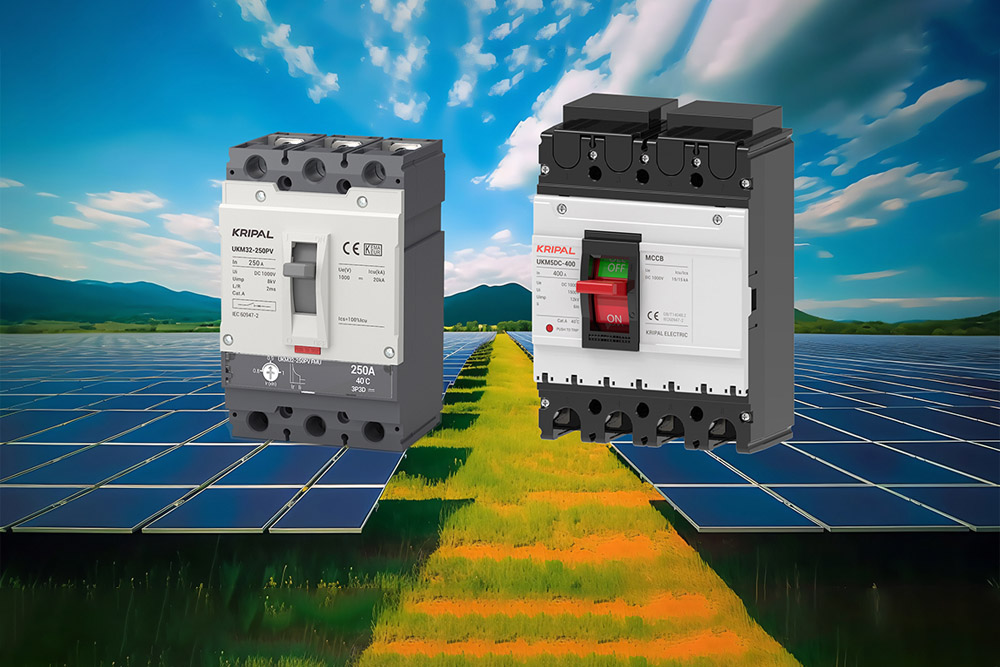
As electric vehicles become more widespread, the construction of charging stations is accelerating. In high power DC charging systems, safety protection becomes more critical, and DC MCCB, which is molded case circuit breaker for direct current, serves as a core component. Choosing the right DC MCCB can improve the safety of charging stations while ensuring stable operation of the equipment.
Key takeaways
- DC MCCB is a core protection device in electric vehicle charging stations
- Different types of DC MCCB are suitable for different scales and applications
- Intelligent features and higher voltage levels are becoming major development trends
Why do electric vehicle charging stations require high performance DC MCCB?
Electric vehicle charging stations usually operate under high voltage DC systems where power and current levels are high, so once a fault occurs, the risk becomes much greater than in typical electrical scenarios. As a result, high performance DC MCCB is required.
Since direct current does not have a natural zero crossing point, arc extinguishing becomes more difficult, which means that higher breaking capacity is required. At the same time, charging stations often operate under high load for long periods, which increases the chance of overload or short circuit. A high quality DC MCCB can interrupt fault current quickly and protect the equipment. In addition, a reliable breaker can reduce downtime and improve overall operational efficiency and service life.
High voltage DC MCCB 1000V and 1500V DC
Core features
High voltage DC MCCB is designed for high voltage direct current systems and typically supports 1000V or even 1500V DC, which allows it to be used in current and future high voltage platforms for electric vehicle charging stations. This type of breaker provides stronger arc extinguishing performance and higher breaking capacity so that it can interrupt fault current under high voltage and high current conditions while maintaining system stability.
Advantages
- Suitable for high power fast charging above 120kW
- Strong breaking capacity with high safety level
- Compatible with future high voltage platforms such as 800V systems
Disadvantages
- Higher cost
- Higher requirements for installation and selection
Applications
- Ultra fast charging stations from 150kW to 350kW
- High voltage DC bus systems
- Energy storage and charging integrated systems
Technical Spotlight: KRIPAL Flagship DC MCCB Comparison
To help you select the most suitable protection for your specific charging infrastructure, here is a direct performance comparison between our two flagship series.
| Technical Feature | UKM32-400PV (Solar Specialist) | UKM5DC-400 (High Voltage Pro) |
| Core Advantage | High Breaking Capacity & Durability | 1500V System Compatibility |
| Rated Current (In) | 300A, 350A, 400A | 250A, 300A, 350A, 400A |
| Max Working Voltage (Ue) | DC 1000V | DC 1500V |
| Rated Insulation Voltage (Ui) | 1000V | 1500V |
| Breaking Capacity (Icu) | Up to 50kA (Type H) / 20kA (Type N) | 20kA (Ics=15kA) |
| Impulse Withstand Voltage (Uimp) | 12kV (Superior Surge Protection) | 8kV |
| Mechanical Service Life | 10,000 Operations | 4,000 Operations |
| Extreme Temp. Range | -40°C to +70°C | -45°C to +70°C |
| Best For | 1000V PV Systems & Inverters | 1500V Utility-Scale PV & ESS |
| Accessories Available | Shunt trip, Auxiliary, Motorized, Handle | Shunt trip, Auxiliary, Motorized, Handle |
High breaking capacity DC MCCB
Core features
High breaking capacity DC MCCB focuses on enhancing short circuit interruption capability, which can reach tens of kA or even higher, so that it can be applied in scenarios where grid capacity or fault current is high. This type of breaker can disconnect current rapidly during a short circuit, which helps prevent equipment damage and fault escalation.
Advantages
- Strong short circuit protection capability
- Improves overall system safety level
- Suitable for complex grid environments
Disadvantages
- Larger size
- Higher cost
Applications
- Large scale centralized charging stations
- Industrial park charging systems
- Projects with high grid connection capacity
Smart DC MCCB with communication and monitoring
Core features
Smart DC MCCB builds on traditional protection functions while integrating monitoring of current, voltage, and temperature, and it supports communication protocols such as Modbus so that remote monitoring and data analysis can be achieved. This type of breaker is more suitable for digital and intelligent charging stations where higher operational visibility is required.
Advantages
- Supports remote monitoring and control
- Improves operation and maintenance efficiency
- Can be integrated into energy management systems
Disadvantages
- Higher cost
- Higher requirements for system integration
Applications
- Smart charging stations
- Energy storage and charging integrated systems
- Projects that require remote operation and maintenance
Compact DC MCCB
Core features
Compact DC MCCB adopts a smaller design so that it occupies less space, which makes it easier to install inside limited distribution cabinets or charging equipment. While maintaining basic protection performance, it optimizes size and structure so that it can be integrated into standardized equipment more easily.
Advantages
- Small size which saves installation space
- Easy integration into charging equipment
- Flexible installation
Disadvantages
- Lower breaking capacity
- Not suitable for ultra high power applications
Applications
- Wall mounted or small charging units
- Integrated charging equipment
- Distributed charging systems
Cost effective DC MCCB
Core features
Cost effective DC MCCB is designed for projects with budget constraints where basic DC protection requirements need to be met while reducing product complexity and cost. Although functions are relatively simple, it provides good value in standardized applications.
Advantages
- Lower cost with high value
- Suitable for large scale deployment
- Simple installation
Disadvantages
- Limited functions
- Long term reliability depends on product quality
Applications
- Small charging stations
- Overseas or budget limited projects
- Standardized charging network deployment
Future trends
As electric vehicles move toward 800V and higher voltage platforms, DC MCCB needs to provide higher voltage resistance, stronger breaking capacity, and more reliable arc extinguishing performance so that it can meet the safety requirements of high power fast charging systems. At the same time, products are being optimized toward smaller size and better heat dissipation so that they can fit more compact charging equipment.
Meanwhile, DC MCCB is evolving toward intelligent solutions that integrate monitoring and communication functions so that remote management and fault warning can be achieved. This development improves operational efficiency of charging stations while reducing maintenance costs.
Conclusion
Overall, choosing a suitable DC MCCB for electric vehicle charging stations directly affects system safety, operational stability, and service life. When products are selected based on actual application needs, a better balance between performance, cost, and reliability can be achieved.
KRIPAL offers a wide range of MCCB products, and there is always an option that can match your charging station system. You are welcome to visit the homepage for more information.
FAQs
Q: What is the difference between DC MCCB and AC MCCB
DC MCCB is designed for direct current systems where arc extinguishing is more difficult and design requirements are higher, while AC MCCB is used for alternating current systems, so they cannot replace each other
Q: What current rating is typically required for EV charging stations
This depends on charging power, which usually ranges from tens of amps to several hundred amps, while high power fast charging stations may require higher ratings
Q: Is it required to choose 1000V or higher DC MCCB
If the system is designed for fast charging or high voltage platforms such as 800V systems, choosing 1000V or higher is recommended to ensure compatibility and safety
Q: Is a smart DC MCCB required
If the charging station is large or requires remote operation and maintenance, smart products can improve management efficiency, while smaller projects may not need them
Q: How can I determine whether a DC MCCB fits my project
You can evaluate voltage, current, breaking capacity, and compliance with project standards so that it matches system parameters