Search
News
KRIPAL Electric Launches 2026 Quality Month to Strengthen Product Reliability
KRIPAL Electric launched its 2026 Quality Month on September 10, running five programs that tighten quality control from training to new product validation.
 September 10, 2026
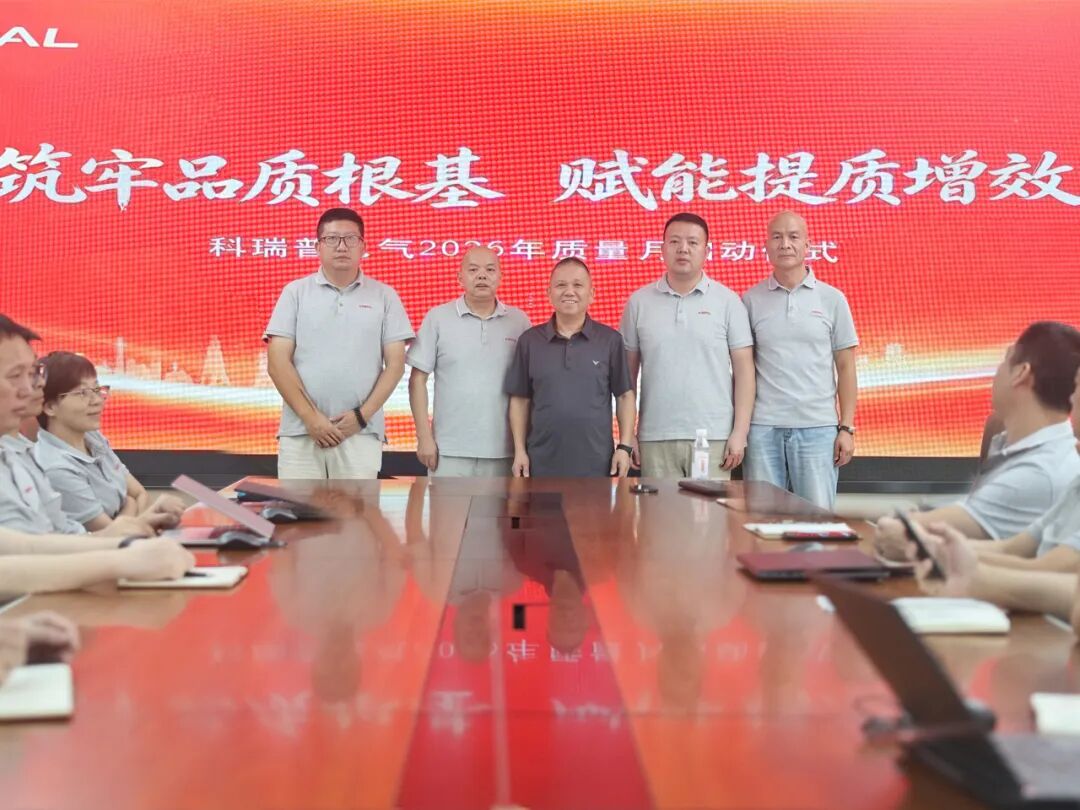
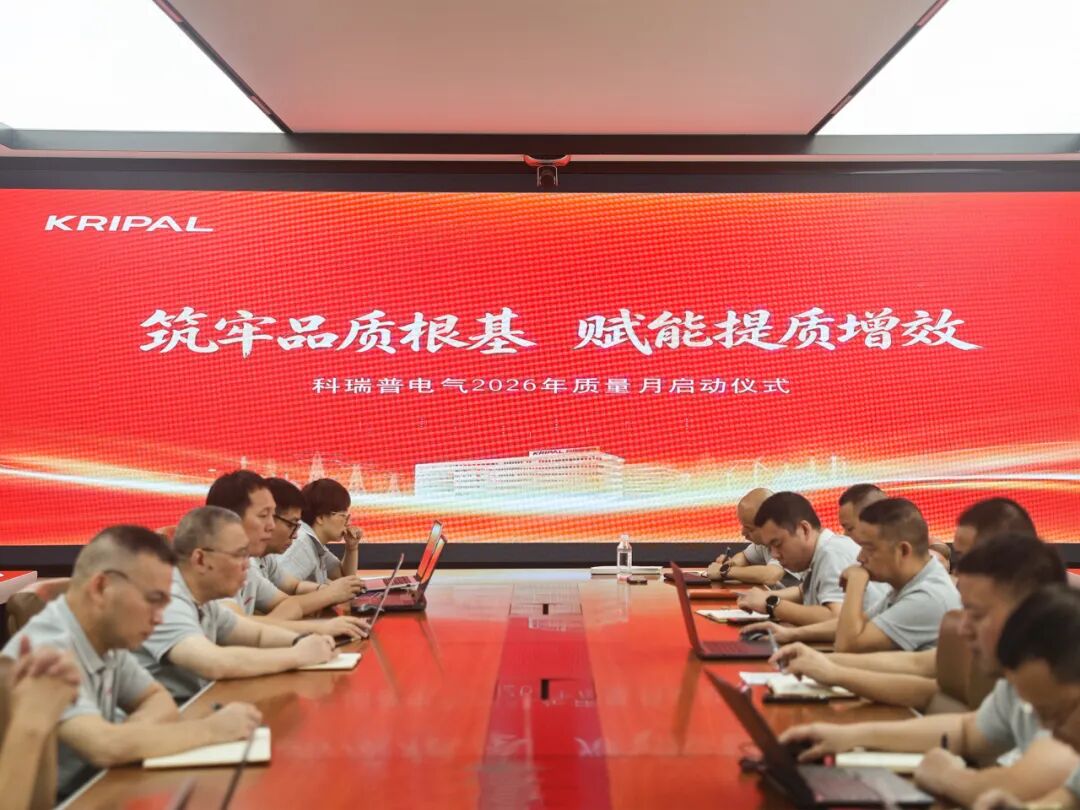
Quality is the foundation on which every electrical component either earns a buyer’s trust or loses it for good. On September 10, 2026, KRIPAL Electric formally opened its 2026 Quality Month at its Zhejiang headquarters, putting the whole organization behind one objective: tightening the quality management system from the training room through to the production floor and out to final product validation.
The program runs under the theme Strengthening Quality Foundations, Empowering Efficiency Gains, and it rests on a simple conviction that quality is not the responsibility of a single inspection department but a shared habit of every employee on every shift.
Why KRIPAL Electric Dedicated a Full Month to Quality
Quality management literature is full of programs that begin with a banner and end with a photograph, and manufacturing buyers have learned to discount them. The difference in a company that has spent more than three decades building low voltage electrical products is that the annual quality program is less about motivation and more about closing specific gaps that show up in real production data. A device that passes type testing can still fail in service if a terminal is torqued inconsistently, if a gasket is seated by hand rather than by fixture, or if a supplier changes a resin compound without notice.
KRIPAL approaches its quality month as an operating cycle rather than a campaign. The company set five working principles for the 2026 edition: full participation, entire process control, comprehensive quality improvement, and continuous correction, and paired them with five measurable objectives covering awareness, skills, process closure, benchmark leadership, and risk reduction. In practical terms, that means the program is judged not by how many events were held but by whether nonconforming product rates fell and whether process deviations were closed out before they reached a customer.
Five working principles behind the program
- Full participation, with every employee in every role expected to contribute rather than observe
- Entire process control, extending from incoming material inspection through assembly and testing to packaging and shipment
- Comprehensive quality improvement, addressing product performance, documentation accuracy, and delivery reliability together
- Continuous correction, treating every deviation as a permanent process change rather than a one-time fix
- Sustained improvement, keeping the gains in place long after the program closes
Five objectives the program targets
- Raise quality awareness across all positions and shifts
- Strengthen the practical skills required by each workstation standard
- Close the loop on process control so that deviations are detected and resolved at source
- Establish benchmark teams whose methods can be replicated across production lines
- Reduce quality risk in both mature products and newly released models
Who Leads the 2026 Quality Month
Senior leadership involvement is the clearest signal of how seriously a manufacturer treats a quality initiative. Rather than delegating the program to a middle management committee, KRIPAL placed its two most senior executives in direct charge of the effort and gave each a distinct mandate for direction and execution.
Chairman Lin Xiaomin serves as chief supervisor
Chairman Lin Xiaomin leads the program as chief supervisor, holding authority over overall direction and final judgment on whether the program delivers real change. His role is to keep the initiative aligned with the company’s long-term product strategy, to prevent the program from drifting into ceremony, and to ensure that resources and authority are available when a factory floor improvement requires investment.
General Manager Lin Tiemin serves as chief commander
General Manager Lin Tiemin acts as chief commander, responsible for driving each of the five programs to completion and for verifying that outcomes hold after the activity period ends. That division of labor matters to buyers because it separates oversight from execution, so a problem raised in a quality control circle does not stall for want of a decision maker.
Building the Quality Habit Across Every Workstation
Quality failures in low voltage electrical equipment rarely originate in exotic engineering problems. They most often come from ordinary tasks performed slightly differently by two people on two shifts, which is why the training component of the program targets depth rather than volume. Coverage is structured by position and level rather than delivered as a single all-hands briefing, so an operator who terminates cables receives different content from an engineer who approves a new molding tool.
The competition and speech components then reinforce that training through practice and peer learning. A knowledge competition forces people to retrieve standards and defect handling procedures under pressure, while a speech contest gives employees a channel to describe real quality cases from their own workstations, which surfaces problems that formal reporting systems frequently miss.
Training aligned to each role and level
Training content covers quality system standards, workstation operating specifications, identification of quality hazards, and the correct handling of abnormal production conditions. Because the material is tailored by position, an operator learns what a defect looks like at their station while supervisors learn how to trace it back to its process cause.
Competition and peer learning as reinforcement
A competition format creates memory and accountability in ways that passive instruction cannot, and the speech contest pushes quality thinking out of the quality department and into daily conversation. Together they turn a compliance requirement into something closer to a shared professional standard.
The Five Programs Running Through Quality Month
The 2026 program consists of five coordinated activities, each with its own owner, timeline, and completion criteria. They are designed to work as a sequence, where knowledge established in the first two programs is converted into process changes in the third and fourth, and then applied directly to new product releases in the fifth.
| Program | What happens during the program | What it changes for buyers |
|---|---|---|
| Company-wide quality knowledge training | Role-based and level-based instruction covering standards, workstation practice, hazard identification, and abnormal condition handling | Fewer defects traced to operator variance between shifts and production lines |
| Quality knowledge competition | Team-based competition on quality fundamentals, system standards, practical specifications, and defect case studies | Verification that training was absorbed rather than merely delivered |
| Quality-themed speech contest | Employees present quality experience, workstation cases, and personal improvement stories | Ground level problems surface earlier, before they become field complaints |
| QCC quality control circle improvement | Self-organized improvement teams run projects on defect reduction, efficiency, process optimization, and hazard prevention | Measurable process changes rather than one-time corrections |
| New product quality consolidation | Review of development, validation, trial production, and delivery data to identify latent risks | New models reach the market with validation records that hold up to scrutiny |
Programs that build capability
The training and competition activities create the baseline knowledge that everything else depends on. Without them, an improvement circle has nothing to work from and a new product review becomes a paperwork exercise, so the program deliberately sequences capability building before process change.
Programs that change the process
The QCC improvement activity is where knowledge becomes a modified fixture, a revised work instruction, or a changed inspection point. The new product consolidation activity then applies those revised standards to models in the development and trial production stages, which is the point at which quality problems are cheapest to correct.
What Quality Month Means for Overseas Buyers
Importers, distributors, and engineering contractors who source electrical components from China carry a specific risk, which is that a supplier’s quality capability may not survive a change of shift, a change of subcontractor, or a change in the specification of a purchased material. Programs of this kind matter to those buyers only when they translate into process controls that persist after the audit visit ends.
Where quality control touches the product range
The disciplines being reinforced apply across the company’s low voltage portfolio. Process control on contact materials and arc chambers affects the reliability of low voltage circuit breakers and thermal magnetic MCCBs, while tightened terminal torque and sealing practice directly affect the field performance of wall mounted industrial plugs and sockets and industrial plugs and socket outlets used in wet and dusty environments. The same controls govern miniature circuit breakers and surge protection devices, where a marginal internal joint produces failures that only appear after months in service.
How buyers can verify quality before ordering
Programs such as quality month are worth little if a buyer cannot audit their effect, and the practical way to do that is to ask for evidence rather than assurances. Request the type test reports relevant to the model, ask how incoming material is verified and what happens when a supplier changes a formulation, ask for the inspection record format used for the specific part number being quoted, and ask what proportion of nonconforming units was closed out at source rather than at final test. A manufacturer running a genuine improvement program can answer those questions with documents, while one running a campaign will answer with adjectives.
Quality Credentials That Support the Program
The 2026 program sits on top of an existing quality and innovation framework rather than replacing it. KRIPAL operates as a national-level specialized and innovative little giant enterprise and a national high-tech enterprise, recognized for research and development, production, and sales of low voltage electrical, waterproof electrical, and new energy products.
National specialized and innovative little giant enterprise
This designation is awarded to manufacturers that combine specialization in a defined technical field with measurable innovation output, and it reflects depth in low voltage and waterproof electrical products rather than breadth across unrelated categories.
National high-tech enterprise
High-tech enterprise status in China requires audited research and development investment and a documented record of technical achievement, which supports the engineering side of the product range from AC contactors and thermal overload relays through to newer solar and energy storage components.
What Comes After September
The closing message of the 2026 launch was directed at employees rather than customers, which is where the value of the program actually sits. Staff were asked to treat their workstation as a competitive arena and the standard as their measuring rule, with the shared goal of building quality to a new level across the company. Improvement has no finishing line, and the practical commitment is that gains achieved during September are written into procedures and held.
For buyers evaluating suppliers, that commitment is testable. Ask for the corrective action records from the improvement circles, ask which work instructions changed as a result, and ask how the company will measure whether the changes held six months from now. KRIPAL welcomes inquiries from importers, distributors, and project contractors who want to review product data, type test documentation, or sample units against their technical requirements.
Related Resources
Explore News >
Need a matching KRIPAL product?
Share voltage, quantity and destination. An engineer will reply with options and lead time.