Search
Knowledge Center
How to Wire a Consumer Unit: Step by Step Installation Guide
Step-by-step consumer unit wiring guide covering main switch, RCBO installation, busbar alignment, earth and neutral connections and BS 7671 testing.
 July 05, 2026
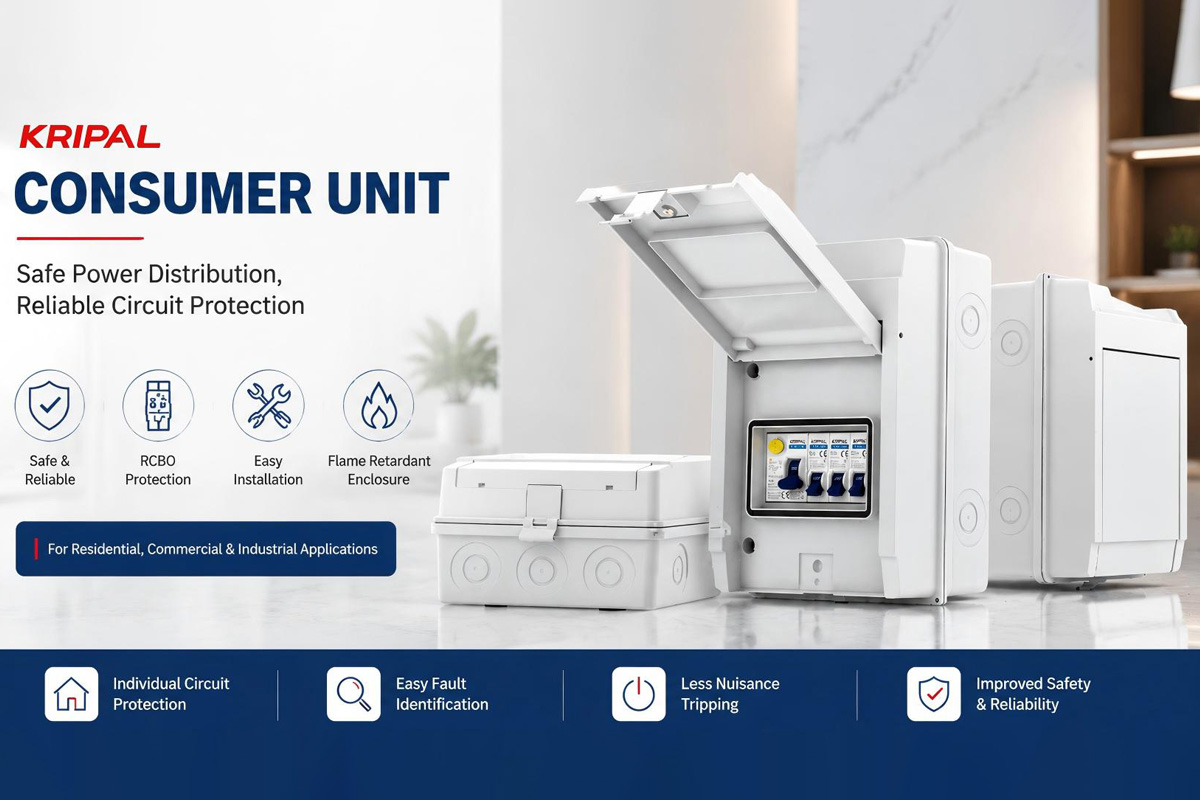
A consumer unit is the central distribution point of an electrical installation, distributing power from the incoming supply to individual final circuits while providing protection against overload, short circuits, and earth leakage faults. Modern installations increasingly use RCBO consumer units, where each final circuit has individual residual current and overcurrent protection. This arrangement improves circuit safety and makes fault identification easier because a fault on one circuit does not normally disconnect the entire installation.
This guide explains the basic consumer unit wiring process, including component layout, RCBO connections, busbar installation, earth and neutral wiring, and final testing procedures.
Safety Notice
Consumer unit installation involves mains electrical work and must only be carried out by qualified professionals following applicable regulations, such as BS 7671, and the manufacturer’s instructions.
Understanding Consumer Unit Wiring Structure
A typical consumer unit contains several important components that work together to provide safe power distribution and circuit protection. The main switch provides a means of isolating the consumer unit, while protective devices such as RCBOs protect individual circuits from electrical faults. The busbar distributes supply power between protective devices, while the neutral and earth bars provide dedicated termination points for circuit conductors.
The function of each main component is shown below:
| Component | Function |
|---|---|
| Main Switch | Isolates the consumer unit from the incoming supply and provides a means of safe disconnection |
| RCBO | Provides combined protection against overload, short circuit, and earth leakage faults for individual circuits |
| Busbar | Distributes the line supply to multiple RCBO devices according to the manufacturer’s design |
| Neutral Bar | Provides neutral connection points according to the consumer unit configuration |
| Earth Bar | Connects the main earthing conductor and all circuit protective conductors (CPCs) |
In a full RCBO consumer unit, each outgoing circuit has its own residual current protection. This arrangement improves fault identification because only the affected circuit is disconnected. Where an additional upstream disconnection point is required, a lockable isolator switch can be installed ahead of the consumer unit.
Step-by-Step Consumer Unit Installation and Wiring
-
Step 1: Mount the Consumer Unit Enclosure
The first stage is to install the consumer unit enclosure securely on a suitable wall surface. The position should allow easy access to the main switch while providing enough space for cable entry and internal wiring.
Good cable routing is important because a well-organized consumer unit is easier to inspect, test, and maintain in the future. Installation should always follow the manufacturer’s recommendations regarding mounting position and cable arrangement.
-
Step 2: Install the Main Switch
The main switch is installed onto the DIN rail according to the consumer unit design. The incoming supply conductors are connected to the correct terminals following the manufacturer’s wiring instructions. In typical UK installations, the line conductor connects to the line terminal and the neutral conductor connects to the neutral terminal.
The outgoing supply from the main switch then feeds the protective devices through the approved connection arrangement. It is important to note that incoming terminals may remain live depending on the upstream isolation arrangement. The correct isolation procedure must always be followed before any work begins.
-
Step 3: Install RCBO Protection Devices
RCBOs are mounted onto the DIN rail to provide individual protection for each final circuit.
Unlike traditional arrangements using separate MCBs and RCDs, an RCBO combines both functions into one device. It provides protection against overload, short circuits, and residual current faults.
The basic wiring arrangement in a full RCBO consumer unit is:
- Circuit line conductor to RCBO outgoing terminal
- Circuit neutral conductor to corresponding RCBO neutral terminal
- Circuit protective conductor to earth bar
Common Wiring Mistake
A common wiring mistake is connecting a circuit neutral directly to the main neutral bar in a fully RCBO-protected consumer unit. This can bypass the RCBO residual current detection function and prevent correct operation during an earth leakage fault.
However, consumer unit designs vary between manufacturers, so installers should always follow the specific wiring diagram supplied with the product.
-
Step 4: Install the Busbar System
The busbar provides a neat and reliable method of distributing the supply connection to multiple RCBO devices. During installation, the busbar teeth must be correctly aligned with the RCBO terminals and fully inserted. All terminal connections should be tightened according to the manufacturer’s specified torque values.
Incorrect busbar installation, poor alignment, or loose connections can create increased contact resistance, resulting in overheating, arcing, and possible device failure. Busbars should not be modified unless specifically permitted by the manufacturer. Using the correct matching components ensures the protection devices operate as designed.
-
Step 5: Complete Earth and Neutral Connections
The earth bar provides the connection point for the main earthing conductor and all circuit protective conductors. Each earth connection must be correctly inserted and securely tightened. A loose protective conductor connection can create a high-resistance fault path, preventing protective devices from operating effectively during a fault condition.
Neutral wiring must be completed according to the consumer unit design. In a typical all-RCBO installation, each circuit neutral is connected through its corresponding RCBO neutral terminal rather than directly connected to a standard neutral bar. Incorrect neutral arrangements are one of the most common causes of RCBO nuisance tripping or failure to provide proper residual current protection.
-
Step 6: Connect and Label Final Circuits
Each final circuit should be connected carefully, ensuring that line, neutral, and protective conductors are terminated in the correct locations. Conductors should be fully inserted into terminals with no exposed copper outside the connection point. For stranded conductors, suitable ferrules should be used where required to maintain reliable mechanical and electrical contact.
After wiring is completed, each RCBO should be clearly labeled according to the circuit it supplies. Clear identification, such as “Kitchen Socket Circuit” or “Lighting Circuit Upstairs”, makes future inspection and fault finding much easier.
-
Step 7: Testing Before Energizing
Testing is an essential stage before the consumer unit is placed into service.
Before energizing the installation, electrical testing should include:
- Continuity testing of protective conductors
- Insulation resistance testing
- Polarity verification
- RCBO functional testing using appropriate test equipment
Under BS 7671 requirements, insulation resistance values should generally meet the minimum required level of 1 megohm, although new installations often achieve significantly higher readings. RCBO operation should be checked using both the built-in test button and suitable RCD testing equipment to confirm correct operation. A consumer unit should only be energized after all inspection and testing procedures have been completed successfully.
Common Consumer Unit Wiring Problems
Incorrect neutral connections are among the most common problems found in RCBO consumer unit installations. When a circuit neutral is connected incorrectly, the RCBO may not accurately monitor current imbalance, reducing its ability to detect earth leakage faults. Loose busbar or terminal connections can also cause serious reliability issues. Poor electrical contact increases resistance and generates heat, which may eventually damage insulation or protective devices.
Incorrect polarity is another potential problem. Although equipment may appear to operate normally, reversed line and neutral connections can create unsafe conditions during maintenance or fault situations. Unwanted connections between neutral and earth can cause circulating currents and unnecessary RCD or RCBO tripping. Correct separation of these conductors is essential for a safe electrical installation.
Why Choose an RCBO Consumer Unit?
An RCBO consumer unit provides individual protection for each final circuit, improving both safety and maintenance efficiency. When a fault occurs, only the affected circuit is disconnected instead of shutting down multiple circuits protected by a shared RCD. This makes troubleshooting faster and reduces unnecessary interruptions.
For residential, commercial, and industrial applications, selecting reliable RCBO products with suitable ratings and certification is essential for achieving long-term electrical safety and performance. KRIPAL also supplies matching contactors and relays for load control within distribution boards.
Frequently Asked Questions (FAQ)
Q: Can circuit neutrals connect directly to the neutral bar in an RCBO consumer unit?
A: In a fully RCBO-protected consumer unit, circuit neutrals normally connect through their corresponding RCBO neutral terminals. Incorrect neutral connection may prevent the RCBO from detecting earth leakage faults correctly.
Q: What is the difference between an RCBO and an MCB?
A: An MCB protects against overload and short circuits, while an RCBO combines MCB protection with residual current protection against earth leakage faults.
Q: Are RCBO consumer units safer than traditional consumer units?
A: RCBO consumer units provide individual circuit protection, which can improve fault isolation and reduce unnecessary loss of power compared with some traditional split-load arrangements.
Conclusion: Correct Wiring Ensures Long-Term Electrical Safety
A consumer unit is the foundation of a safe electrical installation. Correct wiring requires accurate connections, proper circuit identification, reliable protective devices, and complete electrical testing.
By following the correct RCBO wiring arrangement, maintaining secure earth and neutral connections, and using approved components, installers can create electrical systems that are safer, easier to maintain, and compliant with modern installation requirements.
For electrical professionals and system designers, choosing dependable consumer unit components and protection devices is an important step toward achieving reliable long-term performance. Contact KRIPAL to discuss your distribution board requirements.
Related Resources
Explore Knowledge Center >

Need a matching KRIPAL product?
Share voltage, quantity and destination. An engineer will reply with options and lead time.