Search
Knowledge Center
Guide to Outdoor Industrial Plug Sockets: How to Choose the Right IP66 Power Connection
Learn how to choose the right IP66 outdoor industrial plug socket. This guide covers key factors for durable, safe power connections in harsh environments.
 May 19, 2026
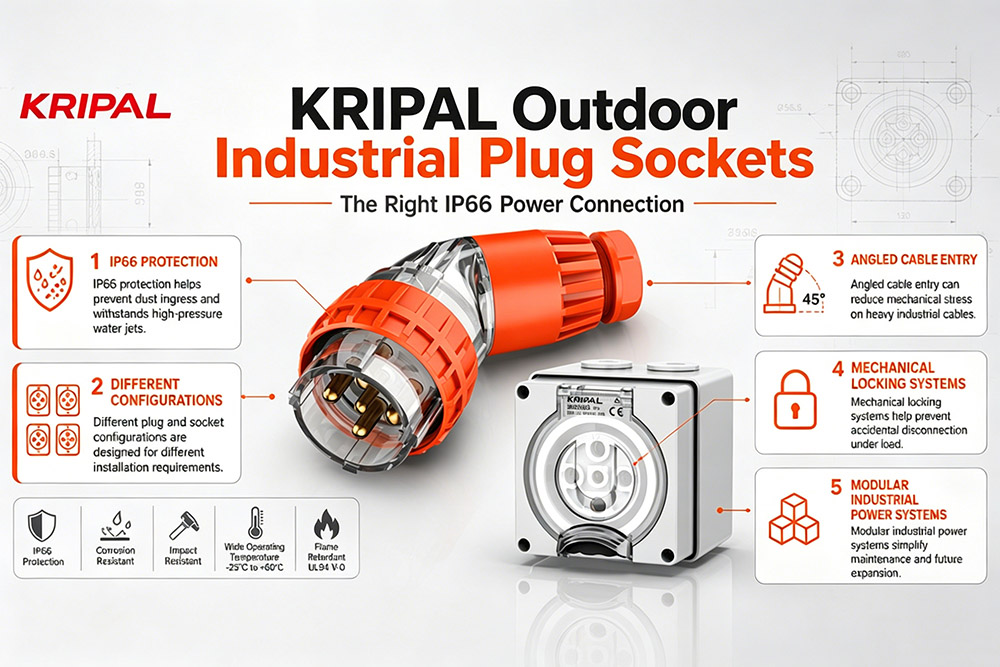
Industrial and commercial outdoor environments place far greater demands on electrical connections than ordinary weatherproof outlets. Construction sites, food processing plants, mining facilities, marine terminals, and manufacturing workshops all expose power equipment to water, dust, UV radiation, vibration, and physical impact.
Choosing the right industrial plug and socket system is essential for reducing downtime, improving workplace safety, and extending equipment life. This guide explains the key factors behind IP66 outdoor connectors and how different KRIPAL industrial plug and socket configurations can support a wide range of applications.
Key Takeaways
- IP66 protection helps prevent dust ingress and withstands high-pressure water jets.
- Different plug and socket configurations are designed for different installation requirements.
- Angled cable entry can reduce mechanical stress on heavy industrial cables.
- Mechanical locking systems help prevent accidental disconnection under load.
- Modular industrial power systems simplify maintenance and future expansion.
Why Industrial Outdoor Sockets Fail
Many electrical failures in outdoor environments are not caused by the electrical components themselves, but by the conditions surrounding them.
Common causes include:
- Water entering through poorly sealed cable entries
- Heavy cables pulling against terminals over long periods
- Accidental unplugging during operation
- UV exposure causing housing materials to become brittle
- Chemical washdowns in food and industrial facilities
Selecting connectors specifically designed for harsh environments can significantly reduce these risks.
Understanding the KRIPAL Industrial Plug and Socket System
KRIPAL’s industrial connector range is designed as a modular ecosystem that includes male plugs, cord extension sockets, and fixed wall-mounted sockets. The system supports multiple pin configurations, from single-phase installations to three-phase and multi-circuit control applications.
Depending on the model, the product range covers:
- 3-pin, 4-pin, 5-pin, and 7-pin configurations
- 10A to 50A current ratings
- 250V AC and 500V AC systems
- Single-phase and three-phase power distribution
This flexibility allows contractors and equipment manufacturers to build power systems for both permanent and temporary installations.
Straight vs. Angled Industrial Plugs
Straight Cable Entry
Straight-entry plugs are often suitable where installation space is unrestricted and cable routing is simple. The cable exits directly from the rear of the housing, making the design compact and easy to integrate into extension leads.
Typical applications include:
- Portable equipment
- Temporary power distribution
- Open workshop environments
90° Angled Cable Entry
In many industrial environments, cable management becomes a mechanical issue as much as an electrical one.
An angled cable entry allows the cable to drop naturally toward the ground instead of extending outward from the wall. This can help reduce long-term stress on terminals while minimizing the installation depth required behind machinery or along narrow walkways.
The semi-transparent housing also allows maintenance personnel to visually inspect internal wiring conditions without dismantling the connector, making routine inspections faster and easier.
Cord Extension Sockets for Mobile Power
Cord extension sockets serve as the mobile female component of an industrial extension assembly.
When combined with matching industrial plugs, they can be used to build heavy-duty extension leads and cable reels suitable for demanding workplaces such as:
- Construction projects
- Mining operations
- Manufacturing plants
- Outdoor maintenance facilities
Protective covers help shield contacts from dust and moisture when the connector is not in use.
Surface-Mounted Industrial Sockets
Surface-mounted sockets provide a permanent power connection point for buildings, machinery, and industrial infrastructure.
Typical installation locations include:
- Factory walls
- Distribution pillars
- Processing equipment
- Maintenance workshops
- Marine loading areas
Because of their modular design, they can often be integrated with isolation switches and protective devices such as residual current protection or miniature circuit breakers, creating a complete weather-resistant power distribution solution.
Typical Applications by Configuration
| Configuration | Electrical Rating | Typical Applications |
| 3-Pin Single-Phase | 10A–20A, 250V AC | Commercial kitchens, car washes, maintenance equipment |
| 4-Pin & 5-Pin Three-Phase | 20A–50A, 500V AC | CNC machinery, air compressors, construction sites, mining operations |
| 7-Pin Multi-Circuit | 20A, 500V AC | Cranes, hoists, pumping stations, industrial control systems |
Different industries have different operational requirements, so selecting the appropriate configuration helps improve both safety and efficiency.
Why Mechanical Locking Matters
One of the biggest hazards in industrial power distribution is accidental disconnection while equipment is energized.
A screwed mechanical locking system helps address this issue by:
- Reducing the risk of unintended unplugging
- Maintaining the environmental seal during operation
- Improving connection stability in high-vibration environments
- Minimizing the possibility of load-breaking arcs
For outdoor installations exposed to rain or washdown procedures, maintaining the sealing performance while the connector is actually in use is particularly important.
Material Selection for Harsh Environments
Housing materials play a major role in the service life of industrial connectors.
UV-stabilized, flame-retardant modified polycarbonate offers several practical advantages:
- High impact resistance
- Better durability under sunlight exposure
- Resistance to industrial oils and many chemical cleaners
- Reduced risk of cracking in demanding environments
These characteristics make the material suitable for applications where equipment is regularly exposed to outdoor conditions.
Installation and Maintenance Tips
Proper installation is just as important as product selection.
Use Appropriate Cable Glands
Select compression glands that match the cable diameter to help maintain enclosure sealing performance.
Verify Grounding Connections
Always ensure protective earth conductors are connected correctly. In three-phase five-wire systems, neutral and earth conductors should remain separate.
Perform Regular Visual Inspections
Routine inspections can help identify loose terminals, discoloration, or signs of overheating before they develop into larger failures.
Check Mechanical Locking Components
Inspect threaded locking mechanisms and sealing surfaces for wear, especially in high-frequency connection cycles.
Conclusion
Outdoor industrial electrical systems must withstand far more than rain. Dust, vibration, UV exposure, mechanical impact, and demanding operating conditions all affect long-term reliability.
By understanding factors such as IP66 protection, cable management, mechanical locking, and modular installation design, engineers and procurement teams can make better decisions when selecting industrial plug and socket systems for their projects.
A properly designed power distribution system not only improves equipment reliability but also helps reduce maintenance costs and enhance workplace safety over the long term.
FAQs
Q1 What is the difference between IP66 and IP68?
IP66 protects against dust and high-pressure water jets, while IP68 is designed for continuous immersion under specified conditions.
Q2 When should an angled industrial plug be used?
Angled plugs are often preferred where heavy cables need better strain relief or where installation space behind equipment is limited.
Q3 Can industrial outdoor sockets remain installed permanently?
Yes. Industrial sockets designed for outdoor use are commonly installed as permanent infrastructure, provided they are correctly installed and maintained.
Q4 How often should industrial plug and socket systems be inspected?
Inspection frequency depends on the operating environment, but many industrial facilities include visual inspections as part of their regular preventive maintenance schedules.
Q5 What should be considered when choosing between 3-pin and 5-pin connectors?
The required power system, voltage, current rating, and whether a neutral conductor is needed should all be evaluated before selecting the appropriate configuration.
Related Resources
Explore Knowledge Center >
Need a matching KRIPAL product?
Share voltage, quantity and destination. An engineer will reply with options and lead time.