Search
Knowledge Center
What Is the Difference Between DC Fuses and AC Fuses?
What’s the difference between DC and AC fuses? Learn how DC fuses vs AC fuses work: DC handles continuous current & arc, while AC uses zero-cross for fast interruption.
 April 01, 2026
Key Takeaways
• DC and AC fuses differ in working principle and breaking characteristics.
• DC fuses must handle continuous current and are not easy to blow, while AC fuses can take advantage of the current passing through zero to blow quickly.
• When selecting a fuse, it is essential to choose one that matches the type of circuit, voltage, and current rating.
What Is a Fuse?
A fuse is a circuit protection device that melts its internal metal element when the current exceeds its rating, breaking the circuit to prevent overload, short circuits, or device damage. It is a single-use protective device that must be replaced after it has blown.
In Structure and Working Principle
Structure
DC fuses contain metal wires or strips that are usually thicker and tightly enclosed to handle continuous current. Their insulation casing and end caps are designed to withstand DC arcs because the arc does not naturally extinguish. Common types include glass tube fuses, ceramic tube fuses, and fast-acting or slow-blow DC fuses.
AC fuses have thinner internal metal elements because AC current passes through zero in each cycle, allowing arcs to extinguish easily. The casing is typically glass or ceramic, and the end caps hold the fuse in place in the socket. The design allows arcs to disappear quickly during operation, enabling faster circuit interruption.
Working Principle
DC current is steady and does not change direction, so when it exceeds the rated current, the metal element heats up and melts. Since DC does not have zero-cross points, the arc may continue, and special designs such as thicker elements or arc chambers are needed to extinguish it safely.
AC current oscillates positively and negatively in cycles, passing through zero each time. When the current exceeds the rating, the fuse heats and melts, and the arc is naturally extinguished at the next zero-cross, making circuit interruption faster and easier.
Applicable Scenarios
DC fuses are mainly used in DC circuits and equipment, especially where stable current is required. Examples include electric vehicles, battery packs, solar photovoltaic systems, communication equipment, and DC power circuits. Because DC current does not pass through zero, DC fuses can reliably melt and protect circuits and devices in these applications.
AC fuses are widely used in household circuits, industrial power equipment, and devices powered by AC sources, such as household sockets, air conditioners, motors, and lighting equipment. The AC current oscillates, allowing the fuse to blow quickly under overload or short circuit conditions and protect the AC circuit.
Advantages and Disadvantages
DC Fuses
Advantages:
- Can handle continuous DC current and reliably protect DC circuits and devices.
- Designed to prevent DC arcs from continuing, ensuring safe circuit interruption.
Disadvantages:
- Structure is more complex and more expensive.
- Blow time is slower than AC fuses and requires special design.
- Must be replaced after blowing and cannot be reused.
AC Fuses
Advantages:
- Use the zero-crossing feature of AC current, allowing fast response and quick interruption.
- Structure is simple and less expensive.
- Widely suitable for household and industrial AC circuits.
Disadvantages:
- Cannot be used in DC circuits, as they may fail to blow or allow arcs to continue.
- Limited ability to withstand sustained overload and may be damaged easily.
Main Differences Between DC and AC Fuses
Influence of Voltage Waveform on Breaking Characteristics
AC current oscillates positively and negatively in cycles, passing through zero regularly. The arc generated when the fuse blows can take advantage of the zero-cross, extinguishing quickly and safely with a simple structure. DC current flows steadily in one direction without a natural zero-cross, so the arc is difficult to extinguish and may continue to burn, damaging the casing or causing short circuits or fire. Therefore, DC fuses require special arc-extinguishing structures and materials to safely interrupt the circuit.
Differences in Blow Time and Current Rating
DC fuses usually require thicker metal elements and higher current ratings to reliably melt under continuous DC current. The steady heat accumulation requires larger elements, otherwise, the fuse may fail to blow or blow prematurely. AC fuses, due to the cyclic current, experience rapid heat accumulation at current peaks, allowing faster interruption with smaller elements and lower current ratings.
Labeling and Selection Considerations
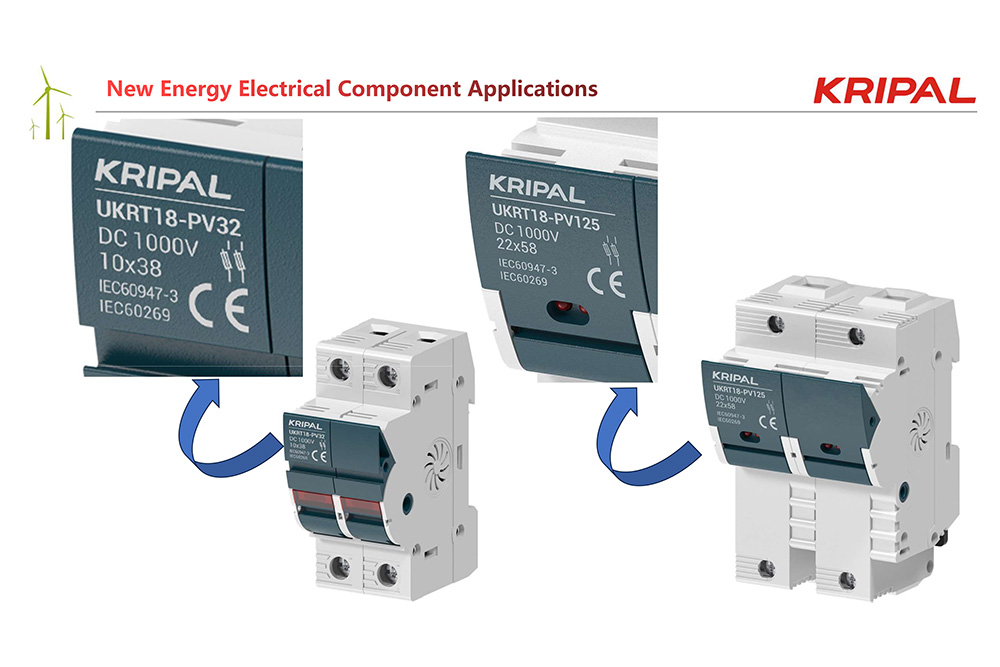
DC and AC fuses may appear similar in size and shape, making visual identification difficult. DC fuses are clearly marked with DC or the DC voltage and current rating, sometimes with the applicable DC voltage level, such as 12V, 24V, 48V, 220V, 1000VDC. AC fuses are labeled AC or with the rated AC voltage, such as 220VAC or 380VAC, matching the characteristics of the AC supply. Fuses should never be mixed.
| Item | DC Fuse | AC Fuse |
| Structure | Thicker metal element, tightly enclosed, with arc-extinguishing design | Thinner metal element, simple structure, uses current zero-cross to extinguish arc |
| Working Principle | Constant DC current melts the element, arc difficult to extinguish naturally | Periodic AC current melts the element, arc naturally extinguishes at zero-cross |
| Applicable Scenarios | Electric vehicles, solar systems, communication equipment, DC power circuits | Household circuits, industrial equipment, AC-powered devices |
| Advantages | Can handle continuous current, reliably protects DC circuits | Fast response, quick interruption, lower cost |
| Disadvantages | Complex structure, slower to blow, must be replaced | Not suitable for DC, limited ability to handle sustained overload |
| Breaking Characteristics | Requires thicker element and higher rated current, heat accumulates slowly | Heat accumulates quickly, fast interruption, lower element requirement |
| Labeling and Selection | Marked DC or with DC voltage/current rating | Marked AC or with rated AC voltage, must not be mixed |
Conclusion
DC and AC fuses have different characteristics. Understanding their structure, working principle, applicable scenarios, and advantages and disadvantages helps ensure proper selection for circuits, keeping electrical systems safe and devices operating reliably.
KRIPAL offers high-quality DC and AC fuses. Visit the homepage to explore products.
FAQs
Q Can DC fuses be used in AC circuits?A: It is generally not recommended. Although DC fuses may work in some AC circuits, they are not the best choice and may compromise protection.
Q Can AC fuses replace DC fuses?
A: No. AC fuses may not blow properly in DC circuits and can produce sustained arcs, creating safety hazards.
Q How can I tell whether a fuse is AC or DC?
A: Check the labeling, which usually indicates the rated voltage and shows AC or DC. Always confirm the specifications before use.
Q Can a fuse be reused after it blows?
A: No. Fuses are single-use protection devices and must be replaced with a new fuse of the same specification.
Q What parameters should I consider when selecting a fuse?
A: Consider the voltage rating, current rating, and type of circuit, AC or DC. All three must match the application for proper protection.