Search
Knowledge Center
What is a Thermal Overload Relay
Learn what a thermal overload relay is, its working principle, key components, and types. Discover how it protects motors from overload damage in industrial applications.
 December 11, 2025
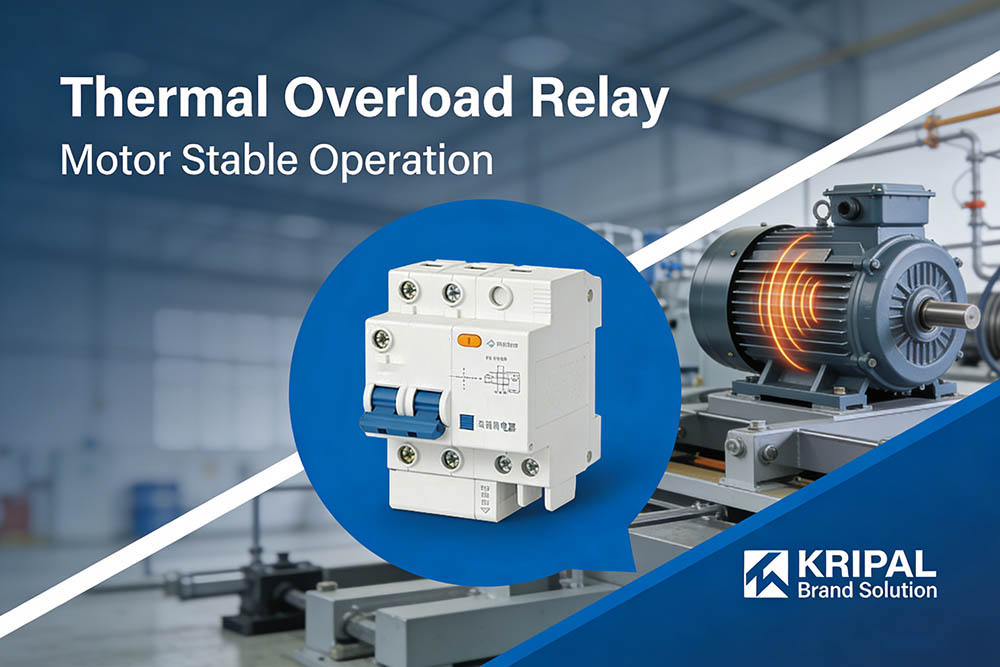
In electrical control and industrial automation, abnormal working conditions such as overload, phase loss and poor heat dissipation may cause motors to overheat, shorten service life or even burn out. Thermal overload relays are widely used to protect motors.
These devices work on the thermal effect principle. When current exceeds the rated value for a period, the relay trips and cuts off the control circuit to prevent motor damage. Its performance matches the actual heating characteristics of motors.
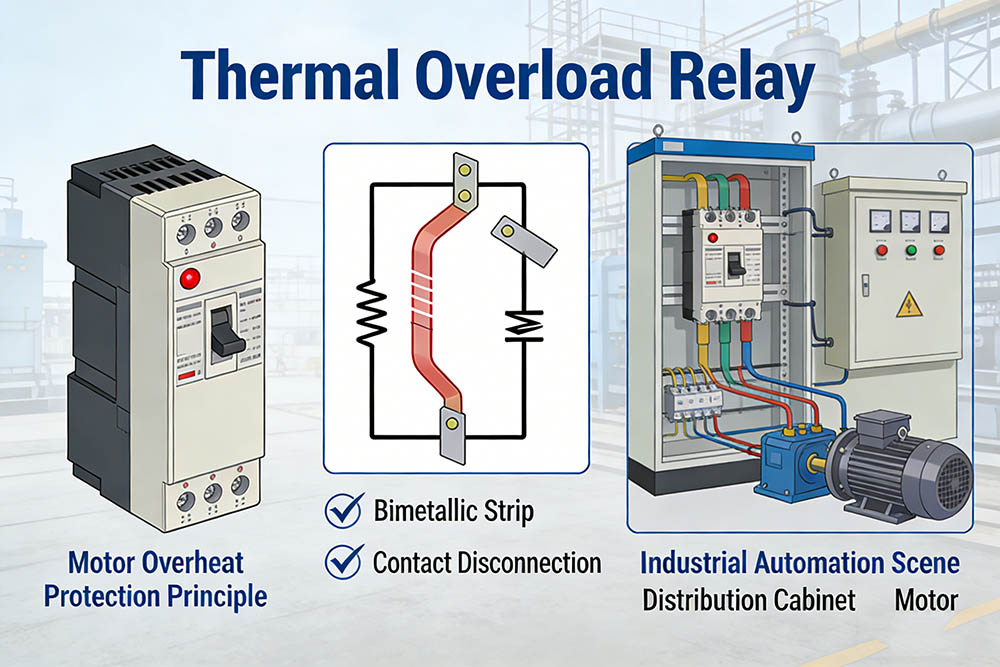
This article introduces the definition, working principle, structure and application of thermal overload relays.
Key Takeaway
- A thermal overload relay is an electrical protection device that protects motors from overload by using the principle of thermal effect.
- It prevents motors from overheating and being damaged during long-term overload operation and maintains stable and safe operation of equipment.
- When the current exceeds the set value and lasts for a certain time, the internal bimetal strip bends under heat and drives the contacts to act so as to cut off the control circuit.
- It provides inverse-time characteristics, which means the action time becomes shorter as the overload current increases and matches the actual heating law of motors.
- It is widely used in industrial motor control systems and is usually used together with contactors.
- It features simple structure, low cost, high reliability and convenient maintenance.
What is a Thermal Overload Relay?
A thermal overload relay is an electrical protection device that intended protect motors against overload operation.
Its main function is that when the motor current exceeds the rated value and lasts for a certain time, the internal components of the relay will act due to heat generation and automatically cut off the control circuit, which can prevent the motor from being damaged by overheating.
What is the Working Principle of a Thermal Overload Relay?
When a motor runs normally, the current flowing through the thermal overload relay stays within an allowable range, and the heat generated by internal heating elements is not enough to trigger an action. When the motor is overloaded and the current rises and lasts for a certain time, the temperature of the heating elements will increase and make the internal bimetal strip bend under heat.
After the deformation of the bimetal strip reaches the set value, it pushes the mechanical mechanism and makes the normally closed contact of the relay open or the normally open contact close, which cuts off the power supply to the contactor coil and stops the motor.
The larger the overload current is, the more heat will be produced, the faster the temperature of the bimetal strip will rise and the shorter the relay action time will be. The closer the current is to the rated value, the longer the action time will be. This characteristic is called inverse-time characteristic, which is consistent with the actual heating law of motors.
After the action, the bimetal strip needs to cool down before the device can be restored to working state through manual or automatic reset.
What are the Advantages and Disadvantages of Thermal Overload Relays?
Advantages of Thermal Overload Relays
- Protection characteristics are close to the heating law of motors
- Simple structure and high reliability
- Low cost and high performance-price ratio
- Easy to use and maintain
- Wide application range
Disadvantages of Thermal Overload Relays
- Slow response speed
- Greatly affected by ambient temperature
- Relatively single protection function
- Lower precision than electronic protectors
What are the Components of a Thermal Overload Relay?
They are usually made of heating resistors or coils and are connected in series in the motor circuit to sense the current level. Greater current generates more heat. As the core component of a thermal overload relay, it is composed of two metals with different thermal expansion coefficients. It will bend when heated and provide mechanical displacement for the relay action.
It generally includes a group of normally closed contacts for cutting off the contactor coil and a group of normally open contacts for signal indication or alarm. It transfers the displacement of the bimetal strip to the contacts and makes the contacts act quickly and reliably in case of overload.
It sets the action current of the relay through a knob or adjusting screw to match the rated current of the protected motor. It is used for restoration after overload action and can be divided into manual reset and automatic reset.
| Component | Description |
| Heating Elements | Sense motor current and generate heat proportional to load. |
| Bimetal Strip | Bends when heated to trigger the relay action. |
| Contact System | Opens the contactor coil circuit and provides alarm signals. |
| Actuating Mechanism | Transfers bimetal movement to operate the contacts. |
| Current Setting Device | Adjusts trip current to match motor rating. |
| Reset Mechanism | Resets the relay after tripping, manual or automatic type. |
What Types of Thermal Overload Relays Are There?
General Motor Protection Type
Designed mainly for overload protection of three phase asynchronous motors in general industrial equipment such as fans, water pumps, and conveyors. This type features a simple structure and cost effective performance.
Heavy Duty Starting Type
Suitable for equipment with high starting current and long starting time, including crushers, compressors, and mixers. The relay allows extended starting duration to prevent nuisance tripping.
Light Load or Frequent Starting Type
Commonly applied to equipment with small load variations or frequent start stop operations, such as machine tools and small transmission systems. High sensitivity ensures accurate protection.
Phase Loss Protection Type
Provides overload protection together with phase loss protection for three phase power systems. Frequently used in applications requiring high operational reliability.
Multifunctional Comprehensive Protection Type
Integrates multiple protection functions, including overload, phase loss, unbalance, and locked rotor protection. Often selected for automated systems or critical equipment.
Special Environment Application Type
Developed for high temperature, high humidity, dusty, or explosion proof environments such as mining, chemical, and metallurgical industries. Enhanced structural design and material selection ensure strong environmental adaptability.
What Are the Practical Applications of Thermal Overload Relays?
Motor Control Circuits
In various low-voltage power distribution cabinets and motor control cabinets, thermal overload relays are usually used together with contactors and circuit breakers to form the most basic protection circuit for motors. When the motor current rises continuously due to excessive load or abnormal operation, the relay will act to cut off the control power, release the contactor and stop the motor, which prevents winding burnout caused by overheating.
Fan and Water Pump Systems
In ventilation, air conditioning and water supply and drainage systems, fans and water pumps often suffer from overload caused by pipe blockage, incorrect valve operation or working condition changes. Thermal overload relays can cut off the power supply in time when motors run under overload for a long time, which protects equipment and reduces maintenance costs.
Conveying and Transmission Equipment
In belt conveyors, chain conveyors, hoists and other equipment, material accumulation or mechanical jamming can easily lead to higher motor current. Thermal overload relays can protect against such continuous overload and prevent motors from running under abnormal conditions for a long time, which reduces the risk of equipment damage.
Machine Tools and Processing Equipment
In lathes, milling machines, drilling machines and other machine tools, motors may be overloaded if the cutting load is too large or the tools are badly worn. Thermal overload relays can disconnect the motor control circuit in time and improve the safety and stability of equipment operation.
Compressors and Pump Equipment
In air compressors, hydraulic pumps and other continuous running equipment, motors often work under high load. Thermal overload relays can provide protection before motors overheat, which prevents insulation aging and equipment damage.
Automated Control Systems
In automated production lines and industrial control systems, thermal overload relays serve as basic protection components and work together with PLCs, contactors and other equipment to form a complete motor protection system, which still maintains high value in intelligent systems.
| Type of Thermal Overload Relay | Applications |
| General Motor Protection Type | Fans, water pumps, conveyors and other general industrial equipment |
| Heavy-Duty Starting Type | Crushers, compressors and other equipment with large starting current |
| Light-Load/Frequent Starting Type | Machine tools, small transmitters and other equipment with small load changes |
| Phase Loss Protection Type | Occasions that require high operational reliability |
| Multifunctional Comprehensive Protection Type | High-automation systems and important equipment |
| Special Environment Application Type | Mining, chemical, metallurgical and other harsh environments |
How to Select a Thermal Overload Relay?
- The setting current range of the relay should cover the motor rated current, and the setting value is usually set at about 1.0 to 1.1 times the motor rated current.
- Equipment with long starting time and large starting current should choose models suitable for heavy-duty starting. Equipment with light load or frequent starting should choose sensitive-action types.
- Split type or combined type can be chosen according to the control cabinet structure, and combined type is more convenient for installation and wiring.
- In environments with high temperature or large temperature difference, models with temperature compensation should be selected. Products with stronger protection performance can be chosen for special environments.
- General type can be chosen for ordinary occasions. Multifunctional type with phase loss and unbalance functions or electronic relays can be selected for occasions with high safety requirements.
How to Maintain a Thermal Overload Relay?
Make sure the setting value meets the motor rated current to avoid malfunctions or protection failure. Prevent extra heat generation or affected action reliability caused by poor contact. Look for ablation, oxidation or mechanical jamming and replace the contacts if necessary.
Clean up dust and debris, and strengthen inspection especially in dusty or humid environments. After the relay acts, check the cause of motor overload first and reset the relay only after troubleshooting, which avoids repeated overload operation.
Conclusion
Thermal overload relays are commonly used components for motor protection and can effectively prevent motors from overheating and being damaged during long-term overload. They feature simple structure, low cost and high reliability and are widely used in various electrical control systems.
In actual use, proper selection, correct setting and regular maintenance can provide stable and reliable overload protection for motors, which makes them a basic component in the motor protection system. KRIPAL provides a wide range of thermal overload relays that can provide perfect solutions for your needs in this field. Please contact our engineer. He can help you solve the problem.
FAQs
Q: Can thermal overload relays be used for short-circuit protection?
No. Thermal overload relays are mainly used for long-term overload protection of motors and respond slowly to high-current faults such as short circuits. They usually need to be used together with circuit breakers or fuses.
Q: Can a thermal overload relay be reset immediately after it acts?
It is not recommended to reset it immediately. The cause of motor overload should be found and eliminated first, and then reset after the relay cools down to avoid repeated overload operation of the motor.
Q: How is the setting current of a thermal overload relay usually set?
It is usually set according to the motor rated current, generally 1.0 to 1.1 times of the rated value, and can be adjusted properly according to load characteristics.
Q: Does ambient temperature affect the action of a thermal overload relay?
Yes. Excessively high or low ambient temperature may affect the action characteristics, so models with temperature compensation should be selected for occasions with large temperature differences.
Q: Can a thermal overload relay replace an electronic motor protector?
It can meet basic overload protection needs in general applications, but electronic motor protectors are more suitable for occasions that require high protection precision and functions.
Related Resources
Explore Knowledge Center >

Need a matching KRIPAL product?
Share voltage, quantity and destination. An engineer will reply with options and lead time.