Search
Knowledge Center
What Is the Difference Between Single Phase and Three Phase Power
Discover the key differences between single-phase and three-phase power, including structure, capacity, and applications of Three Phase Power.
 December 08, 2025
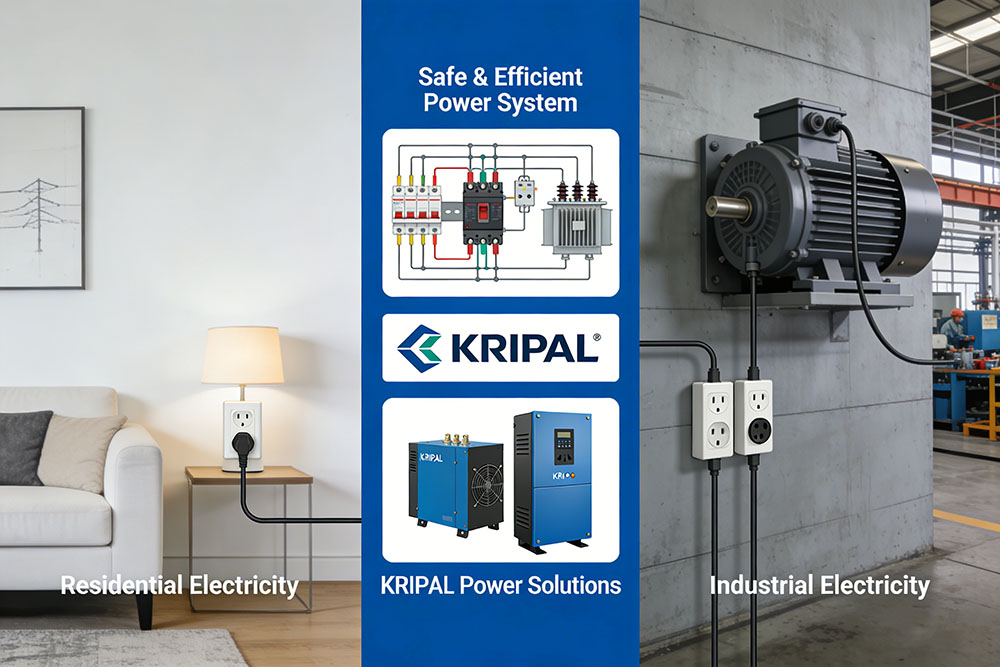
In daily life and industrial production, single phase power and three phase power are two commonly mentioned concepts. Residential electricity supply is usually single phase, while factories and large equipment typically rely on three phase power. These two power supply methods differ clearly in terms of supply structure, power output, and application scenarios.
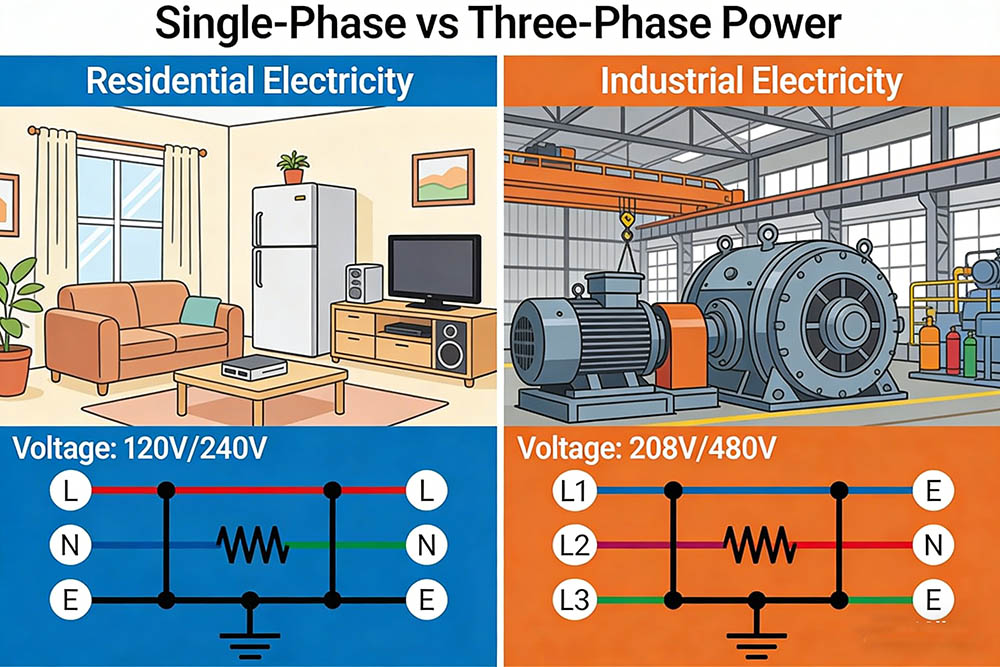
So what exactly is the difference between single phase and three phase power, and where is each one more suitable? This article provides a clear overview of their main differences to help readers understand their characteristics and applications more easily.
Key Takeaway
- Single phase power has a simple structure and is suitable for residential and low power applications.
- Three phase power provides higher output and more stable operation, which makes it suitable for industrial and large scale equipment.
- The choice of power supply depends mainly on load size and usage conditions.
What types of alternating current are there?
Electricity forms the foundation of modern society, powering everything from household appliances to large industrial machines. Most electricity used in daily life is alternating current, which utility companies supply as single phase or three phase power.
Single phase power is mainly used in homes and small businesses for lighting, TVs, refrigerators, air conditioners, and small tools. Smaller loads use single phase power .
Three phase power is used in industrial and commercial settings to operate motors, pumps, compressors, elevators, large HVAC systems, and manufacturing equipment. Higher power demands require three phase power.
What Is Single Phase Power and What Are Its Characteristics?
Single phase power is the most common form of alternating current supply. It usually consists of one live wire and one neutral wire, with voltage and current varying periodically over time. Since the system structure is simple and wiring is convenient, both power distribution and electrical equipment costs remain relatively low. As a result, single phase power is widely used in homes, offices, and small commercial environments, including lighting systems and household appliances.
Main characteristics of Single phase power
Its circuit structure is simple, as it generally requires only one phase and one neutral wire, which makes installation and wiring easier. System and equipment costs are relatively low, which suits residential applications well.
It is suitable for low power devices such as lighting, home appliances, and office equipment. Power output fluctuates within each AC cycle, since only one phase is involved. Load capacity is limited, which means it is not suitable for high power equipment or systems that require stable operation.
What Is Three Phase Power and What Are Its Characteristics?
Three phase power is an alternating current supply system composed of three live wires, with each phase offset by 120 degrees. This configuration allows power to be delivered continuously and smoothly during operation. Because of its advantages in stability and efficiency, three phase power is widely used in industrial, commercial, and high power applications such as motors, production equipment, elevators, and central air conditioning systems.
Main characteristics of Three phase power
Power output remains balanced and stable at all times, which results in smooth operation with minimal fluctuation. Transmission efficiency is higher, since smaller conductor cross sections are required for the same power level, which reduces line losses.
It is suitable for high power loads and continuous operation equipment. Three phase motors offer good starting performance, stable operation, and high efficiency due to their simpler structure. System complexity is higher, as wiring, distribution, and maintenance requirements increase along with installation costs.
What Are the Differences Between Single Phase and Three Phase Power?
Supply Structure
Supply structure differs, since single phase power uses one live wire and one neutral wire, while three phase power uses three live wires that are phase shifted by 120 degrees and may also include a neutral wire.
Power Output Characteristics
Power output characteristics differ, because single phase power experiences noticeable fluctuations during each cycle, whereas three phase power maintains a more stable and continuous output through phase rotation.
Load Capacity
Load capacity differs, as single phase power is suitable for lower power loads, while three phase power can handle higher current levels and greater overall power demand.
Application Scenarios
Application scenarios differ, since single phase power is commonly used in residential buildings and small businesses, while three phase power is widely applied in factories, commercial complexes, and data centers.
Transmission Efficiency
Transmission efficiency differs, because three phase power achieves lower energy losses and higher efficiency when transmitting electricity over long distances or at high capacity.
Motor Performance
Motor performance differs, as three phase motors start more easily and operate more smoothly, while single phase motors require auxiliary starting components and generally operate at lower efficiency.
System Cost and Expandability
System cost and expandability differ, since single phase systems are simpler and less expensive to install but offer limited room for expansion, whereas three phase systems involve higher initial investment while providing greater flexibility for future growth.
| Aspect | Single Phase Power | Three Phase Power |
| Supply Structure | One live wire and one neutral wire. | Three live wires phase shifted by 120 degrees, sometimes with a neutral wire. |
| Power Output | Output fluctuates during each cycle. | Output remains stable and continuous. |
| Load Capacity | Suitable for low power loads. | Suitable for high power loads. |
| Applications | Homes and small businesses. | Factories and large commercial facilities. |
| Efficiency | Higher losses in high power transmission. | Lower losses and higher efficiency. |
| Motor Performance | Requires auxiliary starting and runs less smoothly. | Starts easily and runs smoothly. |
| Cost and Expansion | Lower cost but limited expansion. | Higher cost with better scalability. |
When Should Each Type of Power Supply Be Chosen?
Single Phase Power Supply
Single phase power is suitable when electrical loads are small and equipment power ratings remain low. Homes, offices, and small shops typically use lighting, computers, and household appliances that operate at modest power levels. Since single phase systems are easy to install and maintain, they suit general residential and light commercial use.
Three Phase Power Supply
Three phase power should be selected when equipment requires high power or continuous operation. Industrial motors, compressors, production lines, elevators, and central air conditioning systems benefit from the stable output and higher efficiency provided by three phase power, which supports long term reliable operation.
| Power Type | Typical Applications |
| Single Phase Power | Homes and apartments |
| Offices and small shops | |
| Lighting and household appliances | |
| Low power or intermittent loads | |
| Three Phase Power | Factories and industrial plants |
| Motors and compressors | |
| Production lines and elevators | |
| High power and continuous operation equipment |
Why Is Choosing the Right Power Supply So Important?
Correct power selection ensures proper equipment operation, since mismatched power types can lead to startup failure, unstable performance, or frequent faults. Efficiency improves when the power supply matches the load, as energy losses are reduced and system performance becomes more consistent.
Safety risks are reduced, because insufficient capacity or improper supply can cause overheating, overloads, or electrical fires. Construction and operating costs can be controlled more effectively, since overdesigned systems increase expenses while undersized systems raise maintenance costs.
Future expansion becomes easier, as proper planning allows capacity upgrades without repeated reconstruction.
Conclusion
Single phase and three phase power each have their own characteristics and suitable applications. Single phase power works well for residential and low power usage due to its simplicity and lower cost, while three phase power offers stable output and higher efficiency for industrial and high power equipment. In practical applications, the power supply should be selected based on load requirements, equipment type, and future expansion plans.
When power systems are chosen according to actual demand, system safety, efficiency, and long term reliability can be achieved. KRIPAL offers a wide range of solutions for both single phase and three phase applications. Explore our product range to find the right solution for your application.
FAQs
Q: Is household electricity single phase or three phase?
Most households use single phase power, since household appliances generally require limited power and single phase supply is sufficient.
Q: Can three phase power be used in homes?
Yes, although it is rarely required. Unless large power equipment such as central air conditioning systems is installed, single phase power remains more practical.
Q: Is three phase power more energy saving than single phase power?
Three phase power does not reduce energy use directly, but it operates more efficiently under high load conditions by reducing transmission losses.
Q: How can I tell if three phase power is needed?
If equipment requires high power, long term operation, or involves large motors and industrial machinery, three phase power is usually recommended.
Q: Can single phase power run three phase equipment?
Direct operation is not possible in most cases. Frequency converters or phase converters are required, which increases cost and system complexity.
Q: Which is safer, single phase or three phase power?
Both are safe when installed and used correctly. Safety depends on system design, protective devices, and proper operation rather than the type of power supply itself.
Related Resources
Explore Knowledge Center >

Need a matching KRIPAL product?
Share voltage, quantity and destination. An engineer will reply with options and lead time.