Search
Thermal Magnetic MCCB 16A-1600A | 10kA-100kA | Adjustable Trip | IEC 60947-2
Dual Protection for Reliable Power
KRIPAL manufactures thermal magnetic molded case circuit breakers (MCCBs) including the ABE/ABS, UKM5, and UKM30 series for low-voltage power distribution protection from 16A to 1600A with breaking capacities from 10kA to 100kA at 380/415V AC per IEC/EN 60947-2. These series feature a thermal-magnetic trip unit with a bimetallic strip for overload protection and a magnetic coil for short-circuit protection, providing reliable circuit protection without the need for an external power supply. Available in 2P, 3P, and 4P configurations in compact frame sizes from 30AF to 1600AF, these MCCBs serve as incoming devices, feeder protection, and motor circuit protection in main switchboards, sub-distribution boards, and motor control centers. They accept a full range of accessories including shunt trip, undervoltage release, auxiliary and alarm contacts, motor operators for remote switching, and rotary handle mechanisms with door interlock and padlock facilities. Certified to IEC 60947-2 with CE marking, KRIPAL MCCBs are supplied to panel builders, switchboard manufacturers, and electrical contractors for industrial and commercial projects worldwide.
Get A Quote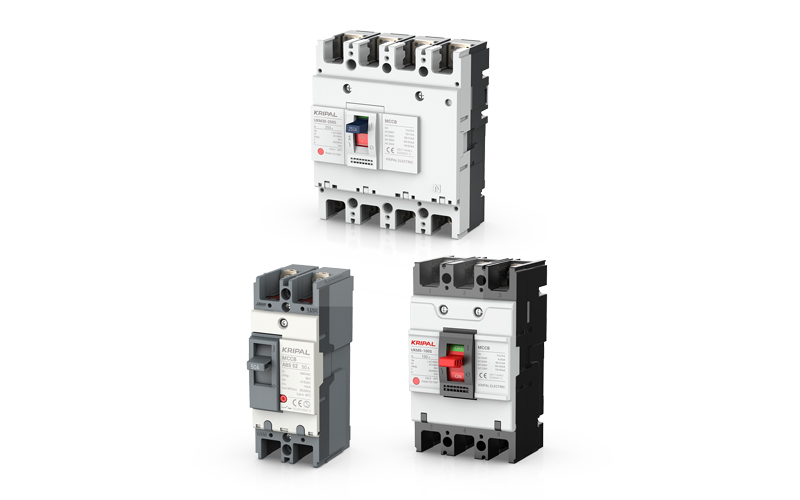
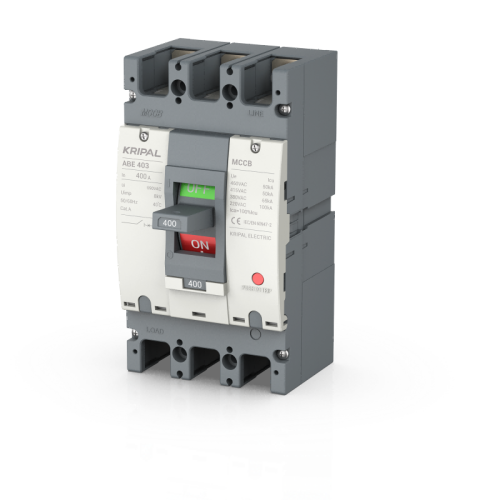

ABE-403 MCCB 3 Pole 400A Moulded Case Circuit Breaker CE Certified
The ABE-403 400A 3-pole moulded case circuit breaker is designed for current protection.
Ask a Quote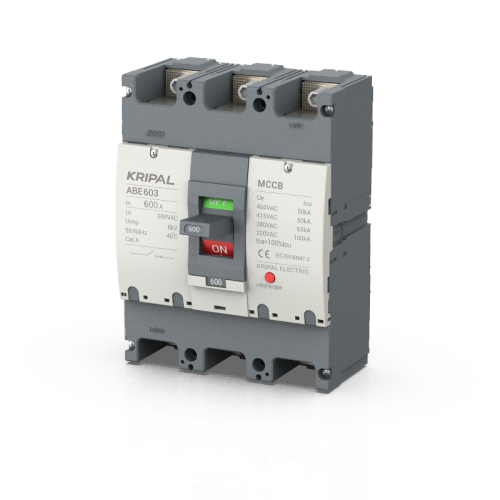
ABE-603 MCCB 3 Pole 600A Moulded Case Circuit Breaker CE Certified
The electronic MCCB ABB-603 moulded case circuit breaker is designed specifically for protection.
Ask a Quote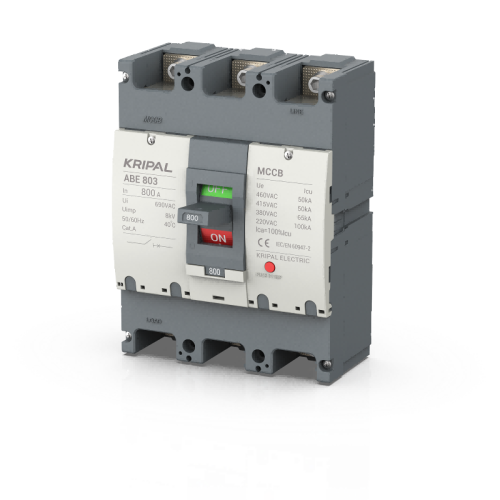
ABE-803 MCCB 3 Pole 800A Moulded Case Circuit Breaker CE Certified
The trip unit of the MCCB ABE-803 moulded case circuit breaker is designed for industrial low-voltage protection.
Ask a Quote
ABE-103 MCCB 3 Pole 100A Moulded Case Circuit Breaker CE Certified
ABE Series Plastic Case Circuit Breakers represent cutting-edge technology designed for the 21st century.
Ask a QuoteSelecting the Right Thermal Magnetic MCCB for Power Distribution Networks
A molded case circuit breaker provides overcurrent and short-circuit protection for low-voltage power distribution circuits where the fault current exceeds the breaking capacity of miniature circuit breakers. An MCCB uses a rigid molded case housing that contains the arc chamber, and its larger physical size compared to an MCB allows for higher current ratings, higher breaking capacities and adjustable trip settings. The thermal-magnetic trip unit provides two protection functions in one mechanical assembly: a bimetallic strip for thermal overload protection with an inverse time-current characteristic, and a magnetic coil for instantaneous short-circuit protection without intentional time delay. This selection guide covers frame size, current rating, breaking capacity and trip unit adjustment to match your circuit protection requirements.
Thermal Magnetic MCCB Series Technical Specifications
Frame Size and Current Range Selection
The UKM series is available in seven frame sizes: 100AF (16-100A), 160AF (100-160A), 250AF (125-250A), 400AF (200-400A), 630AF (400-630A), 800AF (500-800A), and 1600AF (630-1600A). The frame size (AF, Ampere Frame) defines the maximum current rating that the MCCB’s physical structure can accommodate, while the actual trip unit rating (In) can be adjusted within the frame’s range. For example, a 250AF frame can be equipped with a 200A trip unit and then field-adjusted between 140A and 200A. Selecting the correct frame size involves balancing the installation’s present maximum demand, expected load growth over the equipment’s 20-year service life, and the physical space available in the switchboard. It is generally recommended to select a frame that allows for at least 20 percent spare capacity without moving to the next larger physical size.
Breaking Capacity and System Voltage Matching
The UKM ultimate breaking capacity (Icu) ranges from 25kA at 400V AC (standard performance, suitable for installations where the switchboard is located more than 50 meters from the supply transformer) to 100kA at 400V AC (high performance, for installations where the switchboard is adjacent to a large transformer and prospective fault currents exceed 50kA). The required breaking capacity is determined by calculating the prospective short-circuit current at the MCCB’s point of installation using the supply transformer kVA rating, impedance voltage, and cable impedance from the transformer to the switchboard. The UKM series also offers a service breaking capacity (Ics) that is typically 50% to 100% of Icu, meaning the MCCB can clear a fault at its full rated Icu, be reset, and continue to provide protection without needing replacement.
Thermal-Magnetic Trip Unit Adjustment
The UKM thermal trip (overload protection) is adjustable from 0.7 to 1.0 × In via a rotary dial on the front face, allowing the MCCB’s thermal characteristic to be matched to the actual circuit cable ampacity after installation. For example, a 400A trip unit installed on a circuit with 300 mm² copper cable (ampacity 340A in air at 40°C) would be adjusted to 0.85 In = 340A. The magnetic trip (short-circuit protection) is available as a fixed setting (typically 10 In for standard distribution applications) or adjustable from 5 to 10 In for applications requiring coordination with downstream devices. The adjustable magnetic trip allows the instantaneous pickup to be raised above the downstream MCCB’s let-through threshold, achieving selective coordination where a downstream fault clears locally without tripping the upstream breaker.
Accessories and Remote Operation
The UKM series supports a comprehensive range of plug-in accessories that install without tools. A motor operator module allows remote opening and closing via 24V DC or 230V AC control signals from a PLC or SCADA system, enabling automated load transfer and remote circuit restoration. The shunt trip release enables remote tripping from a fire alarm panel or emergency stop circuit. The undervoltage release trips the MCCB when the supply voltage drops, preventing automatic restart of motors. Auxiliary contacts (up to 2 changeover) signal the MCCB open/closed status, and an alarm contact signals when the MCCB has tripped on a fault. The rotary handle mechanism provides clear ON-OFF-TRIP position indication, featuring a handle padlockable in the OFF position and a door interlock that prevents the switchboard door from opening while the MCCB is ON.
Specify MCCBs for Your Switchboard
- Selectivity Study: Submit your single-line diagram and we will return a complete protection coordination table with UKM series settings optimized for total discrimination.
- 3D CAD Models: Request STEP files of UKM series MCCBs for your switchboard layout design, including all accessory configurations.
- OEM Volume Supply: Dedicated production scheduling and JIT (Just-In-Time) delivery for switchboard manufacturers with repeat UKM series orders.
Power Distribution Protection Across Commercial and Industrial Sectors
KRIPAL UKM series thermal magnetic MCCBs protect low-voltage power circuits at the main switchboard, sub-distribution board, and large equipment feeder level across commercial buildings, industrial plants, and infrastructure installations. From the 1600A incoming device on a factory main switchboard to the 100A feeder MCCB on a building floor distribution board, the UKM series provides adjustable overcurrent and short-circuit protection with selective coordination across multiple levels of the power distribution hierarchy.
Commercial Building Main Switchboard Incoming Device
A 20-story commercial office building’s main LV switchboard uses a UKM series 1600A 4P MCCB with a 65kA breaking capacity as the incoming device from the 2000 kVA supply transformer. The thermal trip is set to 0.9 In (1440A) to protect the 4x 240 mm² per phase incoming cables, and the magnetic trip is set to 8 In (12,800A) to provide selectivity with the 400A feeder MCCBs on outgoing circuits. The motor operator allows the facilities manager to remotely open or close the main incoming device from the BMS workstation, enabling automated load shedding during peak demand periods or transfer to the standby generator during a supply outage. Auxiliary contacts signal the MCCB status to the BMS for real-time monitoring of the building’s electrical supply.
Industrial Plant Sub-Distribution & Motor Control Center Protection
A manufacturing plant’s sub-distribution board serving a production line is fed by a UKM series 400A 3P MCCB with a 36kA breaking capacity, where the thermal trip is set to 0.85 In (340A) to protect the 150 mm² feeder cable and the magnetic trip is adjusted to 7 In (2800A) to coordinate with downstream 63A MCBs. Its undervoltage release trips if the supply voltage drops below 70%, preventing safety hazards from automatic motor restarts. For motor control centers (MCC) serving multiple starters, a UKM series 630A 3P MCCB serves as the main incoming device with the thermal trip set to 0.9 In (567A) and magnetic trip set to 10 In (6300A) to prevent nuisance tripping during simultaneous motor starting currents (up to 4000A). A shunt trip release connects directly to the emergency stop system, de-energizing all motor circuits simultaneously in emergencies.
Data Center UPS Input Protection
A data center’s UPS input circuit is fed by a UKM series 250A 3P MCCB with a 50kA breaking capacity from the main switchboard. The thermal trip is set to 1.0 In (250A) because the UPS input current is essentially constant, drawing stable power from the supply regardless of load power factor changes. The magnetic trip is set to 5 In (1250A), the lowest available setting, to provide rapid short-circuit protection for the UPS input cable without interfering with the UPS’s internal bypass contactor operation. The motor operator allows the data center BMS to remotely transfer the UPS input from the utility supply to the standby generator during a prolonged outage, with the entire transfer sequence managed automatically by the BMS.
Crane and Hoist Feeder Protection
Overhead cranes and hoists in heavy industrial factories and warehouses are fed by UKM series 1606A/160A 3P MCCBs with the thermal trip set to 0.8 In (128A) to protect the flexible trailing cable supplying the crane bridge. The magnetic trip is adjusted to 10 In (1600A) to handle the high inrush starting current of crane hoist motors (typically 6-8 times full load current) plus the bridge and trolley traverse motors running simultaneously. The shunt trip release is wired to the crane’s upper limit switch, providing a redundant safety disconnect if the hoist overruns its upper threshold. Additionally, the rotary handle on the MCCB can be padlocked in the OFF position during maintenance, creating a visible, secure isolation point for service teams.
Specify MCCB Protection for Your Power Distribution
- Protection Coordination: Our engineers design a complete selectivity scheme for your power distribution system with UKM series MCCBs at every level.
- Type-Test Certificates: Obtain IEC 60947-2 test reports and discrimination tables for your switchboard IEC 61439 certification.
- OEM Switchboard Supply: Source UKM series MCCBs pre-assembled on mounting plates with busbar connections for your switchboard production line.
Manufacturing Quality and OEM Supply Capability
KRIPAL thermal magnetic MCCBs are manufactured on a dedicated production line where molded cases are precision-molded from glass-fiber reinforced polyester, contact assemblies are fabricated from silver-tungsten and silver-graphite composites, and thermal-magnetic trip units are individually calibrated. Each MCCB undergoes rigorous production-line thermal testing and instantaneous trip verification to meet global standards for power distribution and motor protection applications.
DMC/BMC Molded Case Injection Molding
MCCB housing cases are injection-molded from glass-fiber reinforced unsaturated polyester (DMC/BMC) using precision compression molding presses. This material formulation provides a CTI above 600V and a UL94 V-0 flammability rating. All molded cases undergo strict dimensional inspections on CMM equipment to ensure internal clearances for the arc chamber, contact mechanism, and trip unit remain within a 0.1 mm tolerance.
Silver-Tungsten and Silver-Graphite Contact Assembly
Main contacts utilize silver-tungsten (AgW) for exceptional arc erosion resistance, while arcing contacts feature silver-graphite (AgC) for anti-welding properties. Contact tips are resistance-brazed to copper carriers within a controlled-atmosphere furnace. Every contact assembly is measured for exact contact force and gap distance before installation into the MCCB mechanism.
Thermal-Magnetic Trip Unit Individual Calibration
Each trip unit is individually calibrated on an automated test station. The thermal element (bimetal strip with adjustable heater) is calibrated at 1.05 × In and 1.30 × In per IEC 60947-2 standards. The magnetic element is set for the instantaneous trip threshold (5 to 10 × In for standard distribution, and up to 10 to 14 × In for motor protection). All calibration data is digitally recorded against individual serial numbers for complete traceability.
Production-Line Temperature Rise and Trip Testing
Every MCCB undergoes a full temperature-rise test at rated current in free air, taking precise measurements at accessible terminals and molded case surfaces per IEC 60947-2 limits. Instantaneous tripping performance is verified at 120% of the set threshold. Comprehensive test results are linked to each serial number for 100% production-lot traceability.
Distributor Stock Holding Programs for MCCBs
KRIPAL supports distributor inventory programs with flexible stock allocation for standard MCCB models from 16A to 1600A with breaking capacities spanning 10kA to 100kA. Shipments are scheduled based on demand forecasting to maintain stable, continuous supply chains for global partners.
Private Label and OEM Branding for MCCBs
We offer laser-marked part numbers customized to your product catalog, OEM-branded packaging, and multilingual instruction manuals. Unbranded supply options are also available upon request for white-label or private-label production.
Multi-Region Certification and Compliance Support
Complete CE, UKCA, and IEC/EN 60947-2 compliance documentation and test reports are provided to support your target export markets. Technical documentation packages are continuously maintained and updated to reflect evolving international regulatory standards.
Direct Technical Access to KRIPAL Production Engineers
Your technical team communicates directly with the engineering team behind the design and calibration of your MCCBs—not a third-party sales agent. Application support, including selectivity and cascading protection coordination, receives authoritative responses within 24 hours during regular business hours.
Frequently Asked Questions
Explore FAQ >Recent Blog
Explore Blog >
How to Choose a Reliable Circuit Breaker Supplier
Learn how to verify circuit breaker suppliers through certificates, factory audits, sample testing, traceability, and total cost analysis.
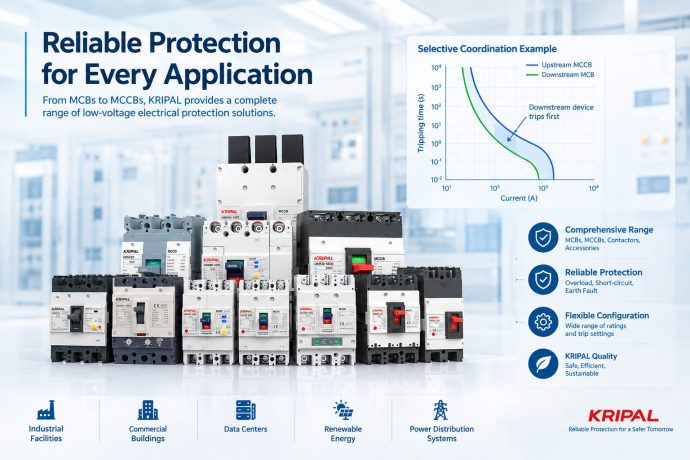
Why Selective Coordination Matters in Electrical Distribution (and How to Get It Right)
Why selective coordination matters: TCC curves, trip settings, fault current, and verifying MCCB/MCB device combinations.
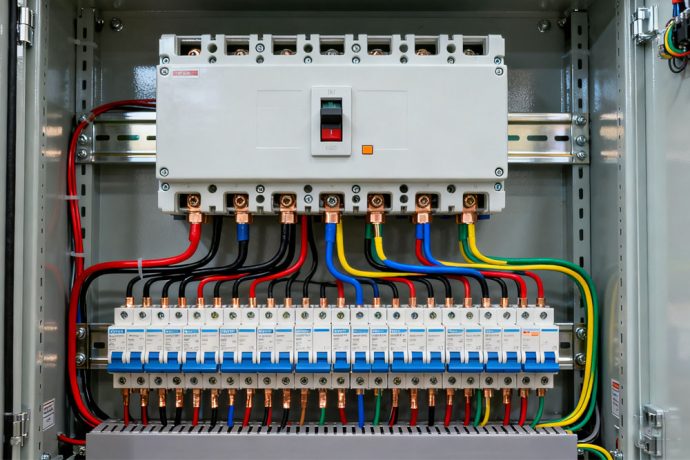
Circuit Breakers for Power Distribution Panels
Circuit breakers inside these panels are the devices that turn this structure into a safe and controllable system. Understanding how they work and how...
Direct from Manufacturer
How Can We Assist You?
Tell us a bit more so we can route your request to the right engineer. Get factory-direct pricing and custom specifications within 24 hours.