Search
Knowledge Center
Thermal vs Electronic Overload Relay: Key Differences, Working Principles & Which One to Choose
Compare thermal and electronic overload relays: working principles, differences, and selection tips. Choose the right motor protection for your application.
 June 03, 2026
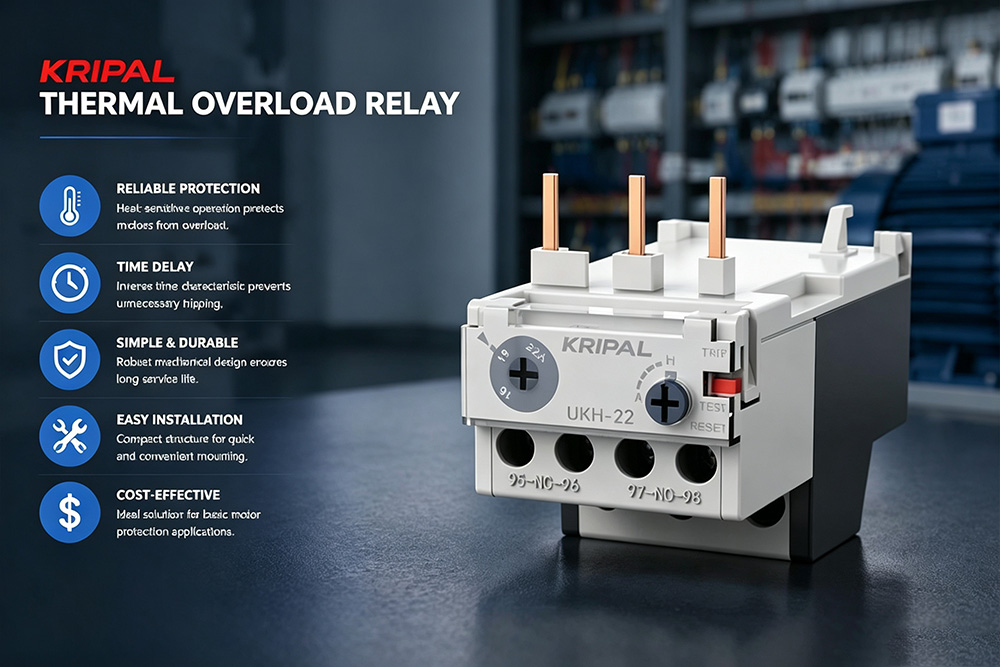
Electric motors are at the heart of industrial systems, and protecting them from overheating is essential for maintaining uptime, efficiency, and equipment lifespan.
Among the most widely used protection devices are thermal overload relays and electronic overload relays. While both serve the same basic purpose—protecting motors from overload conditions—their operating principles, performance, and application suitability differ significantly.
Understanding these differences helps engineers and system designers choose the right solution for different environments, whether it is a simple motor starter circuit or a more advanced automation system.
Core Highlights
- Thermal overload relays operate using heat-sensitive bimetallic elements that respond to current-induced temperature rise
- Electronic overload relays use sensors and microprocessors to measure current more precisely and provide advanced protection functions
- Thermal types are simpler, cost-effective, and widely used in basic applications
- Electronic types offer higher accuracy, flexibility, and better performance in complex or sensitive systems
- Selection depends on application type, accuracy requirements, and environmental conditions
Understanding Thermal Overload Relays
Thermal overload relays are traditional motor protection devices that operate based on the heat generated by electrical current. Inside the relay, a bimetallic strip bends when heated. When the current exceeds a preset limit for a certain duration, the strip bends enough to trigger a mechanical trip mechanism, disconnecting the motor from the power supply.
How thermal protection works
The working principle is closely tied to the relationship between current and heat. When motor current increases due to overload conditions, heat builds up in the bimetallic element. Since different metals expand at different rates, the strip bends gradually. If the overload persists, the bending reaches a point where the relay activates and opens the circuit.
Key characteristics of thermal overload relays
- Simple mechanical design
- Dependence on heat accumulation
- Inherent time delay (inverse time characteristic)
- Suitable for stable operating environments
- No external power supply required
Advantages
Thermal overload relays are widely appreciated for their simplicity and reliability in standard motor applications. They are also cost-effective and easy to install, making them suitable for small machines, pumps, compressors, and basic industrial equipment.
Limitations
Despite their reliability, thermal relays are influenced by ambient temperature. In environments with fluctuating temperatures, their accuracy can be affected. They also lack advanced diagnostic features and precise current measurement.
Understanding Electronic Overload Relays
Electronic overload relays represent a more advanced generation of motor protection devices. Instead of relying on heat, they measure current directly using electronic sensors such as current transformers. A built-in microprocessor analyzes the data and determines whether the motor is operating under safe conditions.
How electronic protection works
Current flowing through the motor is continuously monitored. The relay compares this current with preset thresholds. If abnormal conditions are detected, the system evaluates not only the magnitude but also the duration of the overload. Based on programmed logic, it triggers a trip signal to protect the motor.
Key characteristics of electronic overload relays
- High-precision current measurement
- Adjustable protection settings
- Built-in diagnostics and fault indication
- Compensation for temperature variations
- Integration with automation systems
Advantages
Electronic overload relays offer superior accuracy and flexibility. They allow fine-tuning of protection parameters to match specific motor characteristics. Many models also include communication capabilities, enabling integration with PLCs and smart control systems.
Limitations
The main drawback is cost, as electronic relays are more expensive than thermal versions. They also require a stable control power supply and may involve more complex setup procedures.
Thermal vs Electronic Overload Relay: Key Differences
Although both devices protect motors, their design philosophy and performance differ significantly.
| Aspect | Thermal Overload Relays | Electronic Overload Relays |
| Operating Principle | Rely on physical heat buildup, making them naturally slower and influenced by ambient conditions. | Measure electrical parameters directly for more precise operation. |
| Response & Accuracy | Slower response and less precise, but suitable for simple systems with minor current fluctuations. | Faster response, higher accuracy, and consistent performance across environments. |
| Functionality | Provide basic overload protection. | Offer protection plus monitoring, diagnostics, and system communication. |
| Flexibility | Limited adjustment options. | Allow precise configuration of trip classes, current limits, and delay times. |
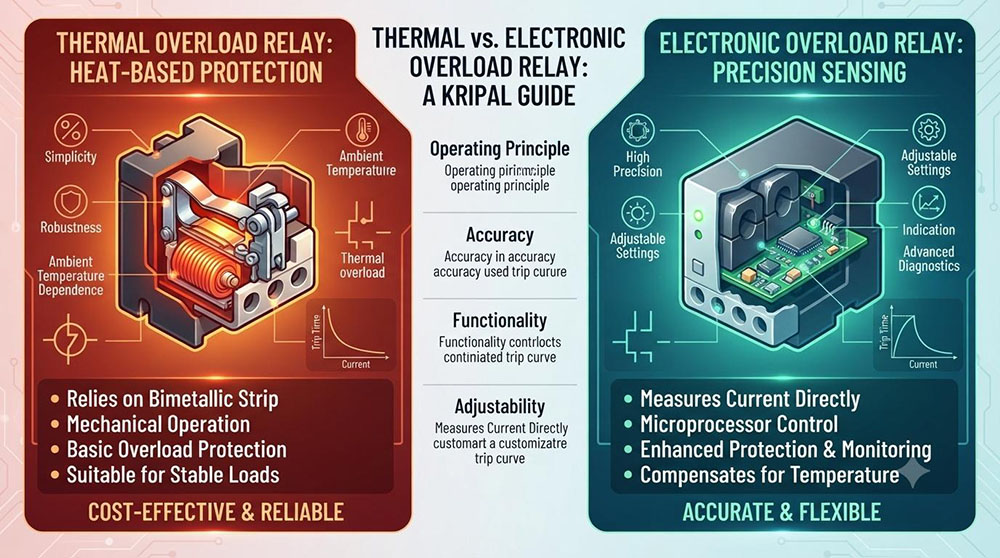
Performance Comparison in Real Applications
In practical industrial environments, both relay types serve different roles.
Thermal relays are commonly used in applications where:
- Motor loads are stable
- Environmental conditions are consistent
- Cost efficiency is a priority
- Advanced monitoring is not required
Typical examples include small pumps, HVAC fans, and basic conveyor systems.
Electronic relays are preferred in applications where:
- Load conditions vary frequently
- High precision protection is needed
- Motors are critical to production processes
- System integration and monitoring are required
They are widely used in automated manufacturing lines, large compressors, material handling systems, and smart industrial networks.
Which One Should Be Chosen?
Choosing between thermal and electronic overload relays depends largely on system requirements rather than one being universally better than the other.
| Type | Suitable Use Cases |
| Thermal Overload Relays | Best when simplicity, durability, and low cost are the main priorities. They perform reliably in straightforward motor control applications without requiring advanced features. |
| Electronic Overload Relays | Best when precision, adaptability, and system intelligence are important. They provide enhanced protection and enable quick response to abnormal conditions through detailed fault information. |
In modern industrial environments where efficiency and monitoring are increasingly important, electronic overload relays are becoming more common. However, thermal relays still remain widely used due to their robustness and affordability.
Industry Perspective
Manufacturers such as Schneider Electric and other global electrical equipment providers offer both thermal and electronic overload relay solutions. This allows system designers to select devices based on application complexity rather than being limited to a single protection method.
In many installations, both types are used together across different parts of the system, balancing cost and performance.
Conclusion
Thermal and electronic overload relays both play important roles in motor protection systems, but they are designed for different levels of application complexity. Thermal relays focus on simplicity and cost-effectiveness, while electronic relays emphasize precision, adaptability, and intelligent control.
Understanding their working principles and differences makes it easier to design safer and more efficient electrical systems that match real-world operational demands. I’m here to help you explore reliable motor protection solutions with both thermal and electronic overload relays. If you need guidance or have any questions, I’m always ready to support you.
FAQ
Q1 What is the main difference between thermal and electronic overload relays?
Thermal relays use heat-based mechanical operation, while electronic relays use sensors and microprocessors to measure current and provide more precise protection.
Q2 Are electronic overload relays better than thermal ones?
Electronic relays offer higher accuracy and advanced features, but “better” depends on the application. Simple systems may not require electronic functionality.
Q3 Why do thermal overload relays have a time delay?
The delay comes from the heat buildup process in the bimetallic strip, which allows short-term current spikes without tripping the motor.
Q4 Can electronic overload relays replace thermal relays?
Yes, in most cases they can, but cost and system complexity should be considered before replacement.
Q5 Where are thermal overload relays commonly used?
They are typically used in basic motor control applications such as pumps, fans, and small industrial machines.
Q6 Do electronic overload relays require external power?
Yes, most electronic overload relays need a control power supply to operate their internal electronics.
Related Resources
Explore Knowledge Center >
Need a matching KRIPAL product?
Share voltage, quantity and destination. An engineer will reply with options and lead time.