Search
Knowledge Center
What Is a Push Button Station and How Does It Work?
Learn how KRIPAL IP66 push button station controls 3-phase motors via contactors. Explore self-holding circuits, E-stop safety & weatherproof industrial control stations.
 May 18, 2026
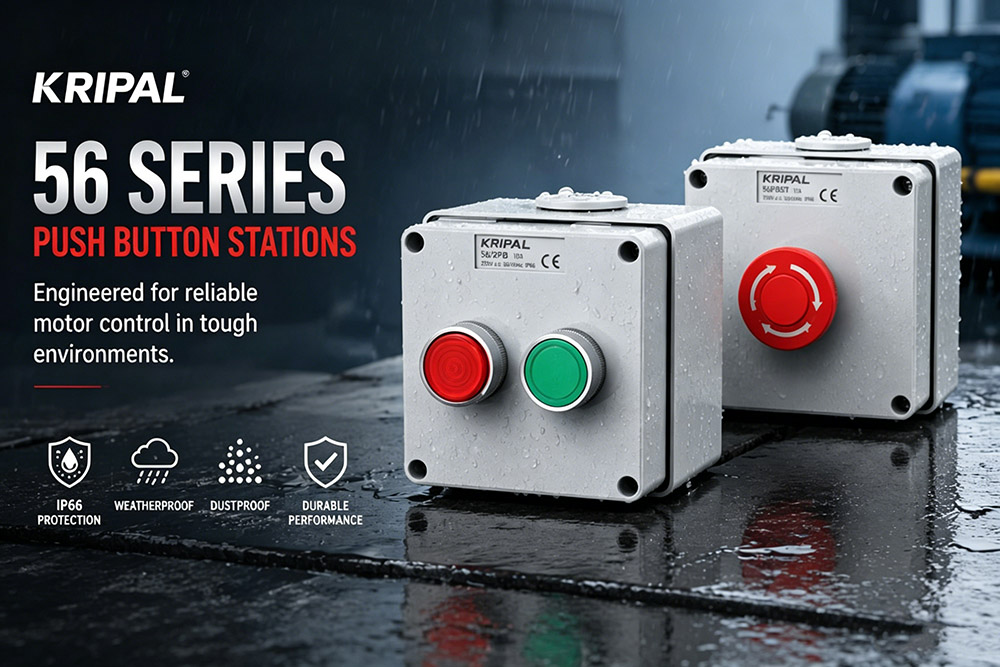
Motor control is a fundamental function of industrial automation. Operators across food processing lines, material conveyors, heavy-duty industrial fans, pumping systems, and outdoor machinery require simple, safe methods to start and stop motors.
Heavy-duty push button stations have become the industry standard for this need, especially in high-power three-phase motor applications.
These control stations manage motor start/stop operations and seamlessly integrate with AC contactors, emergency stop switches, and safety interlock systems to enhance operational safety and reliability under the harshest conditions.
This article explains the fundamentals of push button stations, internal operations, control circuit design, contactor integration, and industrial safety applications to highlight why this rugged device is essential for challenging environments.
Key Takeaways
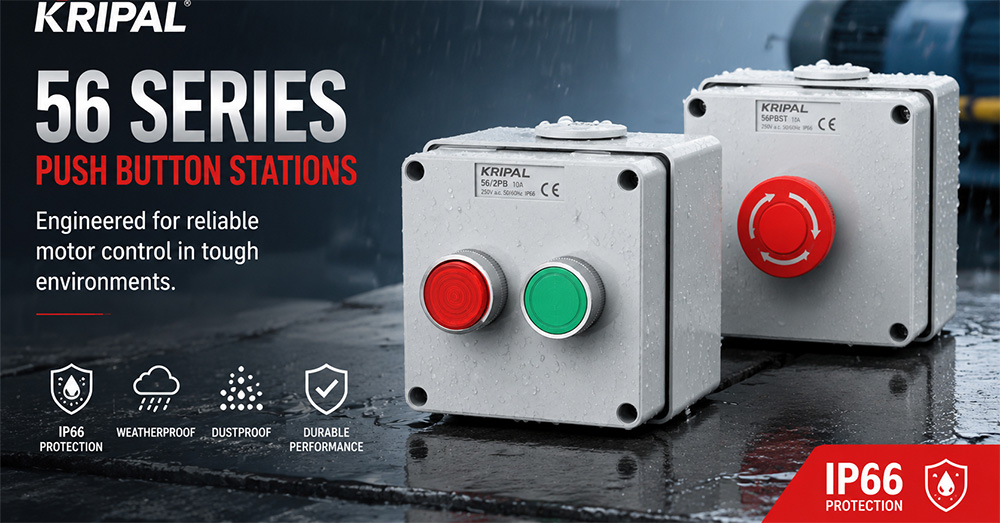
- Heavy-Duty Protection: Push button stations like the KRIPAL 56 Series provide critical motor control with IP66 weatherproof and dustproof reliability.
- Contactor Coordination: They operate within low-current control circuits to safely switch high-power three-phase electrical loads via contactors.
- Standard Logic: Start buttons utilize normally open (NO) configurations, while stop and emergency stop buttons use normally closed (NC) fail-safe structures.
- Self-Holding Design: Auxiliary contacts on the contactor allow the motor to remain running after the start button is released.
- Built for Extremes: Engineered with UV-stabilized materials and impact-resistant designs to thrive where ordinary plastic enclosures fail.
What Is a Push Button Station?
An industrial push button station is a ruggedized control device used to operate machinery or motors through manual button actuation. Common configurations include:
- Motor starting and stopping
- Emergency stop (E-stop) control
- Forward and reverse rotation control
- Manual/Auto selector control
- Safety interlock integration
Unlike standard indoor switches, heavy-duty stations like the KRIPAL 56 Series are designed for surface mounting directly on or near machinery, exposed production lines, and outdoor infrastructure, allowing operators to quickly control equipment on-site.
A standard 56 Series configuration typically ranges from 1-gang to 4-gang enclosures, accommodating start buttons, stop buttons, distinctive red mushroom-head emergency stops, or selector switches based on the application requirements.
Why Do Industrial Motors Require Push Button Stations?
Most industrial motors are three-phase AC motors connected to high-voltage power supplies (such as 380V, 415V, or 480V). Because these motors draw high starting and running currents, they cannot be controlled directly through small manual switches.
Attempting to do so would cause severe electrical arcing, welded contacts, component failure, and extreme shock hazards to the operator.
To eliminate these risks, industrial systems separate the system into a Control Circuit and a Power Circuit:
[KRIPAL 56 Series Station] ──> Low Current Control Loop ──> Contactor Coil
│ (Electromagnetic Action)
▼
[3-Phase Motor] <══════════════ High Current Power Line <═══ Main Contacts
The operator interacts solely with the KRIPAL 56 Series push button station, which handles a safe, low-current control signal (typically 24V DC or 220V-240V AC). This signal energizes an electromagnetic contactor inside the main distribution panel, and the contactor’s heavy-duty main contacts safely switch the high-voltage three-phase power supply to the motor.
The Function of the Contactor in the System
A contactor acts as the heavy-duty muscle commanded by the push button station’s brain. It consists of three essential components:
Main Contacts
The main contacts connect the three-phase power supply directly to the motor. When the contactor is energized, these contacts close simultaneously to start the motor. When de-energized, they snap open to cut power. They are engineered with high current-carrying capacities and robust arc-extinguishing properties to withstand thousands of cycles.
Coil
The coil turns electricity into mechanical movement. When the operator presses the start button on the 56 Series station, control voltage flows through the coil, creating a magnetic field that pulls the contacts shut.
Control Voltage Note: While various coil voltages exist globally, 220V-240V AC is highly standard for robust industrial infrastructure, while 24V DC is widely adopted for safety-centric control loops to eliminate high-voltage risks at the push button station itself.
Auxiliary Contact
Auxiliary contacts handle low current and are used purely for control logic and feedback signals. In a standard push button system, a Normally Open (NO) auxiliary contact is wired in parallel with the start button.
This creates a self-holding (or latching) circuit, allowing the contactor to stay energized and the motor to keep running even after the operator releases the momentary start button.
How Does a Push Button Station Work?
A push button station operates through precise mechanical and electrical coordination:
How the Start Button Works?
The start button features a Normally Open (NO) contact structure. When idle, the circuit is broken. Pressing the button closes the contact, allowing current to flow to the contactor coil.
The contactor fires, the auxiliary contact closes to latch the circuit, and the motor starts. Thanks to an internal spring return mechanism, the button pops back out immediately, but the self-holding circuit keeps the machinery alive.
How Does the Stop Button Work?
The stop button utilizes a Normally Closed (NC) contact structure. Under normal running conditions, current flows continuously through this button.
When pressed, it mechanically breaks the control circuit, starving the contactor coil of voltage. The contactor releases, the self-holding circuit unlatches, and the motor instantly stops.
Why Is the Stop Button Normally Closed (Fail-Safe)?
A core tenet of industrial safety is Fail-Safe Design. Because the stop button is Normally Closed, the control circuit requires continuous electrical continuity to keep the machine running.
If a control wire breaks, a terminal loosens, or the button component gets damaged, the circuit is automatically interrupted, and the motor shuts down safely. If it were designed as a normally open switch, a broken wire would go unnoticed until an emergency arose, leaving the operator unable to stop the machine.
Emergency Stop (E-Stop) Switches
Emergency stop buttons are paramount for personnel safety. KRIPAL 56 Series E-stops feature a prominent red mushroom-head design with a twist-to-release latching mechanism.
Wired in series at the very beginning of the control loop, pressing the E-stop instantly kills power to the contactor coil. Because it locks into place mechanically, the machine cannot be restarted accidentally until the operator physically twists and resets the mushroom head.
Weatherproof and Industrial Adaptability
Where standard plastic stations fail due to moisture, dust, or UV degradation, the KRIPAL 56 Series thrives. It is widely engineered into demanding setups across multiple sectors:
- Food & Beverage Processing: Survives daily high-pressure, high-temperature chemical washdowns thanks to its IP66 rating and tight sealing gaskets.
- Mining & Aggregate Sites: Resists heavy dust penetration and mechanical impact with an IK08-rated impact-resistant housing.
- Marine Docks & Chemical Plants: Formulated from UV-stabilized, chemical-resistant Polycarbonate (PC) materials that refuse to crack or discolor under intense salt mist or scorching sunlight.
- Commercial Car Washes: Operates reliably amid constant water spray, high humidity, and airborne detergents.
Advantages of KRIPAL 56 Series Push Button Stations
| Enclosure Type | Core Configuration | Primary Application |
| Emergency Stop | Red Mushroom Head (Latching, Twist-Reset, NC) | Mounted directly adjacent to hazardous machinery as the primary safety line of defense. |
| Start/Stop Station | Green Flush Button (NO) + Red Extended Button (NC) | Classic Direct-On-Line (DOL) motor starting for three-phase industrial pumps, exhaust fans, and compressors. |
Every KRIPAL 56 Series station is designed with installation efficiency in mind, featuring ample internal wiring room and standard M20/M25/M32 threaded conduit entries (knockouts) to ensure a perfectly sealed, moisture-proof connection via matching cable glands.
Conclusion
Push button stations are the indispensable bridge between human operators and heavy industrial power. By coordinating momentary inputs with electromagnetic contactors, they allow high-voltage three-phase machinery to be managed with absolute safety and precision.
As industrial environments demand higher durability and stricter safety compliance, selecting ruggedized hardware becomes vital. KRIPAL’s 56 Series push button control stations provide the ultimate IP66 weatherproof and IK08 impact-resistant protection, ensuring your motor control loops remain safe, sealed, and reliable in the world’s toughest environments.
FAQs
Q1 What is the difference between a push button station and a standard toggle switch?
A standard toggle switch directly opens or closes the main power lines mechanically and stays in position. A push button station uses momentary contacts to send low-current electrical impulses to a contactor, which handles the actual high-power switching safely inside a remote enclosure.
Q2 Why can’t I wire an industrial three-phase motor directly to a push button?
Industrial three-phase motors draw high operating and inrush currents. Standard push button contacts lack the physical size and arc-quenching capabilities to break these heavy electrical loads. Wiring them directly would cause immediate contact welding, short circuits, and severe arc-flash risks to the operator.
Q3 What is the purpose of an auxiliary contact in a motor control station loop?
Because industrial start buttons are momentary (they open the moment you release your finger), an auxiliary contact on the contactor is wired in parallel with the start button. When the contactor engages, this contact closes and “latches” or “self-holds” the control circuit, keeping the motor running automatically.
Q4 Can the KRIPAL 56 Series control station handle outdoor rain and washdown environments?
Yes, absolutely. The KRIPAL 56 Series is explicitly engineered for these environments. It features a certified IP66 ingress protection rating, specialized weatherproof sealing gaskets, and durable UV-stabilized Polycarbonate housing, making it fully immune to heavy rain, dust storms, and high-pressure water jets.
Q5 What control voltages are compatible with KRIPAL 56 Series stations?
Although the internal insulation voltage rating handles standard control circuits seamlessly (up to 250V AC), they are most commonly integrated into standard 220V-240V AC industrial control loops or safe 24V DC automated systems utilizing PLCs and safety relays.
Q6 Is an emergency stop button required?
In most industrial equipment, emergency stop buttons are widely used as part of industrial safety systems, and many industry standards require them.
Related Resources
Explore Knowledge Center >

Need a matching KRIPAL product?
Share voltage, quantity and destination. An engineer will reply with options and lead time.