Search
Knowledge Center
The Real Difference Between Contactors and Relays
Discover the key differences in load capacity and applications as we explore contactor vs relay for your system needs.
 December 14, 2025
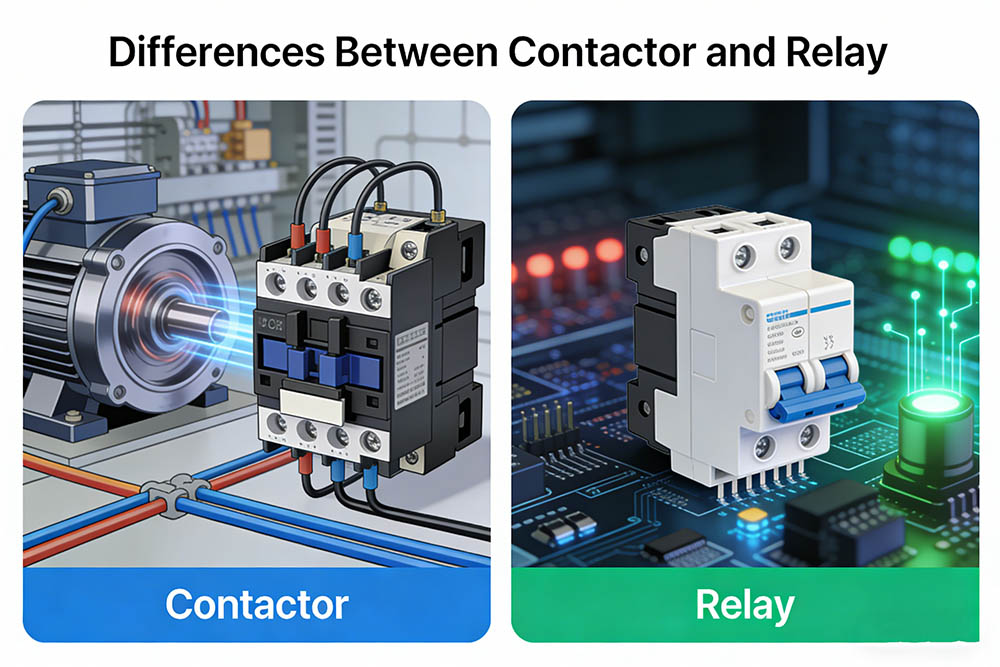
In the field of electrical control, contactors and relays are two terms that are frequently encountered. Many beginners, and even experienced engineers, often wonder whether a contactor is simply a larger relay and what the fundamental difference between the two devices really is. In practical applications, improper selection can lead to system instability, equipment damage, and potential safety risks.
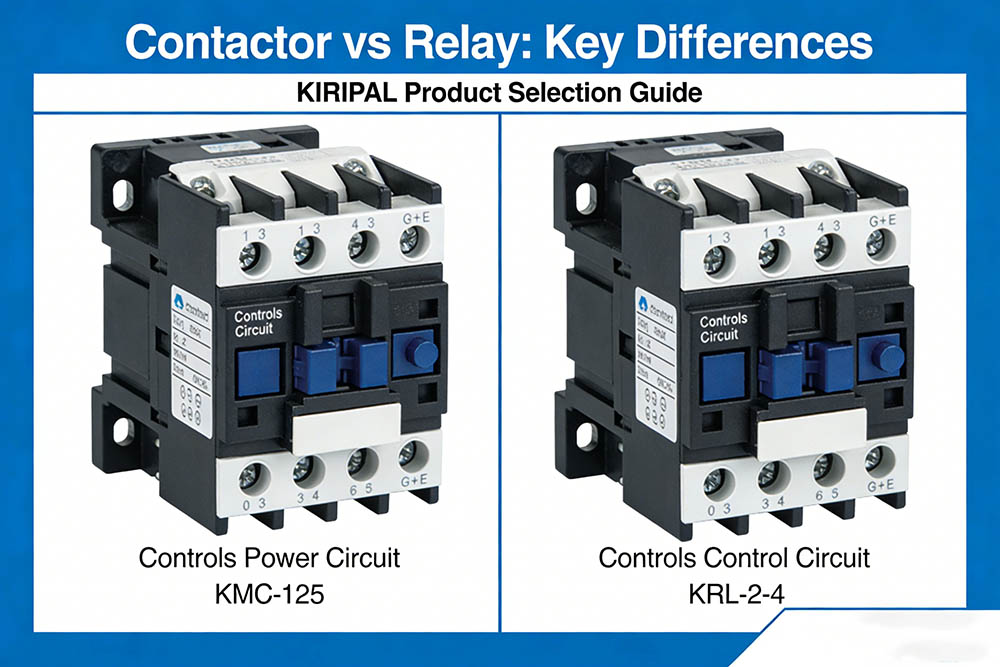
This article explores the differences between contactors and relays from the perspectives of working principles, load capacity, application scenarios, and design philosophy, so that engineers and technicians can clearly understand how they differ in real world use.
Key Takeaway
- In terms of function, contactors focus on power control, while relays are primarily intended for signal control.
- For application range, high current and high power equipment typically requires contactors, whereas relays are more suitable for low current and control circuits.
- From a structural perspective, arc extinguishing devices and higher contact capacity are features of contactors, while relays are lighter and emphasize sensitivity and precise operation.
- Within industrial systems, contactors are widely applied in automation and power distribution, while relays are commonly used in logic control, protection circuits, and signal switching.
- If a relay is used to replace a contactor in controlling high power loads, contact damage or even accidents may occur.
What Is a Contactor?
A contactor is an electrical device used to switch high current power circuits such as motors, heaters, and lighting systems. It works through electromagnetic action. When the coil is energized, the contacts close and power flows through the circuit. When power is removed, the contacts open and the circuit stops. To ensure safe operation, contactors are equipped with arc extinguishing devices to reduce damage caused by electrical arcs.
What Is a Relay?
A relay is an automatic switching device that allows a small current to control another circuit. It is mainly used for signal control, logic control, and protection. When the coil is energized, the contacts change position to complete or switch a circuit. When de energized, the contacts return to their original state. Relays are typically used in low current applications such as PLC outputs, appliance control boards, and automotive circuits.
What are the characteristics of a contactor?
Contactors are designed specifically for power circuits and are capable of controlling high power loads such as motors, heaters, and air conditioning compressors, whose rated current may range from tens to hundreds of amperes. When large currents are interrupted, arcs are produced, so contactors include arc extinguishing systems that suppress the arc and extend contact life.
They are suitable for frequent switching, and both their mechanical and electrical service life are relatively long, which makes them appropriate for repeated motor starting and stopping operations.
The main contacts are large and robust, which allows them to withstand high inrush currents such as those generated during motor startup.
Auxiliary contact modules can be added so that self holding, interlocking, and signal feedback functions can be implemented. They are widely used in industrial automation, power distribution systems, and motor control cabinets.
What are the characteristics of a Relays?
Relays are typically used to control small or medium power loads and are suitable for signal and control circuits. They operate with small actuation current and respond quickly, which allows accurate control in automation systems.
Relays are available in various types including electromagnetic relays, solid state relays, time relays, and intermediate relays, and their compact structure allows flexible installation. They provide normally open, normally closed, or changeover contacts, which makes them suitable for different logic control requirements.
Relays provide electrical isolation between the control circuit and the controlled circuit, which enhances system safety. They are widely used in PLC control, electrical protection, circuit switching, home appliances, and automotive systems.
Main Differences Between Contactors and Relays
Control Positioning
Control positioning differs because contactors are intended for power circuits where they control high power loads such as three phase motors, industrial heaters, and compressors, while relays are used in control or signal circuits where they handle logic control and signal amplification.
Load Capacity and Current Rating
Load capacity and current rating differ because contactors are designed to handle high rated currents and motor inrush currents, whereas relays are designed for smaller loads, and if they are used beyond their rating, contact burning or sticking may occur.
Arc Suppression Capability
Arc suppression capability differs because contactors include arc extinguishing systems that protect the contacts when large currents are interrupted, while relays generally do not include complex arc control structures due to their lower operating current.
Structural Design and Service Life
Structural design and service life differ because contactors have larger and stronger contacts that are built for frequent operation and long term use, while relays are more compact and emphasize control flexibility rather than high load endurance.
Application Environment
Application environment differs because contactors are typically located in the main power circuit of industrial systems, while relays are installed within control systems where they perform signal conversion, isolation, and logical switching.
| Item | Contactors | Relays |
| Design purpose | Designed for power circuits and high power control | Designed for signal and control circuits |
| Load capacity | Control high power loads such as motors, heaters, and air conditioning compressors | Control small or medium power loads |
| Rated current range | Rated current ranges from tens to hundreds of amperes | Rated current is relatively low |
| Arc suppression | Equipped with arc extinguishing systems to suppress arcs during current interruption | Generally lack dedicated arc suppression structures |
| Switching frequency | Suitable for frequent switching operations | Suitable for logic and control switching |
| Service life | Long mechanical and electrical service life | Service life depends on load and operating conditions |
| Contact structure | Large and robust main contacts withstand high inrush currents | Provide normally open, normally closed, or changeover contacts |
| Expansion capability | Auxiliary contact modules support self holding, interlocking, and signal feedback | Multiple contact configurations available by design |
| Electrical isolation | Isolation achieved through electromagnetic operation | Provide electrical isolation between control and load circuits |
Applications of Contactors and Relays
Applications of Contactors
- Used for motor starting, stopping, and forward and reverse control
- Applied in controlling pumps, fans, compressors, and other high power equipment
- Used for electric heating systems and high power lighting systems
- Installed in industrial automation cabinets and power distribution panels
- Suitable for situations where frequent switching and high current are required
Applications of Relays
- Used in PLC systems for signal output and logic control
- Used to implement interlocking, self holding, and status feedback in control circuits
- Applied in electrical protection, circuit switching, and signal isolation
- Commonly used in electronic devices, home appliance control boards, and automotive circuits
- Special types such as time relays and thermal relays are used for delay control and overload protection
How to Choose Between a Contactor and a Relay?
- Selection should be based on load size because high power equipment such as motors and heaters requires contactors, while signal circuits and small loads can be handled by relays.
- Current rating should be considered because high operating current and inrush current require a contactor, while low current control applications can use a relay.
- Operating frequency should be evaluated because equipment that starts and stops frequently is better suited for contactors, while occasional signal switching can be managed by relays.
- Arc and safety considerations should be reviewed because circuits that generate noticeable arcs require devices with arc suppression, which are typically contactors.
- System structure should be examined because the main power circuit generally uses contactors, while control and auxiliary circuits use relays.
- Cost and installation space should be considered because contactors are larger and more expensive, while relays are compact and suitable for dense control panel layouts.
Conclusion
In practical applications, the focus should not be on which device appears more advanced, but rather on understanding the type of load, the working current, and the role of the device within the system. Power circuits are controlled by contactors, while control circuits are handled by relays. When each device is used within its intended scope, the electrical control system operates safely and reliably.
A clear understanding of the differences between contactors and relays helps prevent improper selection and supports better system design decisions. KRIPAL offers a wide range of contactors and relays that can meet various application requirements. You may visit our product page to find solutions that match your needs.
FAQs
Q:Can a relay replace a contactor
In general, it cannot. Relays have limited contact capacity and arc suppression ability, which makes them unsuitable for long term control of high current or high power loads.
Q:Can a relay control a motor
Small motors may be controlled by relays under certain conditions, but most industrial motors should be controlled by contactors to ensure reliable operation during startup and continuous running.
Q:Is a contactor simply a larger relay
Although both devices operate using electromagnetic principles, contactors are specifically designed for high power applications, so they cannot be regarded as enlarged relays.
Q:Why does a contactor make a clicking sound
The sound is produced when the coil energizes and the magnetic core moves, which is normal as long as the action is clean and not vibrating continuously.
Q:Why do relay contacts burn easily
Common causes include operating beyond the rated current, frequently switching inductive loads, or lacking protective suppression measures. Proper selection and usage can extend relay service life.
Related Resources
Explore Knowledge Center >
Need a matching KRIPAL product?
Share voltage, quantity and destination. An engineer will reply with options and lead time.