Search
News
How Circuit Breakers Work to Protect Electrical Circuits
If the current becomes too high, the wiring may overheat, or connected equipment may suffer damage. A circuit breaker prevents that by cutting off the current when abnormal conditions appear.
 November 08, 2025
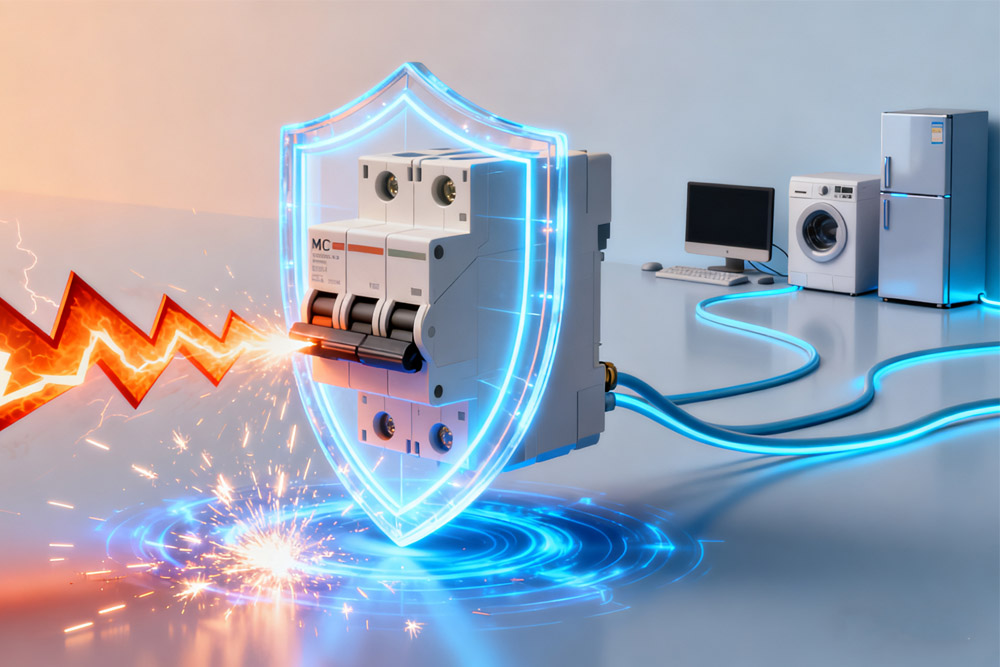
When an electrical circuit carries current, wiring and devices have limits for how much current they can safely handle. If the current becomes too high, the wiring may overheat or connected equipment may suffer damage.
A circuit breaker prevents that by cutting off the current when abnormal conditions appear. Once the issue is resolved, you can restore power with a reset. That simple behaviour helps prevent overheating, wiring damage or electrical hazards.
What Protection a Circuit Breaker Provides
A circuit breaker acts as a switch with built‑in detection. Under normal load, it stays closed, letting current flow to appliances or equipment. If load becomes too heavy or a fault occurs the breaker senses the condition and opens the circuit. This stops current flow instantly and breaks the path.
After correcting the fault you simply reset the breaker to resume normal operation. This makes circuit breakers reliable, on‑off safety devices usable again and again.
A breaker also provides convenient control. It allows you to shut off power for maintenance or installation work. That means you can safely access wiring or devices without risk of live current. This function supports safer working procedures.
How It Detects Faults Inside the Breaker
Inside a typical breaker, there are several parts working together. There is a housing that holds components. Inside, you find contacts that carry current when the circuit is closed.
There is a trip unit responsible for detecting overcurrent or fault conditions. When detection happens, the trip unit triggers the mechanism that separates contacts and cuts power.
For circuits with overloads that build up slowly, a thermal element will respond. If the current remains above the rating for a period, heat builds, causing a bimetal strip to bend. When it bends enough, the latch releases and the contacts open.
For sudden surges or short circuits, a magnetic or electromagnetic element reacts instantly. A strong magnetic field pulls a lever and trips the breaker. After contacts open, an arc may form. The breaker includes an arc‑extinguishing design to suppress and extinguish the arc safely. That ensures interruption is clean and prevents damage to the breaker itself.
Because of this dual protection approac,h the breaker handles both slow overloads and fast fault currents. Many common breaker types use this thermal‑magnetic architecture.
Where Breakers Are Used
Circuit breakers appear nearly everywhere electricity flows. In homes, they protect lighting circuits, wall sockets, air conditioners, kitchen appliances and more. In office buildings, they safeguard distribution panels, equipment circuits, lighting, heating or air conditioning systems. In industrial settings, breakers protect motor circuits, machinery, main feeders, distribution boards, and heavy equipment.
In complex systems — like factories or large commercial buildings — designers often use several layers of breakers. A main breaker handles incoming power. Sub‑feeders and individual circuits have smaller breakers sized for their load. This layering ensures each part of the system is protected appropriately.
What to Check When You Use a Breaker
To make sure a breaker works well, you need to match it to the circuit and load. Evaluate how much current the load draws in normal and peak conditions.
- For equipment like motors that draw high startup current pick a breaker tolerant of inrush.
- Ensure the breaker’s rating matches the circuit voltage and whether the system is single‑phase or three‑
- Consider environmental conditions. Heat, humidity, dust or confined spaces may affect performance.
- Wiring layout, enclosure ventilation and maintenance access matter too.
All these influence breaker performance and lifespan. Use a breaker with a suitable interrupting capacity if fault currents may be high. For safe, stable operation in systems with varied loads, choose a breaker with appropriate trip characteristics and ratings.
Resettable Protection vs Fuse Replacement
Older systems sometimes use fuses. A fuse breaks the circuit when the current exceeds the threshold. After that, you must replace the fuse. A breaker instead just opens contacts and can later be reset. That makes breakers convenient for systems where faults might occur more than once or where downtime matters.
Breakers support repeated use without parts replacement. They reduce maintenance effort and cost over time. In many installations, breakers are now preferred over fuses because of that flexibility.
Breakers also offer more precise protection. Many models support adjustable trip settings or different trip response curves. That helps when loads vary or include motors, electronic devices, or mixed equipment. This flexibility makes breakers better suited for modern wiring scenarios than fuses.
Ensuring Safe and Stable Electrical Installations
Using circuit breakers correctly improves safety and system stability. Breakers interrupt current flow quickly when an overload or a fault occurs. They help avoid damage to wiring and devices. They enable safe maintenance by allowing circuits to be de-energised. When selected and installed properly, breakers handle a range of load conditions and fault scenarios.
If you are designing a new installation, upgrading distribution boards, or managing electrical loads, make sure to choose breakers sized and rated properly for each circuit. Consider current demand, fault potential, environmental conditions and load type. That ensures circuits are protected, and equipment remains secure under varying conditions.
To explore a wide selection of circuit breakers suitable for residential or commercial installations, contact the Kripal Electric sales team and find breakers that match your needs.
Related Resources
Explore News >
How can we assist you?
Tell us a bit more so we can route your request to the right expert.