Search
 November 14, 2025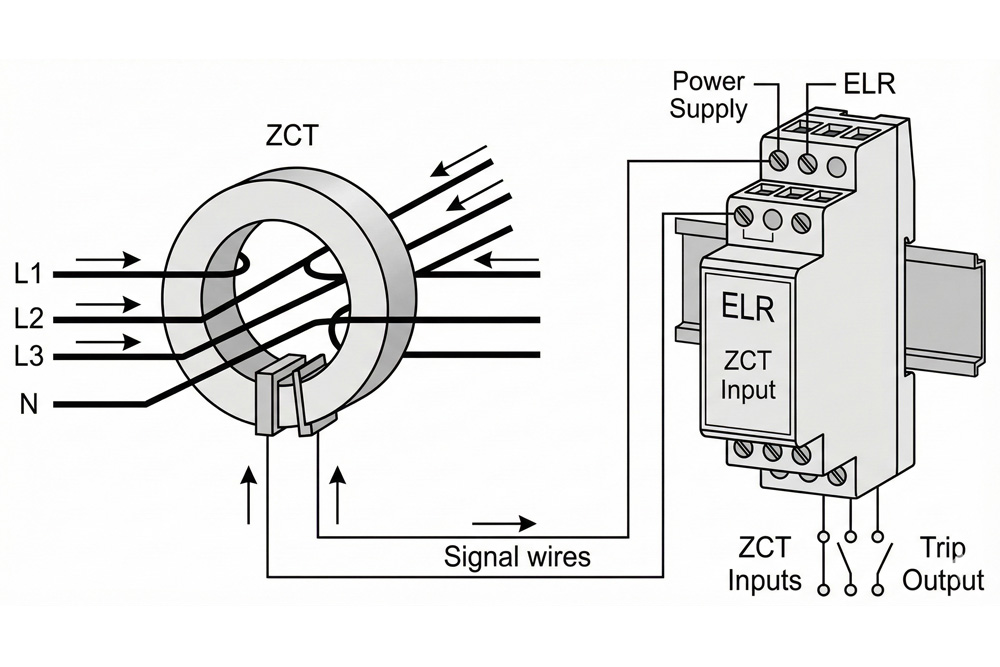
Ground faults or leakage currents represent a serious hazard in electrical installations. Standard over‑current breakers may not detect small leakage that bypasses neutral conductor and flows to earth.
To capture this category of fault we use zero‑phase current transformers and earth leakage relays. These devices monitor residual current and trigger protection actions when imbalance appears.
Role of Earth Leakage Relay (ELR) or Ground Fault Relay
The earth leakage relay monitors the output from ZCT. When the relay detects a leakage current exceeding the preset threshold, it triggers a trip signal. That signal can actuate a circuit breaker — cutting off power to the faulty circuit. This protects human life and prevents potential fire or equipment damage due to leakage current.
Compared with early voltage‑sensing devices, modern ZCT + ELR (or residual‑current devices) detect leakage even when the ground path is not via a dedicated protective conductor. For instance, when a person contacts a live conductor and the earth. Trip thresholds are often set to a few tens of milliamps for human safety.
What is Zero‑Phase (Residual) Current and Why It Matters
In a properly functioning three‑phase or single‑phase circuit current entering through phase conductors should return exactly via the neutral conductor. The sum of currents in all live conductors and neutral should equal zero.
If wiring or insulation fails, or a conductor contacts ground or equipment housing, part of current may flow to earth instead of neutral. This difference is called residual or zero‑phase current.
Normal over‑current protection does not react to such small leakage, yet leakage can cause shock, equipment damage or fire risk. Detecting residual current early helps prevent these hazards.
How Zero‑Phase Current Transformers (ZCT) Work
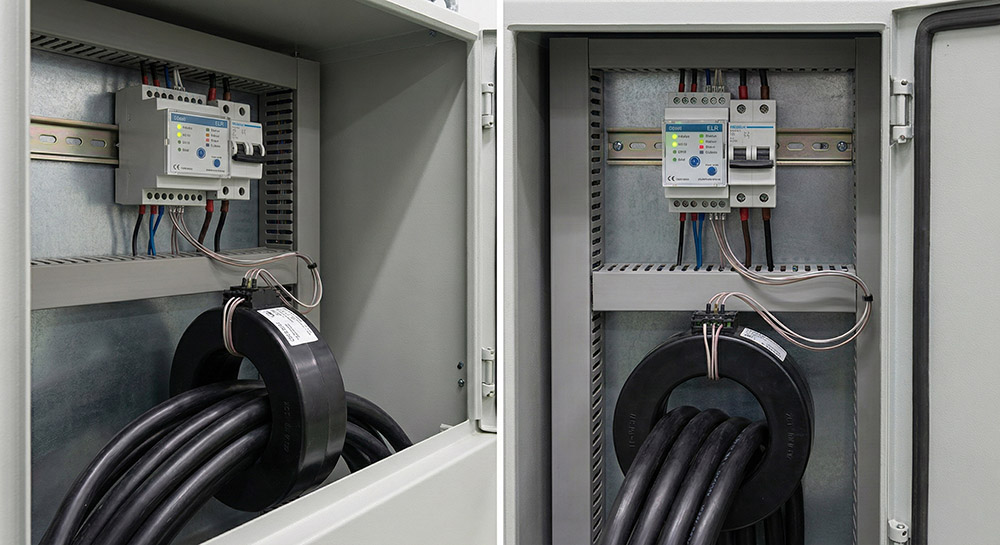
A zero‑phase current transformer encloses all conductors of a circuit (phases and neutral) through its toroidal core. Under balanced conditions, the vector sum of magnetic flux is zero, and no signal appears on its secondary winding.
When leakage or ground fault causes unbalanced current, the flux changes and a current is induced in the secondary winding. That induced current is proportional to the leakage current. The ZCT output is fed to a protective relay or circuit breaker triggering mechanism.
Because ZCT senses vector imbalance rather than absolute magnitude on one conductor, it can detect very small leakage currents. ZCTs are compact and designed for high-accuracy residual current measurement.
Where ZCT + ELR Protection Is Recommended
ZCT with earth‑leakage detection is highly recommended for circuits such as
- Circuits in wet areas, bathrooms, kitchens, outdoor outlets, pump motors, etc.
- Circuits supplying portable tools, metal‑housed equipment, pumps, compressors, motor drives
- Installations where insulation may age, wear or degrade over time
- Commercial or industrial installations with complex wiring, long cable runs, multiple sub‑circuits
- Environments where the safety of personnel or equipment is priority, or compliance with safety regulations is required
For these applications reliance on over‑current protection alone is inadequate. ZCT + ELR adds a layer of protection against leakage and ground‑fault risk that otherwise might go undetected.
What to Check When Implementing ZCT and Earth Leakage Protection
When designing or retrofitting protection with ZCT and Earth Leakage Relays, consider the following points
Ensure all phase conductors and neutral pass through the same ZCT core (including any protective conductors if required for system type). Leaving wires out of the core undermines detection reliability.
Select a relay with sensitivity suitable to application. For circuits where human contact or low‑current leakage matters choose a low trip threshold (e.g. 30 mA). For equipment circuits with higher tolerances, threshold may be adjusted accordingly.
Ensure grounding (earth) wiring is correctly implemented and meets code. ZCT/ELR rely on proper earthing to ensure faults or leakage currents have defined return paths. Faulty grounding can render leakage protection ineffective.
Pair leakage protection with over‑current or short‑circuit protection. Earth‑leakage relays protect against residue currents but do not limit overloads or high short‑circuit currents. A complete protection scheme combines leakage detection and over‑current interruption.
Test the system regularly. Most leakage relays include a test button. Periodic testing ensures relay and transformer are functional and wiring remains intact. Without testing protective devices may fail to trip when fault occurs.
Benefits for People, Equipment and Maintenance
Zero phase current transformers with leakage relays give an extra layer of protection for people. If live parts accidentally touch a metal frame, the resulting leakage current will be detected and the circuit will disconnect before touch voltage becomes dangerous.
For equipment, this system helps reveal insulation problems early. Repeated trips or frequent leakage alarms often point to cables or devices that are starting to degrade. Maintenance teams can then inspect and repair before the fault leads to downtime or fire.
From a maintenance point of view these devices are also convenient. Regular testing, using the test functions built into many relays, gives a simple check that the protection system still operates correctly after years of service.