Search
 June 04, 2026
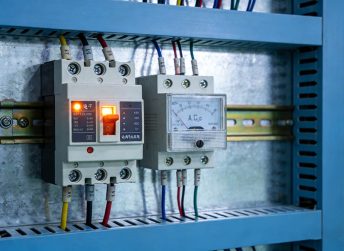
Earth leakage relays play an essential role in modern electrical and electronic systems. From industrial automation to commercial building power distribution, these devices are critical for detecting residual currents, preventing electric shocks, and mitigating the risk of fire in electrical installations.
Core Highlights
- Earth leakage relays detect current imbalances between live and neutral conductors.
- They provide vital protection for personnel and equipment against ground faults.
- Multiple relay types exist, each suited for different sensitivity and response requirements.
- Key advantages include enhanced safety, automatic disconnection, and system reliability.
- Widely used in industrial control systems, construction sites, and power distribution panels.
What Is an Earth Leakage Relay?
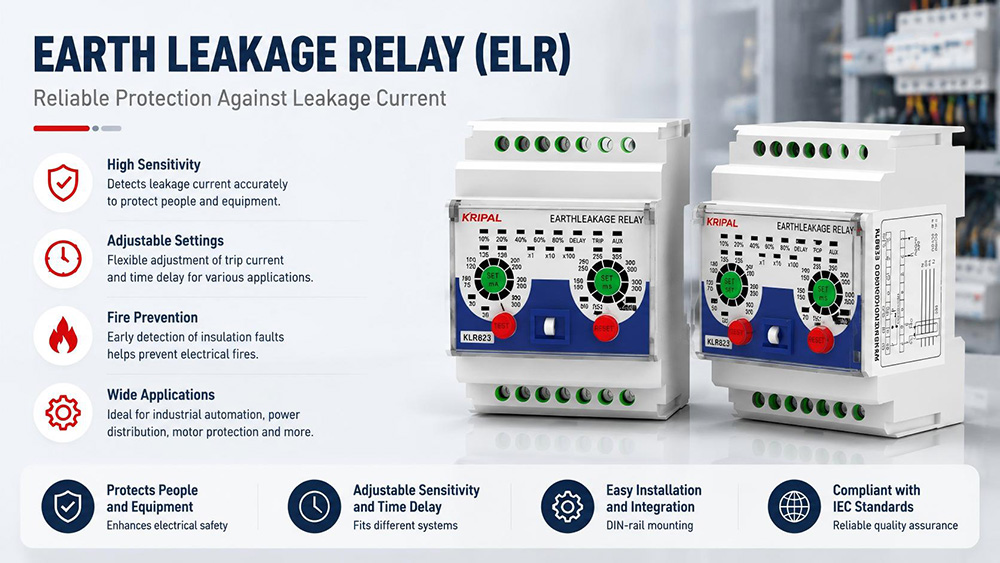
An earth leakage relay (ELR) is a protective device that monitors the flow of current in a circuit. Under normal operating conditions, the current flowing to the load must return through the neutral conductor; any discrepancy indicates a leakage current, potentially flowing through a person or the equipment casing to the ground.
When this leakage current exceeds a preset threshold, the relay triggers an action to disconnect the circuit, thereby preventing hazards. These relays are essential in environments where electrical safety is paramount, such as factories, hospitals, and commercial buildings.
Working Principle of Earth Leakage Relays
The working principle is based on the application of Kirchhoff’s Current Law.
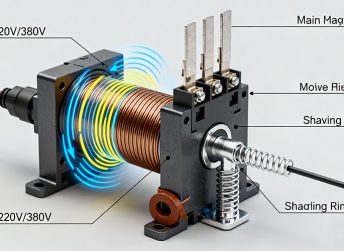
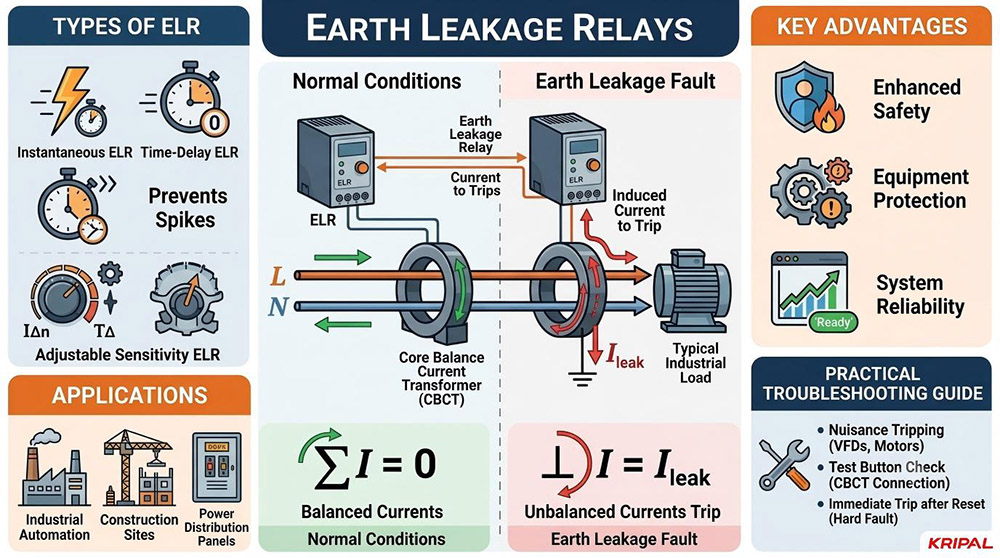
The relay continuously monitors the vector sum of currents in the live and neutral conductors. Under normal conditions, the current entering the load equals the current returning, resulting in a net magnetic flux of zero in the internal detection transformer.
When a leakage occurs (a fault), the current returning is less than the current leaving. This creates an imbalance, inducing a small secondary current in the transformer. An electronic circuit processes this signal, and if the current exceeds the configured trip value for a specific duration, the relay contacts switch to disconnect the circuit.
Main Types of Earth Leakage Relays
Different applications require different levels of sensitivity and response timing.
1. Instantaneous Earth Leakage Relays
These relays trigger immediately upon detecting leakage. They are used where rapid protection is needed to prevent electric shock in human-accessible circuits.
2. Time-Delay Earth Leakage Relays
Designed for coordination, these relays introduce a slight delay. This prevents nuisance tripping in systems with high starting currents or transient spikes, ensuring only genuine faults trigger the disconnection.
3. Adjustable Sensitivity Relays
These offer flexibility by allowing the user to set both the tripping current and the time delay. They are ideal for complex industrial setups where specific site conditions must be accommodated.
Key Advantages of Earth Leakage Relays
Earth leakage relays remain a cornerstone of electrical safety due to their high reliability and sensitivity.
| Advantage | Description |
|---|---|
| Enhanced Safety | Protects personnel from fatal electric shocks and prevents electrical fires. |
| Equipment Protection | Detects insulation failures early, saving costly industrial machinery from damage. |
| High Precision | Offers adjustable thresholds to ensure reliable protection even in noisy electrical environments. |
| System Reliability | Provides early warning of degrading insulation before total failure occurs. |
| Versatile Use | Essential for compliance with international safety standards across various industries. |
Applications of Earth Leakage Relays
Earth leakage relays are used in a variety of industrial and commercial fields. In industrial automation, they protect motors and production lines from fire hazards caused by ground faults. In power distribution panels, they act as the primary safety barrier for entire sections of a facility. They are also essential in temporary installations, such as construction sites, where equipment is frequently moved and exposed to harsh environments.
Limitations to Consider
While earth leakage relays are indispensable, they require professional installation and periodic testing. Improperly set thresholds can lead to nuisance tripping. Additionally, they do not provide protection against short-circuit currents or overloads, so they must be used in conjunction with circuit breakers or fuses for total system protection.
Practical Troubleshooting Guide for Earth Leakage Relays
Even the most reliable earth leakage relays can experience issues if environmental conditions change or system configurations are altered. Here is a quick troubleshooting guide for the most common scenarios encountered in low-voltage electrical systems:
1. Nuisance Tripping (Tripping without a real fault)
Possible Causes: This is the most common issue. It is often caused by transient high currents during motor startups, harmonic interference from Variable Frequency Drives (VFDs), or moisture buildup in the wiring insulation.
Quick Fix: Check the environment for moisture or water ingress. If the system uses heavy machinery or VFDs, consider increasing the time-delay setting slightly (if using a Time-Delay ELR) to allow transient spikes to pass without triggering the relay.
2. The Relay Fails to Trip During a Test
Possible Causes: Every ELR has a “Test” button to verify functionality. If it fails to trip, the issue usually lies in a disconnected Core Balance Current Transformer (CBCT) wire, loss of auxiliary control power, or internal component failure.
Quick Fix: First, verify that the control voltage is present at the relay terminals. Next, check the continuity of the wiring between the CBCT and the relay. If all external connections are sound, the unit itself may require replacement.
3. Relay Trips Immediately After Being Reset
Possible Causes: A permanent (hard) ground fault still exists somewhere in the circuit. This often points to severely damaged cable insulation or a shorted motor winding.
Quick Fix: Do not forcefully bypass or repeatedly reset the relay. Disconnect downstream loads one by one to isolate the faulty section. Use an insulation resistance tester (Megger) to pinpoint the exact location of the insulation failure before restoring power.
Conclusion
Earth leakage relays are vital safety devices that enable the detection of dangerous residual currents, ensuring both personnel safety and equipment protection through precise current monitoring. By comparing current flow, these relays trigger reliable circuit disconnection before faults become hazardous. With various types available, including adjustable and time-delayed models, they meet the diverse needs of industrial automation and power distribution.
We explore earth leakage relay solutions that help control power safely and efficiently. If you need support or want to learn more, feel free to contact me anytime.