News

Comprehensive Overview of the Price of AC Contactor

Explore a complete overview of AC contactor prices in 2025. Learn how current rating, brand, and type affect cost to make an informed purchase decision.

date December 03, 2025

Comprehensive Overview of the Price of AC Contactor
Home > Resources > Comprehensive Overview of the Price of AC Contactor

Contactors are common and useful components in electrical control systems, widely used in industrial equipment, power distribution systems, and automation control. Due to pivotal role in ensuring safe and stable operation of electrical circuits, selecting the right contactor is essential, and price is often one of the most important factors for users.

In fact, the price of a contactor is influenced by multiple factors such as brand, specifications, application scenarios, and market conditions, resulting in salient price differences between products. This article will briefly analyse these factors and help readers better understand the market, enabling them to make more informed purchasing decisions.

Key Takeaways

  • The price of contactors varies significantly based on the brand and specifications.
  • The price and performance requirements differ based on the application scenario.
  • When selecting a contactor, a balance between price and reliability should be achieved.

What Costs Are Typically Involved When Replacing a Contactor?

This includes the price of the contactor itself, which varies greatly depending on the brand, rated current, coil voltage, and contact configuration. The cost of electricians or technicians for disassembly, wiring, and debugging. The cost is generally higher in industrial environments than in residential or commercial settings.

During the replacement process, equipment downtime may result in production loss or business interruption, which can be one of the most overlooked yet significant costs in industrial and commercial systems.

This may involve replacing auxiliary contacts, thermal relays, bases, rails, and conducting electrical tests and system debugging. If the wrong type of contactor is selected or the product quality is substandard, it may lead to frequent replacements, malfunctions, or even equipment damage, increasing long-term maintenance costs.

Types of Contactors

By Usage

Contactors can be divided into motor contactors and general-purpose contactors. Motor contactors are primarily used for starting, stopping, and reversing electric motors, with higher requirements for frequent operation and arc resistance. General-purpose contactors, on the other hand, are commonly used for lighting, electric heating, and general load control, and they have a simpler structure with a broader range of applications.

By Control Power Type

Depending on the coil control power type, contactors can be classified as AC coil contactors and DC coil contactors. AC coil contactors are simple in design and cost-effective, making them the most widely used in industrial settings. DC coil contactors have stable attraction and better anti-interference capabilities, making them suitable for automation control systems or applications requiring higher stability.

By Structure

Contactors can be divided into modular contactors and compact contactors. Modular contactors are convenient for installation and function expansion, allowing auxiliary contacts or functional modules to be added as needed. Compact contactors have a more compact design, making them suitable for installation in space-constrained distribution boxes or control cabinets.

By Function

From a functionality perspective, contactors can be divided into basic and functional types. Basic contactors mainly perform simple circuit switching, while functional contactors may include auxiliary contacts, overload protection, delay control, or energy-saving functions, catering to more complex control needs.

By Environment

Contactors can also be categorized as standard type and special environment type based on usage conditions. Standard types are suitable for general industrial and commercial environments, while special environment types, such as explosion-proof, anti-corrosion, and high-temperature contactors, are designed for environments with more stringent safety and reliability requirements.

Classification Categories Features & Applications
By Usage Motor contactors For motor start/stop/reverse; high frequency, arc resistance.
General-purpose contactors For lighting, heating, and general loads; simple structure, wide use.
By Control Power AC coil contactors Simple, cost-effective; most common in industry.
DC coil contactors Stable attraction, anti-interference; for highstability automation.
By Structure Modular contactors Easy installation & expansion; add auxiliary/function modules.
Compact contactors Small size; for narrow distribution boxes & cabinets.
By Function Basic contactors Simple circuit switching.
Functional contactors With protection, delay, energy saving, and complex control.
By Environment Standard type For general industrial & commercial use.
Special environment type Explosion-proof, anti-corrosion, high temp, harsh environments.

What Are the Price Differences Between Different Types of Contactors?

By Rated Current

The rated current is one of the core factors influencing the price of contactors. Low-current contactors, which are typically used in light load or low-power equipment, have a simpler structure and lower cost. As the rated current increases, the contactor must handle larger currents and higher thermal loads, requiring more advanced contact materials, cooling structures, and mechanical strength. This leads to a significant increase in the price of medium to high-current contactors.

By Brand

The price of contactors can differ significantly depending on the brand. International brands, which invest more in research, manufacturing processes, and quality control, typically offer products with more stable performance and longer lifespans, resulting in higher prices. Domestic mainstream brands, while meeting industrial application needs, offer more competitive pricing with a better cost-to-performance ratio. Some smaller or non-mainstream brands may offer lower prices, but there could be concerns regarding reliability and consistency.

By Function Configuration

The functionality of a contactor directly impacts its price. Basic models, which only meet simple switching requirements, are priced relatively low. In contrast, contactors with auxiliary contacts, overload protection, or energy-saving coils provide more complex control logic and enhanced safety, which increases their price. The more advanced the functionality, the higher the production costs and price.

By Application Scenario

The price of contactors can also vary based on the application environment. Standard models used in general industrial environments have a stable price, while contactors used in high-temperature, high-humidity, corrosive, or explosion-proof environments require special materials and structural designs, thus increasing manufacturing costs and the final price.

Type Main Features Typical Price Range
Small Power Basic Type ≤9 A, no auxiliaries Low
Industrial General Type 9–65 A, basic configuration Medium
High Performance / High Current Type ≥95 A, with functions Higher
Smart / Special Type With modules / special environments Highest

Why Choose Kripal Contactors?

Internationally Certified and Globally Trusted

Kripal contactors are backed by multiple international certifications and comply with widely recognized electrical standards such as IEC. Our products meet strict global safety and quality requirements, making them suitable for export projects and high standard industrial applications worldwide.

Reliable Quality and Stable Performance

Designed according to international standards, our contactors ensure safety, durability, and stable operation. Optimized structure, high quality contact materials, and reliable coil performance reduce the risk of overheating, poor contact, and arc damage, even under frequent switching conditions.

Complete Product Range

We offer a wide selection of rated currents, coil voltages, and contact configurations for motor control, power distribution, automation systems, and industrial control applications. Flexible solutions are available for both general and demanding environments.

Cost Effective and Easy to Use

Kripal contactors provide strong performance at competitive prices, helping customers reduce overall procurement and maintenance costs. Standardized design ensures convenient installation, replacement, and long term operation.

What Should Be Considered When Purchasing a Contactor?

  • Rated Current and Load Type: Ensure the contactor meets the actual current requirements and load types of the equipment.
  • Operating Voltage and Coil Voltage: Ensure that the main circuit voltage and coil voltage match the control system to ensure stable operation.
  • Usage Frequency and Lifespan: For equipment that is frequently operated, choose a contactor with a long mechanical and electrical lifespan.
  • Functional Requirements: Choose a contactor with additional functions such as auxiliary contacts, overload protection, and delay functions if needed.
  • Installation Conditions and Compatibility: Consider the installation space and compatibility with the existing system.
  • Brand and After-Sales Support: Choose a reliable brand to ensure product quality and long-term technical support.

Conclusion

When purchasing a contactor, selecting the right model is essential. It is important to consider factors such as current, voltage, load type, frequency of use, and required functions. By making an informed selection, you can ensure the stability and efficiency of your equipment while balancing performance and cost.
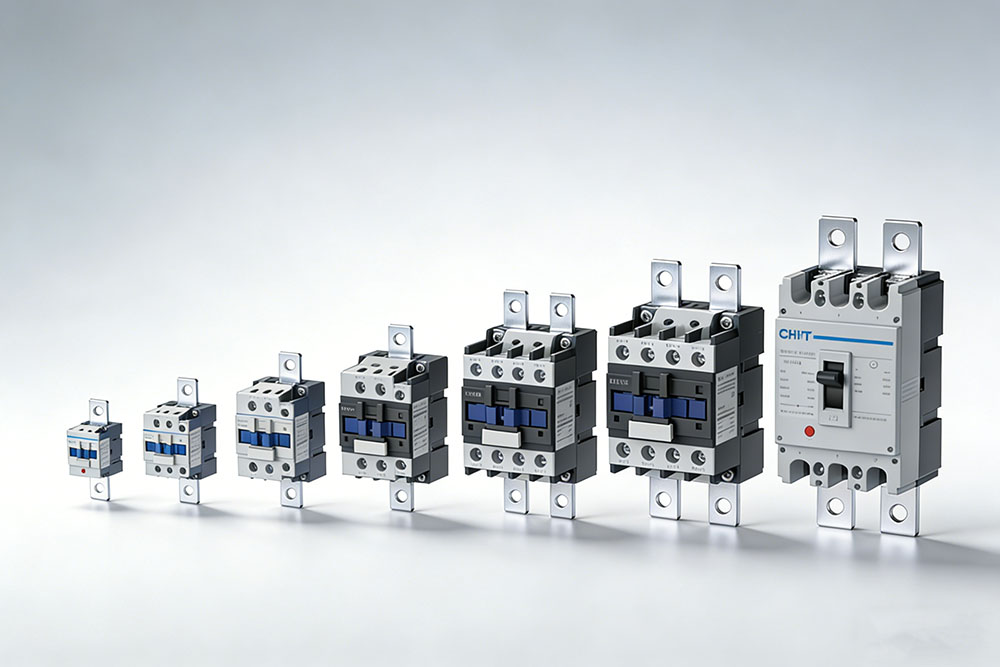
Various sizes of electrical contactors

To meet your needs, our contactors offer reliable performance and a wide range of specifications. Our products excel in multiple industries, offering high cost-performance to effectively reduce operational and maintenance costs. By choosing our contactors, you will receive long-term stable operation and professional after-sales support, ensuring your systems operate efficiently and safely.

FAQs

Q What applications are contactors suitable for?
Contactors are used in motor control, power distribution, automation, and lighting systems for reliable load switching.

Q What specifications of contactors are available?
Contactor options vary by current, voltage, and contact configuration, suitable for both low and high-power applications.

Q How should I choose the right contactor?
Consider load current, voltage, frequency, and additional features, ensuring compatibility with your system.

Q What is the lifespan and durability of contactors?
Contactors are durable and designed to withstand frequent switching, offering reliable long-term performance.

Q How is after-sales service and technical support provided?
Manufacturers offer installation, technical support, and troubleshooting assistance throughout the product’s life.

How can we assist you?

Tell us a bit more so we can route your request to the right expert.