Search
News
Why Market Demand for 1500V DC Molded Case Circuit Breakers is Exploding
Global energy production and storage are moving toward high‑voltage Direct Current systems. Massive solar farms using 1500 V DC and large Battery Energy Storage Systems create a new paradigm.
 November 01, 2025
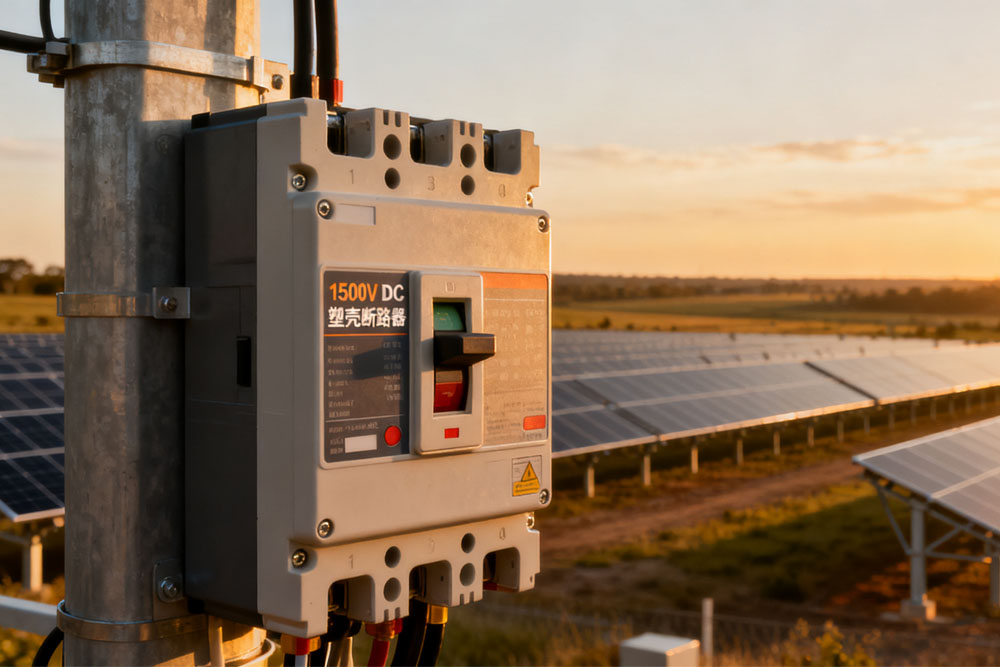
A Revolution in Power Architecture
Global energy production and storage are moving toward high‑voltage Direct Current systems. Massive solar farms using 1500 V DC and large Battery Energy Storage Systems create a new paradigm.
These systems require protection devices capable of handling high continuous current and fast, safe interruption of fault currents. When DC currents exceed 400 A, standard protection devices cannot guarantee safe arc extinction. High‑capacity DC molded‑case circuit breakers (MCCBs) become indispensable as the backbone for modern megawatt‑scale grids.
Drivers Behind the Surge in Demand
Utility‑Scale Solar Photovoltaic Farms
Large solar installations now adopt 1500 V DC architecture for efficiency and cost advantages. Central DC buses, high-capacity combiner boxes and powerful inverters rely on MCCBs to safeguard against overload and DC faults. These breakers often use specialized trip curves designed for photovoltaic conditions to accommodate current fluctuations and protect the array reliably.
Battery Energy Storage Systems (BESS)
Energy storage facilities represent a major force behind the rising demand. Battery banks form low‑impedance energy sources. If a short‑circuit occurs, the resulting DC fault current rises extremely quickly and may reach tens of kiloamperes. Breakers placed on battery racks or DC mains must interrupt this massive fault current safely. For 1500 V DC systems engineers often require breakers rated for high breaking capacity, up to 20 kA, to ensure arc extinction under worst‑case conditions.
High‑Voltage DC Transmission and Emerging Infrastructure
The push for long-distance and modular HVDC transmission opens new applications for DC MCCBs. Compact prefabricated substations, modular power units for renewables or offshore installations often rely on high-voltage DC protection.
Electronic‑trip MCCBs with high interrupting capacity deliver robust protection in tight spaces, support system expansion and enable selective coordination in complex networks.
Table 1: Global Market Trends Driving High-Current DC MCCB Demand (2025-2030 Outlook)
| Sector | Growth Rate (CAGR) | Driving Factor | MCCB Requirement |
| Battery Energy Storage Systems (BESS) | ~15.8%(2025-2030) | Increased utility-scale deployment and grid stability needs. | Protection against extreme, rapid battery fault currents (High Icu, e.g., 20 kA). |
| High Voltage DC (HVDC) Transmission | ~6.34% – 8% (2025-2032) | Integration of remote renewables and long-distance grid interconnections. | Robust high-voltage (1500V+) isolation and selective switching capability. |
| Solar PV Architecture | Standardization on 1500 Vdc | Maximizing energy efficiency and reducing Balance of System (BoS) costs. | Optimized gPV trip curves and enhanced thermal performance. |
Understanding the Challenge: DC Arcs and Safe Interruption
Why DC Arcs Are Harder to Extinguish than AC
Alternating current (AC) breakers benefit from natural current zero‑crossings many times per second. At each crossing the arc loses its energy and can extinguish. Direct current lacks this feature. Once a DC arc forms, it tends to sustain itself until the breaker forces interruption. That makes DC arc extinction a central design challenge for DC breakers.
How High‑Current DC MCCBs Extinguish the Arc
Modern high-current DC breakers incorporate arc‑quenching structures. When contacts open the arc is driven by magnetic blow‑out mechanisms into arc chutes filled with splitter plates or arc‑extinguishing grids. These plates divide the main arc into many shorter segments.
The increased arc voltage, combined with efficient cooling and extended path, forces the plasma to lose ionization, extinguishing the arc even under high fault current. This engineered process ensures safe interruption and protects the breaker contacts from extreme thermal and mechanical stress.
This specialized arc‑extinction mechanism is central to why simple AC breakers or low-rated devices cannot replace DC‑rated MCCBs for high‑voltage, high‑current applications.
Why Fuses and MCBs Fail Where High‑Current DC MCCBs Succeed
Limitations of MCBs and Conventional Fuses
Miniature circuit breakers (MCBs) and standard fuses are designed for lower current and lower voltage DC or AC circuits. Their internal construction and arc‑quenching strategies cannot handle sustained high‑energy DC fault currents. In a 1500 V DC system with hundreds or thousands of amperes, these devices risk catastrophic failure or cannot interrupt the arc reliably.
Flexibility and Operational Advantage of MCCBs
High‑current DC MCCBs provide resettable protection. After a transient fault or temporary overload, the breaker can be reset and service restored without replacing components. This resettable feature reduces downtime, maintenance overhead and operational cost, a strong advantage compared with fuses that need replacement after each fault.
Trip Unit Types and Protection Characteristics
Electronic Trip Unit: Supports adjustable overload and short-circuit protection (e.g., overload current can be set from 1.2 to 10 times the rated current), making it suitable for complex loads such as PV inverters. (Currently, a limited number of manufacturers offer electronic trip DC molded case circuit breakers and electronic trip air circuit breakers.)
Specialized Protection Types: Motor protection circuit breakers require higher instantaneous trip settings to avoid nuisance tripping caused by startup inrush currents.
The starting current of a DC motor typically ranges from 1.5 to 5 times its rated current, with the specific multiple depending on the motor type and design:
- Separately excited or shunt DC motors: Starting current is approximately 5 to 3 timesthe rated current.
- Series DC motors: Starting current is higher, reaching 3 to 5 timesthe rated current.
Table 2: Comparison of High-Current DC Protection Devices
| Protection Feature | DC Molded Case Circuit Breaker (MCCB) | DC Fuse (High-Interrupt Type) | DC Miniature Circuit Breaker (MCB) |
| Max Continuous Current (Industrial Use) | Excellent (400A to 2500A+) | Excellent | Poor (Typically <250A) |
| Adjustable Trip Settings (Overload/Short Circuit) | Yes (Electronic/Thermal-Magnetic LSI/LSIG) | No (Fixed curve) | No (Fixed curve) |
| Selective Coordination Capability | High (Via Time Delay/ZSI) | Limited (Dependent on melt time) | Low |
| System Restoration After a Fault | Immediate (Resettable) | Replacement Required (High Downtime) | Immediate (Resettable) |
Why High‑Capacity DC MCCBs Are a Foundation for Modern DC Infrastructure
High‑current DC MCCBs combine high continuous current capacity, strong interrupting capability, resettable operation and advanced trip logic. For utility‑scale solar farms, battery energy storage systems, EV charging infrastructure, industrial DC microgrids and HVDC transmission modules these devices form a key pillar.
Their superior performance under DC conditions, extended lifespan, repeatable operation and protection features provide long‑term reliability. For entities investing in DC infrastructure, choosing high‑capacity DC MCCBs minimizes risk.
If you want circuit breakers built to real‑world demands and backed by full manufacturing, R&D, and testing strength, reach out for a quote. Kripal delivers professional‑grade MCCBs and OEM support built for long‑term reliability.
Photovoltaic power generation and direct grid integration

Indirect conversion pathways between photovoltaic power generation and grid power

Related Resources
Explore News >


How can we assist you?
Tell us a bit more so we can route your request to the right expert.