Search
Reversing Contactor
Control and Protection - Reversing Contactor
KRIPAL Reversing Contactor is specifically engineered for forward/reverse operation of loads, primarily AC motors. Its core principle involves alternating the power-on and power-off states of two sets of main contacts to change the power phase sequence to the motor stator windings, thereby reversing the motor’s rotation direction.
Get A Quote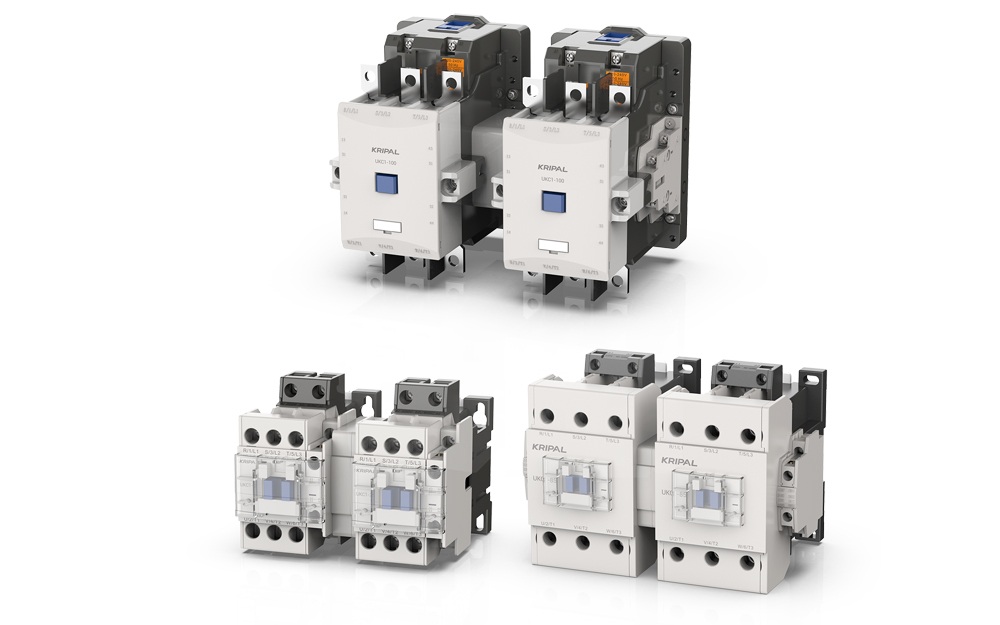


UKC1-100R 3-Pole Reversing Contactor 100A ac Coil 24V 110V 220V 380V
Its interlocked contact design prevents simultaneous closure, ensuring reliable and safe forward/reverse operation for industrial applications.
View Details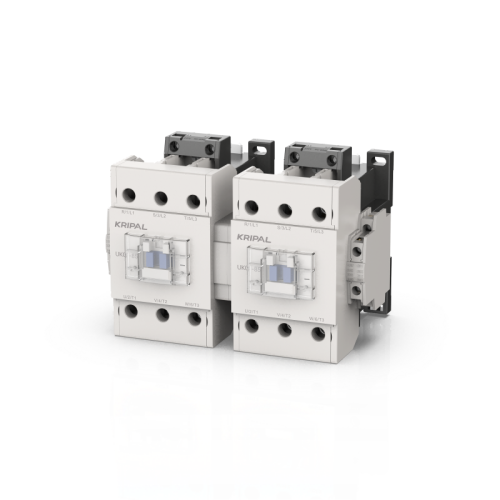
UKC1-85R 3-Pole Reversing Contactor 50/65/75/85A ac Coil 24V 110V 220V 380V
Its interlocked contact design prevents simultaneous closure, ensuring reliable and safe forward/reverse operation for industrial applications.
View Details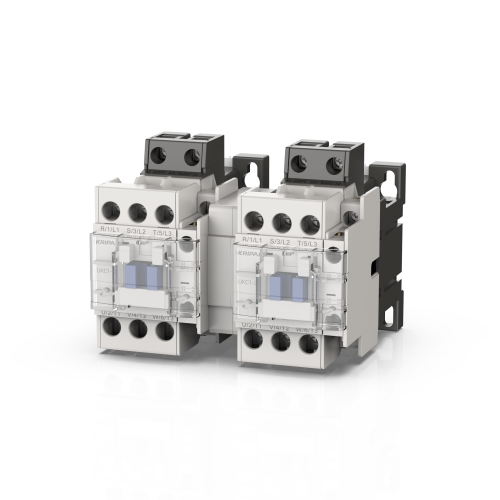
UKC1-22R 3-Pole Reversing Contactor 9/12/18/22A ac Coil 24V 110V 220V 380V
Its interlocked contact design prevents simultaneous closure, ensuring reliable and safe forward/reverse operation for industrial applications.
View DetailsControl and Protection - Reversing Contactor
KRIPAL Reversing Contactor is specifically engineered for forward/reverse operation of loads, primarily AC motors. Its core principle involves alternating the power-on and power-off states of two sets of main contacts to change the power phase sequence to the motor stator windings, thereby reversing the motor’s rotation direction. It integrates forward control, reverse control, and mechanical interlocking protection into a single unit, making it ideal for motor drive applications requiring bidirectional operation and combining efficient control with enhanced safety. The unified design eliminates the need for assembling two separate contactors and additional interlock components, reducing wiring effort and saving significant panel space. For cost-effective maintenance, the contact tips are replaceable individually (certain models support modular contact cartridge replacement), avoiding the need for a full contactor replacement.
Core Safety & Performance Features
Dual Interlocking Protection: Integrates both mechanical and electrical interlocks to completely prevent the simultaneous closure of the two main contactors, thereby eliminating the risk of phase-to-phase short circuits. This is the fundamental safety advantage of the reversing contactor.
Overload & Short-Circuit Compatibility: Can be used in conjunction with thermal overload relays and circuit breakers to provide a complete motor control solution combining “forward/reverse control + overload protection + short-circuit protection”.
Excellent Arc Extinguishing Performance: The main contacts, often made of silver alloy, work in conjunction with a fully enclosed arc chute to suppress electric arcing during contact operation. This reduces contact erosion and significantly extends service life.
Latest Blog Of Reversing Contactor
Explore Solution >Typical Applications
Machine Tools: Controls the forward/reverse rotation of spindles in lathes and milling machines, enabling forward cutting and reverse retraction of workpieces.
Hoisting Equipment: Manages the up/down movement of electric hoists and lifts by reversing motor direction, often coordinated with limit switches for safe starting and stopping.
Conveying Systems: Provides forward (feeding) and reverse (returning) operation for belt conveyors, accommodating bidirectional material handling needs in production lines.
Frequently Asked Questions
Explore FAQ >The primary application is for bi-directional motor control. They are essential in any machinery where a motor needs to run in both forward and reverse directions.
Common examples include:
- Hoists and Lifts: For raising and lowering loads.
- Conveyor Systems: For reversing direction to clear jams or manage material flow.
- Machine Tools: For automatic reverse feed in lathes, milling machines, or drilling machines.
- Opening/Closing Mechanisms: Such as gates, doors, and valves.
Key selection factors include:
- Motor Power: Ensure the contactor's rated operational current and voltage match or exceed your motor's specifications.
- Utilisation Category: Look for categories like AC-3 (for squirrel-cage motors) and AC-4 (for frequent plugging and inching).
- Coil Voltage: Match the coil voltage (e.g., 24V DC, 230V AC) to your control circuit.
- Safety Features: Verify the type of interlocking (mechanical & electrical) and the availability of auxiliary contacts for control feedback.
- Space: Check the physical dimensions to ensure it fits in your control panel.
KRIPAL Reversing Contactors are engineered for performance and safety:
- Robust Interlocking: A failsafe mechanical and electrical interlock prevents both power contactors from closing simultaneously.
- Durable Construction: Silver alloy contacts with excellent arc resistance ensure a long electrical life, even under frequent switching.
- Easy Installation: Pre-assembled units with clear wiring diagrams simplify panel building and save time.
- Compliance with Standards: Manufactured in accordance with international standards like IEC 60947-4-1, guaranteeing safety and performance.
- Reliable Operation: Designed for the demanding conditions of industrial motor control, providing consistent and safe reversal of motor direction.
How can we assist you?
Tell us a bit more so we can route your request to the right expert.