Search
Knowledge Center
Why Do We Use AC in Home Instead of DC?
Why do we use AC instead of DC in homes? Learn the key reasons: easy voltage conversion, efficient long-distance transmission, and modern grid needs.
 April 19, 2026
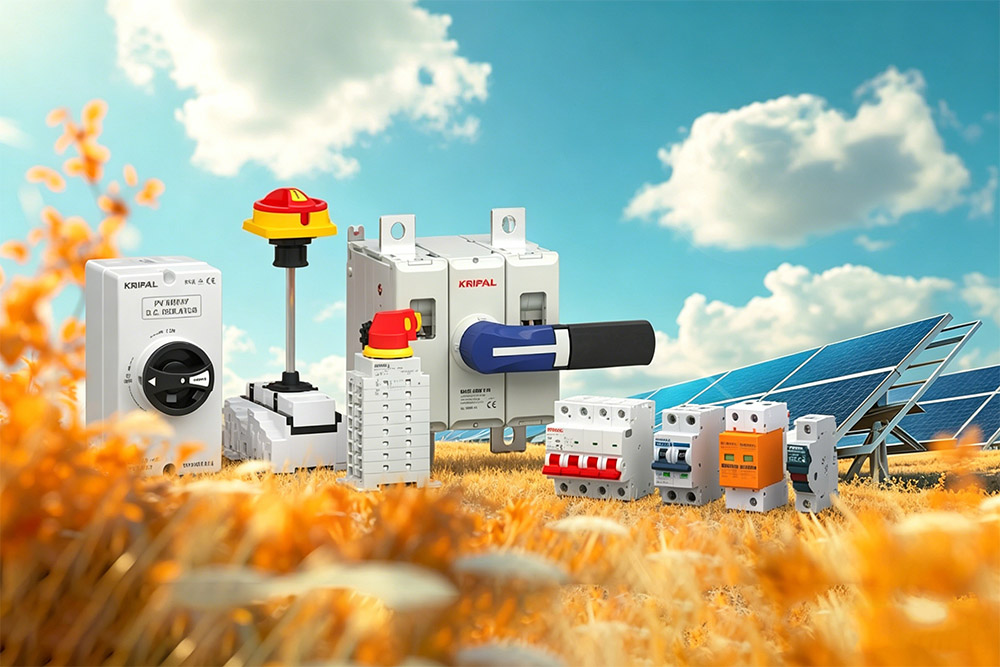
We use electricity every day, but few people ask: Why is AC used in homes instead of DC? This question becomes particularly interesting as many electronic devices rely on DC to operate. This article will briefly explain the differences between AC and DC and focus on why AC is the preferred choice for home use.
Key Takeaways
- Homes use AC mainly because it is more suitable for efficient long-distance transmission.
- AC can be easily stepped up and stepped down, which is fundamental to building a power grid.
- DC is less efficient for voltage conversion in traditional systems.
What are Alternating Current and Direct Current?
AC is a type of current whose direction periodically changes. In other words, the current flows in one direction for a while, then reverses direction. The form of AC commonly used in homes is a sine wave, which is very suitable for long-distance transmission through the power grid.
DC flows in one direction only, with energy flowing steadily from positive to negative. Devices like batteries, phones, and computers use DC because it is more suitable for providing a stable power supply to electronic components.
What is the Difference Between AC and DC?
| Feature | AC | DC |
| Current Direction | The current direction changes periodically, flowing back and forth | The current direction is constant and flows one way |
| Waveform | Usually a sine wave, but can also be a square or triangular wave | The current waveform is a straight line, providing stable current |
| Voltage Type | Voltage varies over time, typically in a periodic sine wave | Voltage remains constant and unchanged |
| Transmission Efficiency | Suitable for long-distance, efficient transmission with minimal energy loss | Significant energy loss in long-distance transmission, requires special equipment for conversion |
| Applications | Widely used in household and industrial power, and electrical networks | Mainly used in electronic devices, batteries, phones, and computers |
| Voltage Conversion | Easily stepped up or stepped down using transformers | Requires complex rectifiers and converters for voltage adjustment |
| Safety | High-voltage AC, when subject to electric shock, usually causes strong current fluctuations | DC does not have periodic fluctuations, but prolonged exposure can cause severe injury |
| Historical Background | Popularized by Nikola Tesla, becoming the standard for power transmission | Advocated by Thomas Edison, but difficult for long-distance transmission |
| Device Requirements | Requires AC motors and electrical grid infrastructure | Devices often require rectifiers to convert AC to DC |
| Transmission Method | Can be transmitted over long distances via high-voltage transmission lines to reduce loss | More suitable for short-distance transmission or use after conversion |
Transmission Efficiency Determines the Dominance of AC
Why Must Energy Loss be Reduced for Long-Distance Transmission?
During the transmission of electricity, current flowing through wires generates energy loss, mainly in the form of heat. This loss is related to the magnitude of the current and the distance of transmission. To reduce this loss, it is necessary to lower the current during transmission. For long-distance transmission, if the current is too high, the energy loss becomes significant, so it is essential to increase voltage and reduce current.
The Advantage of AC in Easily Stepping Up Voltage
One of the major advantages of AC is that its voltage can be easily increased or decreased using transformers. Transformers efficiently raise or lower the voltage of AC, making it highly advantageous in power transmission. By increasing voltage, the current is reduced, which in turn minimizes energy loss. During long-distance transmission, increasing the voltage makes the process more efficient. Once it reaches the destination, the voltage can be stepped down using transformers to ensure safe usage.
The Disadvantages of DC in Traditional Systems
In contrast, DC transmission in traditional electrical grids has certain limitations. While DC could theoretically reduce some losses, its main disadvantage is that traditional grid systems cannot easily step up or step down the voltage like AC. DC voltage conversion technology is complex and inefficient, making DC less effective for long-distance transmission. Although modern technology like high-voltage direct current (HVDC) is improving this issue, AC remains dominant in traditional power grids.
Voltage Conversion Ability is AC’s Unbeatable Advantage
Why Can Transformers Only Be Used for AC?
Transformers are the key devices for voltage conversion, and they operate based on electromagnetic induction. In simple terms, a transformer generates a changing magnetic field in its primary coil due to alternating current. This magnetic field induces current in the secondary coil, allowing the transformer to transfer energy and adjust the voltage. Since AC fluctuates periodically, it produces a varying magnetic field, enabling efficient conversion.
For DC, the current remains constant, so there is no periodic fluctuation to generate a changing magnetic field in the transformer’s coils. This makes DC unsuitable for transformer-based voltage conversion. Therefore, transformers can only be used with AC, and DC requires other forms of voltage conversion, such as rectifiers and inverters.
Without Efficient Voltage Conversion, There Would Be No Modern Power Grid
A key feature of modern power grids is the ability to efficiently adjust voltage at different locations and for various load demands. This is entirely dependent on AC’s ability to be easily transformed by transformers. By stepping up the voltage, the current can be reduced during transmission, thus minimizing losses. At the user end, the voltage is stepped down to match the household or industrial power needs.
Without efficient voltage conversion technology, long-distance power transmission would not be feasible, and modern electrical networks would not exist. Therefore, the ability to convert voltage is not just an advantage of AC, but also what allows power grids to cover large areas, ensuring the stability and cost-effectiveness of power supply.
AC is the Only Choice for Creating a Large-Scale Power Grid
How Does AC Build a Large-Scale Power Grid?
One of AC’s significant advantages is its ability to efficiently regulate voltage using transformers, which is crucial for building a large-scale power grid. In a large power network, electricity must be transmitted over long distances from power plants to various usage points. AC’s voltage is stepped up using transformers, which enables electricity to be transmitted at high voltage and low current, thereby reducing energy losses.
The periodic change in AC’s direction makes it ideal for distribution and coordination within a power grid. Multiple AC sources in the grid can be adjusted and work together flexibly, allowing electricity to be transmitted over long distances while maintaining stability. AC not only supports long-distance transmission but also forms a coherent distribution system between multiple power plants and users, enabling large-scale grid coverage.
The Limitations of DC in Traditional Power Grids
Although DC has unique advantages, it faces several limitations in traditional power grids. First, DC cannot be easily converted using transformers, making it inefficient for long-distance transmission. In traditional power systems, transformers are central to voltage regulation, while DC requires complex rectifiers and inverters, which are not only costly but also less efficient.
Why Do Many Household Appliances Still Use DC?
Electronic Devices Need a Stable Power Supply
Most household appliances (such as phones, computers, and televisions) rely on stable current to power microelectronic components (such as chips, displays, and batteries). DC provides a constant current and voltage, making it suitable for these sensitive components. Using AC directly could damage these components due to voltage fluctuations.
Battery Power Requirements
Many portable devices (such as phones, laptops, and power tools) use DC batteries. Since the battery itself produces DC, household appliances need to convert AC into DC to charge the battery or directly power the device.
Higher Power Conversion Efficiency
DC is usually more efficient for power conversion than AC. Many appliances have power adapters (converters) that convert AC into DC. These converters are typically highly efficient and compact, making them ideal for integrating into devices.
AC is the Only Choice
Through the comparison of AC and DC, we can clearly see that AC is the only logical choice for household electricity. Its unique advantages in long-distance transmission and voltage conversion make it the most suitable option. While DC is gradually playing a role in specific fields as technology advances, AC remains the most suitable and efficient choice for the overall power grid.
| Feature | Alternating Current (AC) | Direct Current (DC) |
| Direction | Periodically reverses (Sine wave) | Constant, unidirectional flow |
| Voltage Conversion | Highly efficient via Transformers | Complex, involves power electronics |
| Transmission | Ideal for standard regional grids | Efficient for HVDC (Ultra-long distance) |
| Storage | Cannot be stored directly | Easily stored in Batteries/Capacitors |
| Appliances | Large motors, Heaters, Ovens | Electronics, EVs, LED Lighting |
| Safety (Human) | Higher risk of cardiac fibrillation | Risk of electrolytic burns & cramping |
| Key Components | Transformers, AC Motors | Rectifiers, Inverters, Batteries |
FAQs
Q: Why do household appliances use DC instead of AC?
Household appliances use DC because it provides stable current and voltage, which is ideal for powering sensitive electronic components. DC is also more efficient and reduces electromagnetic interference.
Q: Why is AC the dominant choice for home electricity?
AC is suitable for efficient voltage regulation and long-distance transmission, which reduces energy loss. This makes it ideal for building large-scale power grids.
Q: Does DC have a future?
While DC has limitations in traditional power grids, it is increasingly being used in specific scenarios like long-distance transmission and energy storage systems, especially with high-voltage direct current (HVDC) technology.
Q: What are the main differences between AC and DC?
AC’s current direction changes periodically, while DC’s current direction remains constant. AC is more suitable for long-distance transmission, while DC is ideal for small devices and battery-powered applications.