News

How to Choose the Right DC Circuit Breaker?

Learn how to choose the right DC circuit breaker selection for solar PV, batteries, and EVs. Compare rated voltage, breaking capacity, and MCB vs isolator types.

date March 28, 2026

How to Choose the Right DC Circuit Breaker?
Home > Resources > How to Choose the Right DC Circuit Breaker?

In a DC power system, the circuit breaker plays an important role as a protective element, directly impacting equipment safety and system stability.

Understanding the basic principles of DC circuit breakers and mastering the proper selection method is critical for ensuring safe system operation.

Key Takeaways

  • Clarify system parameters: Always verify voltage, current, and application scenarios before selecting.
  • Pay attention to breaking capacity: Ensure the circuit breaker can safely interrupt fault currents.
  • Understand the difference between AC and DC: Never replace DC circuit breakers with AC circuit breakers.
  • Choose reliable products: Prioritize brands that meet standards and offer stable quality.

What Are the Key Factors for Selecting a DC Circuit Breaker?

Rated Voltage

Rated voltage is one of the most fundamental and critical parameters when selecting a DC circuit breaker. The rated voltage of the circuit breaker must be greater than or equal to the maximum working voltage of the system.

If the rated voltage is insufficient, the breaker may fail to extinguish the arc when disconnecting the circuit, causing equipment damage or even safety accidents. In DC systems, since there is no zero-crossing point, extinguishing the arc is more difficult, making the voltage rating more stringent.

Rated Current

Rated current determines the amount of current the circuit breaker can carry over a long period. When selecting, choose based on the normal operating current of the load while considering starting currents or instantaneous surge currents.

It is generally recommended to leave some margin above the actual operating current for safety and reliability.

Breaking Capacity

Breaking capacity refers to the maximum current the circuit breaker can safely interrupt during faults such as short circuits. This parameter is directly related to system safety and is a critical aspect of the selection process.

If the breaking capacity is insufficient, the circuit breaker may fail to interrupt the current during a fault, possibly resulting in explosions or burnouts.

Trip Characteristics

Trip characteristics define the speed and response of the circuit breaker under different current conditions.

The commonly used B, C, and D curves are suitable for different types of loads:

  • B curve for resistive loads or sensitive protection applications,
  • C curve for general industrial loads,
  • D curve for equipment with high starting currents, such as motors.

Selecting the right trip characteristic can prevent false tripping and ensure timely protection in the event of a fault, thereby improving the overall stability of the system.
Photovoltaic System Solutions

Types of DC Circuit Breakers and Their Applications

DC MCB

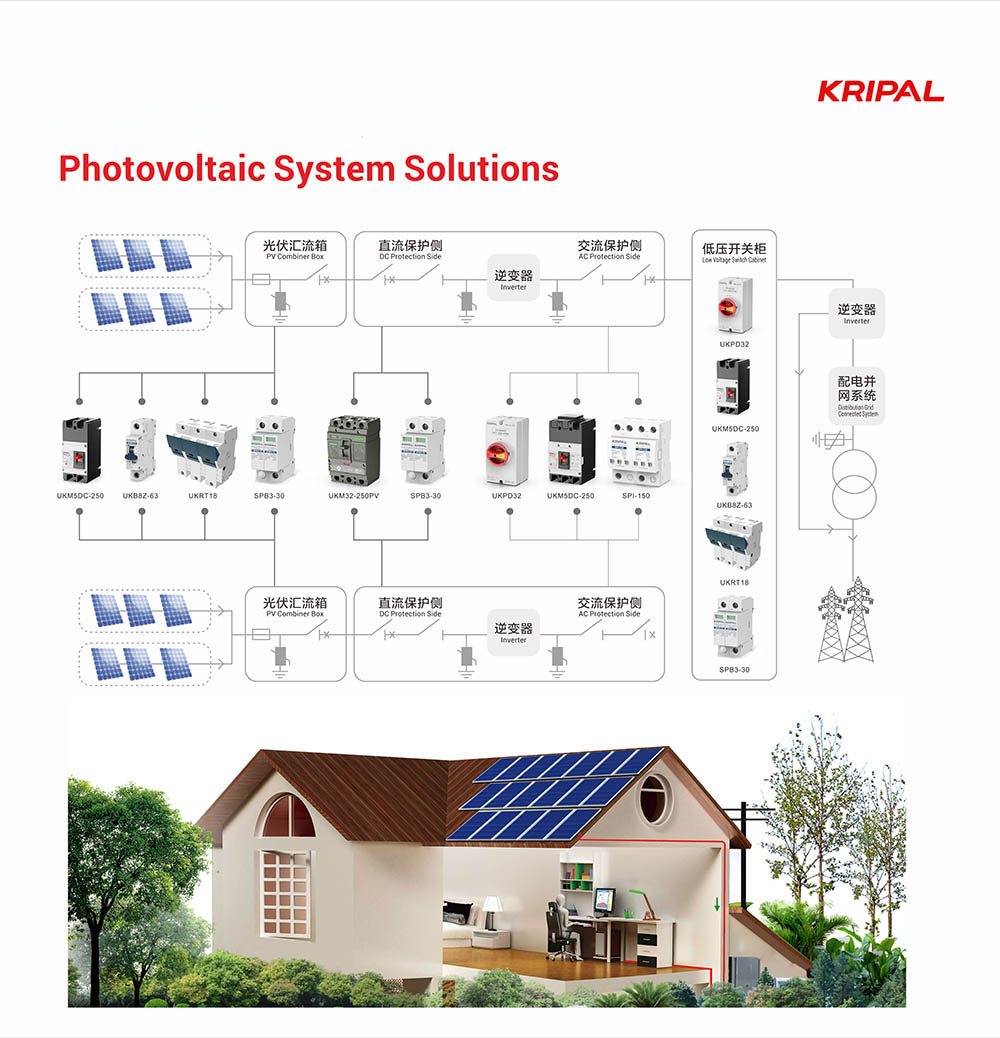
The DC Miniature Circuit Breaker is a common protection device for low-voltage DC circuits, typically suitable for systems with lower rated current. These breakers are compact, easy to operate, and ideal for household photovoltaic systems, power tools, and small equipment.

Applications:

  • DC circuit protection in household photovoltaic systems
  • Small-scale energy storage systems
  • Circuit protection for power tools and small electric vehicles

DC Air Circuit Breaker

The DC Air Circuit Breaker is used in high-voltage, high-current DC circuits and typically has a larger breaking capacity, suitable for use in large systems. They use air as the medium to extinguish the arc and generally come with overload and short-circuit protection.

Applications:

  • Industrial DC power systems
  • Large-scale energy storage systems (e.g., battery storage)
  • High-power photovoltaic systems

DC Isolator Switch

DC isolators are used to disconnect and isolate DC circuits. They typically do not have automatic disconnection functions but ensure safe power disconnection during maintenance. They can be manually operated when no current is flowing.

Applications:

  • Isolation between battery banks and inverters in photovoltaic systems
  • High-voltage DC circuit maintenance in power substations and distribution systems
  • Power switching in electric vehicle charging stations

DC Smart Circuit Breaker

DC smart circuit breakers combine traditional protection functions with intelligent technology, enabling real-time monitoring of current, voltage, and temperature. They come with features like remote control, automatic alarms, and fault diagnostics, suitable for modern, high-demand power systems.

Applications:

  • Smart grids and smart home systems
  • Advanced monitoring and management of photovoltaic and energy storage systems
  • Safety management and fault warning for electric vehicle charging stations

Technical Comparison: KRIPAL DC Protection Solutions

Feature UKB7Z Series (DC MCB) UKPD32 Series (DC Isolator) UKM5DC Series (DC MCCB)
Product Type Miniature Circuit Breaker Isolator Switch Moulded Case Circuit Breaker
Primary Function Overload & Short-circuit Protection Electrical Isolation & Load Breaking Heavy-duty Overload, Short-circuit & Undervoltage Protection
Rated Current (In) 6A to 63A 16A, 25A, 32A 100A to 250A (High Capacity)
Max Voltage (Ue) Up to 1000V DC Up to 1200V DC Up to 1500V DC
Breaking Capacity 6kA N/A (Non-protective) 15kA (Industrial Grade)
Arc Quenching Professional DC Arc Quenching Rapid Magnetic Extinguishing (<3ms) Dual Magnetic & Grid Arc Quenching
Mounting Type Din-Rail Mounting Surface Mounting (Enclosed) Fixed Mounting (Internal Panel)
Protection Rating IP20 (Inside Distribution Box) IP66 (Outdoor/Waterproof) IP20 (Industrial Enclosure)
Certifications CE TUV CE
Best Application Residential/Small Commercial PV String Protection. Rooftop Isolation, Battery Maintenance Disconnect. Large PV Arrays, Energy Storage Systems (BESS), Data Centers.

1. When to choose the UKB7Z (DC MCB)?

Use the UKB7Z when you need automatic protection for low-to-medium power strings (up to 63A). It is the “safety fuse” of the system that trips automatically during a fault. It is ideal for standard PV combiner boxes and communication base stations.

2. When to choose the UKPD32 (Isolator Switch)?

The UKPD32 is a manual safety switch. Use it when you need a visible, reliable way to disconnect power for maintenance. Because it is IP66 rated and TUV certified, it is the perfect choice for outdoor rooftop installations where it is exposed to rain and UV. Note: It does not trip automatically during a short circuit.

3. When to choose the UKM5DC (DC MCCB)?

The UKM5DC is the “heavyweight” protector. Choose this for high-capacity systems (up to 250A and 1500V). Its 15kA breaking capacity and tri-protection (overload, short-circuit, undervoltage) make it the mandatory choice for large-scale solar farms, industrial power banks, and electric vehicle charging hubs.

Common Selection Errors

Using an AC Circuit Breaker Instead of a DC Circuit Breaker

DC and AC currents differ, especially in terms of arc extinction. DC arcs last longer and are more difficult to extinguish, requiring specifically designed DC circuit breakers. Using an AC breaker could prevent the arc from being properly extinguished, leading to equipment damage or fire hazards.

Ignoring Instantaneous Surge Current in the System

Many DC electrical systems, such as motors or charging equipment, produce large instantaneous surge currents. If this factor is not considered, the selected breaker may not withstand the peak surge current, causing protection failure.

Neglecting Environmental Factors

Environmental temperature, humidity, and other factors can significantly affect the performance of DC circuit breakers. If these factors are overlooked, the chosen breaker may not function correctly or could fail prematurely.

How to Install a DC Circuit Breaker?

Confirm Installation Environment and Requirements

Before installing the DC circuit breaker, verify the installation environment and related requirements, including the power voltage, current rating, system electrical design, and breaker installation location.

Ensure that the selected breaker’s rated voltage and current meet the system’s actual requirements. Also, make sure the installation environment meets the breaker’s operating conditions, such as temperature range, humidity, and ventilation.

Choose the Installation Location

The DC circuit breaker should be installed in an appropriate location within the electrical circuit to ensure it can quickly disconnect the current during faults.

Typically, the breaker should be installed at the main loop of either the power input or load output. Additionally, ensure that there is enough space around the breaker for easy operation and maintenance, and avoid placing it in areas exposed to moisture, corrosion, or high temperatures.

Confirm Wiring Direction and Polarity

DC circuits are polarized, so ensure that the wiring direction and polarity are correct when installing the DC circuit breaker. Usually, DC systems have a positive (+) and negative (-) terminal.

Ensure the input and output terminals of the breaker correspond to the correct polarity in the circuit. Incorrect installation may result in the system failing to work properly, or even causing short circuits and equipment damage.

Disconnect Power and Make Connections

Ensure that the system power is completely turned off during installation to avoid electric shock or other hazards. When wiring, follow the breaker’s wiring diagram to connect the positive and negative terminals to the power input and load output.

Be sure to choose cables with the correct voltage and current ratings, and ensure the connections are secure to avoid poor contact.

Testing and Checking

After installation, reconnect the power and check if the breaker operates normally. First, confirm that the system voltage and current are within the breaker’s rated values.

Then, manually operate the breaker switch to test if it can successfully interrupt the current. You can also simulate fault conditions (such as short circuits) to check the breaker’s response speed and breaking capacity.

Conclusion

When selecting and installing DC circuit breakers, the correct selection and standard installation procedures are of utmost importance. By carefully selecting the right breaker and conducting proper installation management, DC circuit breakers provide effective protection for various DC power applications, prevent accidents, and ensure the long-term stable operation of equipment.

DC Electrical Components

KRIPAL offers a wide variety of DC circuit breakers, so you’re sure to find the one you need. Feel free to visit our homepage for purchasing.

FAQs

Q Where can DC circuit breakers be used?

DC circuit breakers are commonly used in photovoltaic systems, energy storage systems, charging stations, and industrial DC systems to protect against overloads and short circuits.

Q How do you install a DC circuit breaker?

Choose the appropriate model based on system voltage and current, ensure proper polarity connections, install it in a distribution box, and perform regular maintenance.

Q What types of faults can DC circuit breakers protect against?

They primarily protect against overloads and short circuits by automatically tripping when the current exceeds preset values, thus protecting equipment and ensuring safety.

Q: How do you select the breaking capacity of a DC circuit breaker?

Select the breaker based on the system’s maximum short-circuit current to ensure it can reliably interrupt faults and prevent equipment damage.

How can we assist you?

Tell us a bit more so we can route your request to the right expert.