Search
Circuit breakers come in different “pole” configurations. The number of poles determines how many conductors the breaker can interrupt at once. Understanding these options helps you choose the correct breaker for a given circuit. This article outlines what 1-pole, 2-pole, 3-pole and 4-pole breakers mean and when to use each.
Knowledge Center
1-Pole, 2-Pole, 3-Pole and 4-Pole Circuit Breakers
Understand the difference between 1 Pole, 2 Pole, 3 Pole, and 4 Pole circuit breakers. Choose the right breaker for single or three-phase electrical systems.
 November 16, 2025

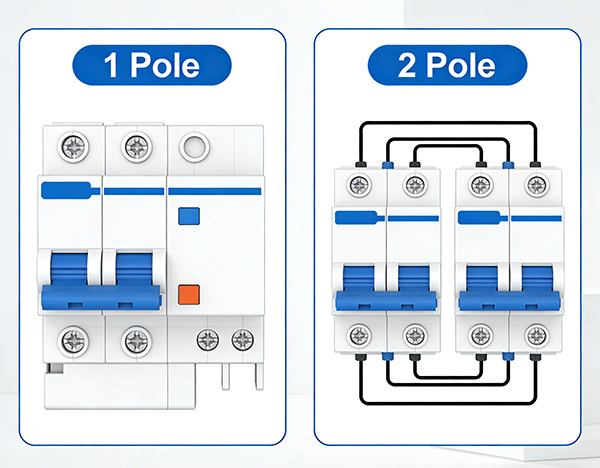
A “pole” in a breaker refers to one set of internal contacts and one external terminal pair controlling a single conductor. A breaker with more poles can simultaneously disconnect multiple conductors.
For example:
- A 1‑pole breaker controls a single live (phase) conductor.
- A 2‑pole breaker controls two conductors, often live and neutral, or two live wires in certain single‑phase systems.
- A 3‑pole breaker controls three conductors, typically the three phases in a three‑phase supply.
- A 4‑pole breaker controls four conductors, usually the three phases plus the neutral in a three‑phase system with a neutral conductor.
The pole count determines how completely the breaker disconnects the circuit under fault or maintenance conditions.
1‑Pole Breakers For Single Live Conductor Circuits
A 1 pole breaker disconnects only the live conductor. It suits simple single‑phase circuits where only one live wire feeds loads such as lighting fixtures or basic outlets. These breakers are ideal for circuits with modest power demand and simple wiring.
They are common in residential wiring for lighting circuits, small appliances, or other non‑complex loads. However, because they do not disconnect neutral, the neutral conductor remains live even after the breaker trips. That can leave residual potential in the circuit under certain fault conditions.
2 Pole Breakers For Full Disconnection in Single-Phase Circuits
A 2 pole breaker disconnects two conductors at once, typically phase and neutral. This ensures full circuit isolation under fault or maintenance. In single‑phase systems with 240 V loads or circuits that draw more current than usual single‑pole circuits, a 2‑pole breaker ensures safer disconnection.
This type of breaker suits higher‑power single‑phase loads such as water heaters, electric ovens, heavy appliances or HVAC units. It improves safety by eliminating possibility that neutral remains live when phase conductor is cut.
3 Pole Breakers For Three-Phase Systems Without Neutral
In three‑phase electrical systems that do not rely on neutral conductor, a 3 pole breaker controls the three phase conductors. When it trips, due to overload, short circuit or fault, it simultaneously disconnects all three phases. This keeps phase balance and protects all phases at once.
This configuration is common in industrial or commercial systems supplying three‑phase loads such as motors, compressors, pumps or heavy machinery. A 3 pole breaker ensures that all phases shut off together, preventing partial load or imbalance that could damage equipment.
4 Pole Breakers For Three Phase Plus Neutral Systems
Some three‑phase systems also carry a neutral conductor, for example, to supply single‑phase loads or for systems where neutral current or imbalance may occur. In these cases, a 4 pole breaker protects all three phases and the neutral simultaneously. This offers full isolation and safer operation under fault or maintenance conditions.
Using a 4 pole breaker ensures that neutral does not remain energized when phases disconnect. This is particularly relevant in installations with mixed single‑phase and three‑phase loads, systems with unbalanced loads, or where equipment is sensitive to neutral disconnection.
How to Choose the Right Pole Configuration
Match to Supply Type and Load Requirements
If the circuit is single‑phase and light load, a 1‑pole breaker may suffice. If single‑phase but higher load or safety demands (e.g. 240 V appliances), consider a 2 pole breaker.
For three‑phase supply feeding balanced loads without neutral requirements, choose a 3‑pole breaker. If neutral is present or if the system mixes single‑phase and three‑phase loads, a 4‑pole breaker ensures full protection.
Ensure Proper Disconnection and Safety
Using a breaker with insufficient poles may leave some conductors energized under fault or maintenance. For instance, a 1‑pole breaker does not disconnect neutral, potentially leaving a hazard. A 4‑pole breaker ensures no conductor remains live after trip.
Consider Code Compliance and System Standards
Some systems or electrical codes require full disconnection of all conductors, including neutral, for safety. In such cases, 2‑pole or 4‑pole breakers are preferred over 1‑pole or 3‑pole, depending on supply type.
Balance Cost, Complexity and Protection Needs
More poles add wiring complexity and cost. Use a configuration that matches actual needs. Avoid over‑specifying as it adds unnecessary cost and size.
Summary
The “pole” count determines how many conductors a breaker can disconnect in one action. Choosing the correct pole configuration depends on supply type, load demands, wiring layout and safety requirements. Proper selection ensures all conductors disconnect under fault or maintenance, preserving safety and system integrity.
If you need high‑quality breakers tailored to your system and load profile, contact us for a quote. Kripal offers professional‑grade breakers and OEM services.
Related Resources
Explore Knowledge Center >

Need a matching KRIPAL product?
Share voltage, quantity and destination. An engineer will reply with options and lead time.